By Dr. Asnat Raziel, bariatric surgeon specializing in obesity treatment, metabolic health and healthy longevity; Director of the Multidisciplinary Center for Obesity Treatment, Assia Medical, Assuta Ramat HaChayal, Tel Aviv
Long-term phentermine: the answer we waited sixty years for
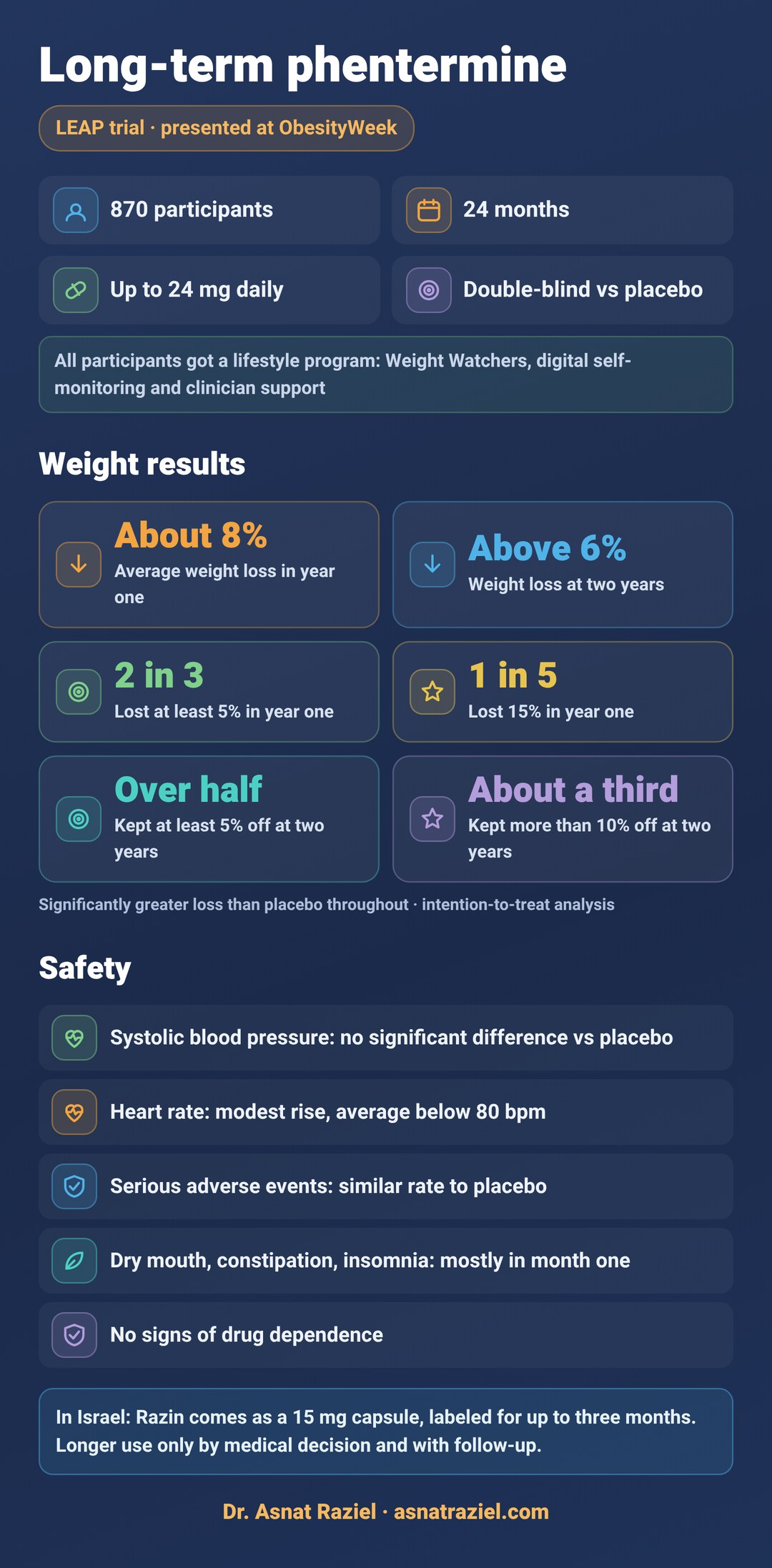
Researchers have finally tested long-term phentermine in a randomized, double-blind trial. The LEAP trial followed 870 participants for two years. At the end, people on phentermine kept off more than 6% of their body weight. Their systolic blood pressure did not rise compared with placebo. The results were presented at ObesityWeek, the annual meeting of The Obesity Society.
What is phentermine (Razin), and why this trial matters
Phentermine is one of the oldest obesity medications. The US approved it back in 1959. In Israel it is sold as Razin. The drug acts in the brain, reduces hunger and helps people feel satisfied with smaller portions.
Phentermine is still very popular. In 2024 it made up about half of all obesity drug prescriptions in the US. Yet no one had tested it in a long-term randomized trial. The reason is simple: approval came before regulators required such trials. So the label allows only short-term use. In Israel, for example, the Razin label allows treatment for up to three months.
The main concern was the heart. Phentermine stimulates the sympathetic nervous system, so doctors worried about higher heart rate and blood pressure. Dr. Jamy Ard of Wake Forest University summed it up well: the most widely used obesity drug is the one we know least about.
How the LEAP trial was designed
LEAP is a phase 4, randomized, double-blind trial. The researchers split 870 participants into two equal groups. One group took phentermine at up to 24 mg a day. The other took a placebo. Treatment lasted 24 months.
All participants also received a full lifestyle program. It included a two-year Weight Watchers membership, digital self-monitoring tools and ongoing clinical support. Entry criteria were broad on purpose, to reflect primary care patients. The two primary outcomes were percent weight loss and the change in systolic blood pressure at 24 months. The US National Heart, Lung, and Blood Institute funded the trial, and it is registered at ClinicalTrials.gov.
Long-term phentermine results: how much weight was lost
Throughout the 24 months, the phentermine group lost significantly more weight than the placebo group. In year one, weight loss reached about 8% of body weight. At two years it stood above 6%, with some expected regain.
Dr. Kimberly Gudzune reported the year-one details. About two in three patients lost at least 5%. One in three reached 10%, and one in five reached 15%. In other words, out of 100 patients, about 20 lost 15% of their weight in a year.
The picture stayed good at two years. More than half of the phentermine group kept off at least 5%. About a third kept off more than 10%. The analysis was intention-to-treat, which includes people who stopped the drug or switched treatment. So the results reflect real clinical practice.
The surprise: the placebo group
The placebo group surprised the researchers. Its members lost more weight than expected and kept it off to the end. Dr. Lewis, one of the investigators, said the result truly amazed them. In her view, it shows a very effective lifestyle program. The conference report does not give the placebo group’s percent weight loss.
Blood pressure and heart rate
This may be the most important finding. Systolic blood pressure did not differ significantly between the groups over two years. Average blood pressure stayed stable throughout. Serious heart events were rare, and new diagnoses of high blood pressure were few.
Resting heart rate did rise slightly, as expected from how the drug works. Still, the average heart rate stayed below 80 beats per minute throughout the trial. Dr. Lewis described the researchers as very reassured by the data.
Long-term phentermine safety and side effects
Serious adverse events occurred at similar rates in both groups. The common side effects were dry mouth, constipation and insomnia. Most appeared in the first month and became rare later on.
The researchers also saw no signs of dependence. This matters, because phentermine was first developed as an alternative to amphetamine. For that reason it is a controlled substance in the US (Schedule IV). An earlier observational study of almost 14,000 adults also linked continuous long-term use with greater weight loss and better blood pressure than short-term use, without more heart events.
What it means for patients in Israel
Phentermine is less effective than the newer drugs. GLP-1 based drugs such as Wegovy and Mounjaro achieve much larger weight loss. Still, losing 6% to 10% is enough to improve blood sugar, lipids and blood pressure. Phentermine is also inexpensive and easy to get. Dr. Gudzune called it a tool that belongs in our toolbox.
A few differences are worth remembering. The trial took place in the US, at doses up to 24 mg a day. In Israel, Razin comes as a 15 mg capsule, and the label allows up to three months of treatment. The trial does not change the label automatically. So long-term treatment is a personal medical decision, with close follow-up.
In the future, these findings may shape clinical guidelines. They also open the door to studies of drug combinations and stepwise treatment.
How to use long-term phentermine safely
Check before starting: the doctor should check blood pressure, heart rate and heart health. The label prohibits use in moderate to severe hypertension, heart disease, hyperthyroidism and glaucoma.
Mental health history and other drugs: phentermine is not suitable for people with a history of depression, eating disorders or addiction. It must not be combined with MAOI drugs.
Take it in the morning: according to the label, take one capsule with breakfast. This lowers the risk of insomnia.
Lifestyle as the foundation: the placebo group proved the power of habit change. Combine nutrition, physical activity and close support.
Regular follow-up: measure blood pressure and heart rate regularly, and review progress with your doctor at least every three months.
Further reading: phentermine (Razin) for obesity and long-term side effects of weight loss drugs. See also choosing a weight loss medication.
Bottom line
The LEAP trial shows that long-term phentermine, together with a healthy lifestyle, keeps meaningful weight off for two years. It did not raise blood pressure and did not cause dependence. It is not as powerful as the newer drugs, but it is an inexpensive, long-established and now well-tested option. In the end, you and your doctor choose the right treatment together, based on your health.
This article is general information and does not replace personal medical advice.
References
LEAP Trial Results Reinforce Long-Term Efficacy and Safety of Phentermine
Long-term Effectiveness of the Antiobesity Medication Phentermine
Razin: Summary of Product Characteristics
Funding: US National Heart, Lung, and Blood Institute (NHLBI). The trial was investigator-initiated, and KVK Tech donated the study drug.