By Dr. Asnat Raziel, bariatric surgeon specializing in obesity treatment, metabolic health and healthy longevity; Director of the Multidisciplinary Center for Obesity Treatment, Assia Medical, Assuta Ramat HaChayal, Tel Aviv
Phentermine (Razin): the classic option in the era of new drugs
Razin is one of the oldest drugs for treating obesity. Its active ingredient is phentermine, at a dose of 15 mg per capsule; Razin is the brand sold in Israel. Even in the era of advanced GLP-1 drugs, phentermine remains a useful tool. It helps reduce hunger, it is available in pharmacies, and it is easy to take. However, it suits only certain patients, and only under medical supervision.
Razin is not a hormonal drug. In addition, it does not directly affect insulin, blood sugar levels or stomach emptying. That makes it very different from the new injections. In suitable patients, it brings good appetite control and a sense of vitality. You can find a broad review of all the options in my guide to drug treatment for obesity.
How phentermine works: appetite suppression through the brain
Phentermine belongs to the family of stimulants. It acts mainly on the hunger and fullness centers in the brain. The drug mainly raises norepinephrine levels and, to a lesser extent, dopamine. As a result, appetite goes down.
In practice, patients describe several changes:
- Less hunger.
- Fewer food cravings.
- More alertness and energy.
- Better control over portions and eating patterns.
Unlike GLP-1 drugs, Razin does not slow stomach emptying. Therefore, it may suit people who suffer from nausea on the injections. On the other hand, it has other side effects, related to the nervous system and the heart. You can find a broader explanation of the different mechanisms in my article on how obesity drugs work.
Who phentermine is for, according to the Israeli label
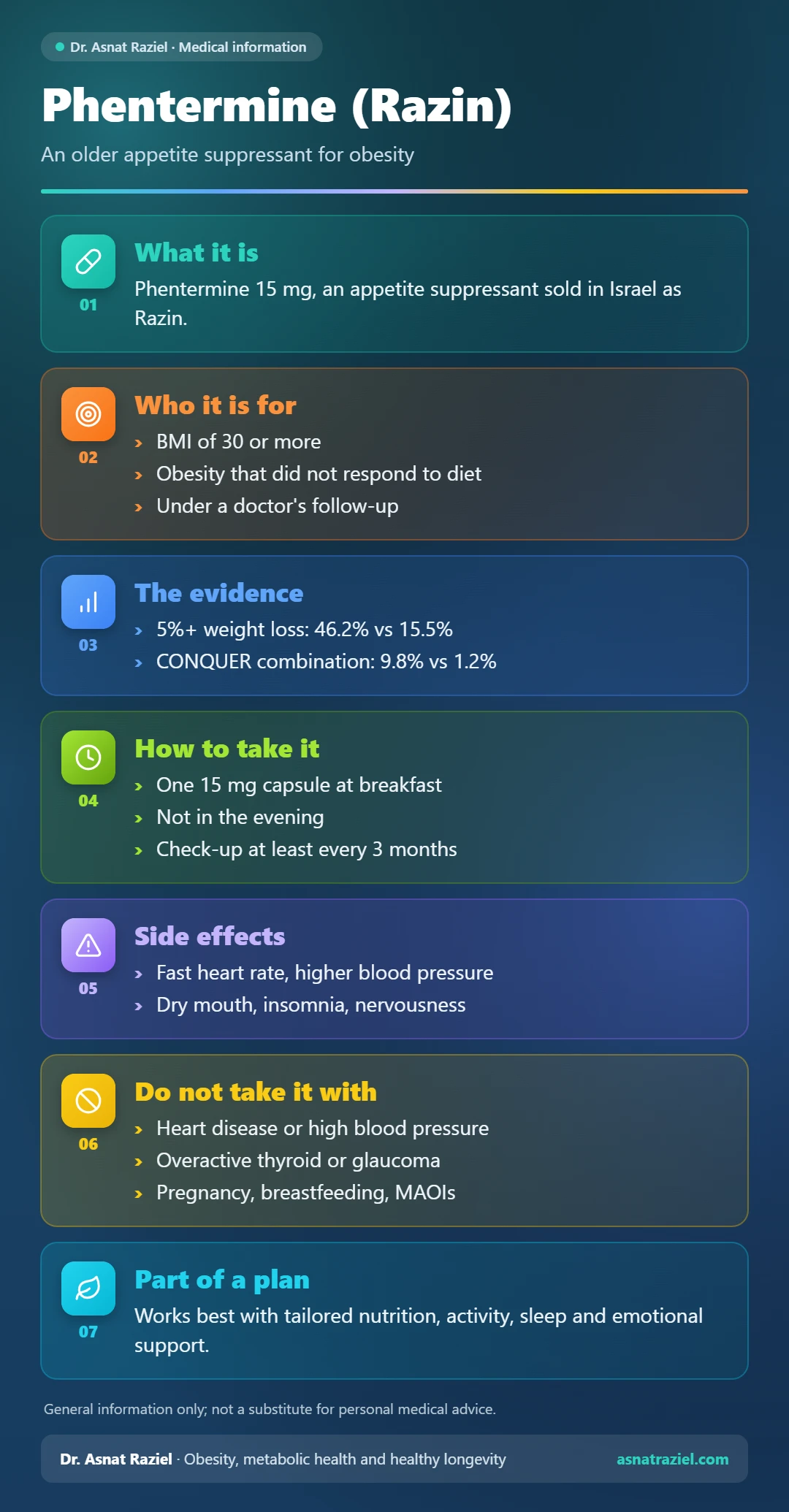
According to the Israeli prescribing information for Razin, the drug is intended for severe obesity that has not responded to dietary treatment. The condition is a BMI (body mass index) of at least 30. In addition, the treatment is given as part of a weight loss program under a doctor’s follow-up.
It is worth knowing that the Israeli label used to limit treatment to three months. However, Israel’s Ministry of Health removed the time limit (report in Hebrew). Today, a doctor may prescribe Razin for long-term treatment too, according to medical need. In the United States, by contrast, the Adipex-P label still defines phentermine for short-term use of a few weeks. It is also a controlled substance there, because of its potential for misuse. In Israel, Razin requires a doctor’s prescription and close medical follow-up.
What studies show about phentermine
Controlled trials have tested how well phentermine works. For example, a 28-week controlled trial compared phentermine with placebo, with lifestyle counseling for everyone. On phentermine 15 mg, 46.2% of participants lost at least 5% of their body weight. In the placebo group, by contrast, only 15.5% reached that goal.
Moreover, researchers have studied the combination of phentermine and topiramate extensively. The CONQUER trial included 2,487 adults for 56 weeks. On the higher dose of the combination, participants lost 9.8% of their body weight, compared with 1.2% on placebo. In the United States, this combination is sold as Qsymia.
What about long-term treatment? A large observational study looked at 13,972 adults who received phentermine. Those who used it continuously for more than 12 months lost 7.4% more weight than those who used it for up to three months. In addition, the researchers found no increase in the risk of a cardiac event or death. However, this is an observational study in low-risk people, not a controlled trial. These data support Israel’s decision to allow longer treatment, as long as the doctor monitors heart rate, blood pressure and the response to treatment.
The advantages: access, flexibility and a fast response
Relatively low cost: Razin is one of the cheapest weight loss drugs. That makes it accessible even to people who find the new drugs too expensive. You can find a detailed cost comparison in my article on the cost of weight loss drugs.
A fast effect on appetite: Many people feel less hungry within the first few days. This gives them a sense of control and the motivation to keep going.
An alternative for people who do not tolerate GLP-1: Some patients suffer from nausea or fatigue on the injections. For some of them, Razin is a reasonable alternative, if there is no medical reason against it.
Combining with other drugs: Some doctors consider combining Razin with GLP-1 drugs. However, there are no large controlled trials of such a combination yet. The Israeli label even prohibits combining it with similar weight loss drugs. That is why any combination is a personal medical decision, with close follow-up.
How to take phentermine
Razin comes as a 15 mg capsule. You take one capsule a day, at breakfast, and swallow it whole. Avoid taking it in the evening, because it can cause insomnia. In addition, the label recommends a medical check at least every three months. The drug is not recommended under age 16 or in older age.
Phentermine side effects and safety
Most suitable patients adapt well to the drug. Still, side effects can occur. According to the patient leaflet, they include:
- A fast heart rate and higher blood pressure.
- Dry mouth.
- Insomnia, especially when taken late in the day.
- Nervousness, restlessness or tremor.
- Headache, dizziness or constipation.
The label also warns of pulmonary hypertension and of damage to the heart valves. Most of the reports on heart valves appeared in combination with fenfluramine, a drug that was withdrawn from the market. Beyond that, long-term use may cause dependence. You can also find a general review in my article on side effects of obesity drugs.
When you must not take Razin
The Israeli label lists several conditions in which you must not take the drug:
- Moderate to severe high blood pressure, or pulmonary hypertension.
- Serious heart disease, heart rhythm disorders or a heart valve problem.
- Disease of the blood vessels in the brain.
- An overactive thyroid, or glaucoma.
- A history of mental illness, including depression and anorexia.
- A history of drug or alcohol addiction.
- Use of MAOI drugs, or within two weeks of stopping them.
Likewise, do not take the drug during pregnancy or breastfeeding. That is why it is important to tell your doctor about every illness and every medication.
Phentermine as part of a holistic plan
Razin works especially well as part of a comprehensive plan. The plan combines tailored nutrition, gradual physical activity and good sleep. It also includes work on emotional eating, stress balance and close professional support.
In other words, a short course of Razin can open a “window of opportunity”. During this period, appetite goes down and control improves. This makes it possible to build new habits that remain even after treatment ends. For a comparison with another long-standing drug, see my article on Mysimba.
Further reading: the LEAP trial.
Bottom line
Despite the revolution of the new drugs, phentermine still holds its place in obesity treatment. It is available, relatively cheap and reduces appetite quickly. However, it is a stimulant that requires regular medical follow-up, even in long-term treatment, and it comes with a clear list of conditions in which you must not take it. Ultimately, the right decision is a personal one, made under a doctor’s care. That way, Razin becomes part of an integrative approach rather than a magic solution.
This article is general information and does not replace personal medical advice.
References
Razin capsules – Summary of Product Characteristics (Israel)
Razin capsules – Patient Information Leaflet (Israel)
ADIPEX-P (phentermine hydrochloride) – Important Safety Information