By Dr. Asnat Raziel, bariatric surgeon specializing in obesity treatment, metabolic health and healthy longevity; Director of the Multidisciplinary Center for Obesity Treatment, Assia Medical, Assuta Ramat HaChayal, Tel Aviv
Long-term side effects: the question I hear again and again in the clinic
Long-term side effects are one of the topics my patients ask about most today. The question is no longer just about weight loss, but about the future: “These drugs are new. What will we discover in ten years?” This is a legitimate, wise and responsible concern. It is not hysterical fear, but a desire to understand before deciding. In this article, I will summarize what we know, what we don’t know yet and how to make a responsible medical decision.
Are these drugs really new?
The answer is complex. Modern weight loss drugs are based on GLP-1, a natural hormone that the gut releases after eating. US regulators approved the first drug in this family, exenatide, for treating diabetes back in 2005. Liraglutide followed in 2010. In other words, medicine has about 20 years of experience with this mechanism.
What is relatively new is their wide use for obesity. The doses are much higher, treatment lasts longer, and patients now include people without diabetes. In addition, tirzepatide also acts on another hormone called GIP. Put differently, the mechanism is familiar, but the population and the scale are new.
What we know for certain today
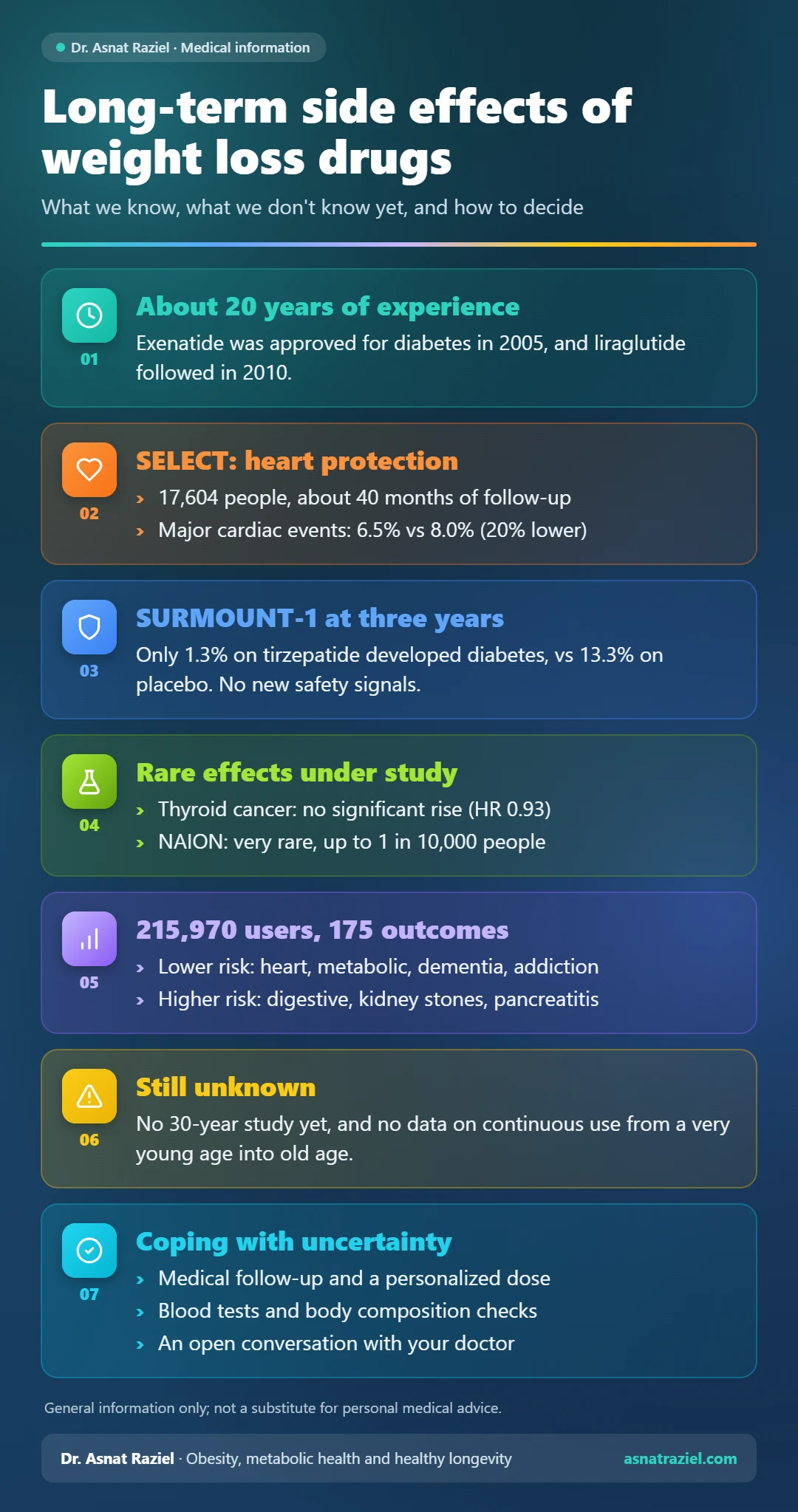
The SELECT trial included 17,604 people with obesity and heart disease, without diabetes. Average follow-up lasted about 40 months. Semaglutide reduced major cardiac events: 6.5% compared with 8.0% on placebo, a 20% reduction in risk. On the other hand, 16.6% stopped the drug because of side effects, compared with 8.2% on placebo. You’ll find more details in my article on how Wegovy protects the heart.
In addition, the three-year follow-up of the SURMOUNT-1 trial included people with obesity and prediabetes. After 176 weeks, only 1.3% of patients on tirzepatide developed diabetes, compared with 13.3% on placebo. The researchers identified no new safety signals. Likewise, a meta-analysis of 21 trials and 99,599 patients found a reduction in all-cause mortality and in serious adverse events. However, it did find an increase in digestive disorders and gallbladder problems.
Long-term side effects: what has been studied in depth
The common side effects are well known and well mapped: nausea, diarrhea and constipation. Most appear at the start of treatment and fade over time. Rare side effects are also under constant surveillance. International reporting systems detect unusual signals almost in real time, so our knowledge keeps updating.
Here are a few examples. A Scandinavian study of 145,410 users, with an average follow-up of 3.9 years, examined the concern about thyroid cancer. The researchers found no significant increase in risk (HR 0.93). You can read more in my article on weight loss drugs and cancer risk. In addition, in 2025 the European Medicines Agency concluded that NAION, damage to the optic nerve, is a very rare side effect of semaglutide. It affects up to one in 10,000 people. Researchers have also studied pancreatitis in depth, and I covered it in a separate article.
Moreover, a large 2025 study followed 215,970 users in US Department of Veterans Affairs databases and examined 175 health outcomes. It found a lower risk of cardiovascular and metabolic disease, dementia, addiction and seizures. On the other hand, it found a higher risk of digestive disorders, low blood pressure, fainting, joint disease, kidney stones, kidney inflammation and pancreatitis. This is how science keeps learning about long-term side effects even years after approval.
And what we still don’t know
There is no 30-year study. We still have no data on continuous use from a very young age into old age. Nor is there a complete answer to what happens after long-term discontinuation in every person. And here is an important point: almost no chronic medication “knew” in advance what would happen decades later. Drugs for blood pressure, cholesterol or depression also came into use long before they had half a century of follow-up.
So why do doctors still recommend them?
The answer is that medicine is not about zero risk, but about balancing risks. Obesity is a chronic disease with proven risks: diabetes, heart disease, stroke, cancer, joint damage, sleep apnea and shorter life expectancy. I wrote about this in detail in my article on the health risks of excess weight. So the question is not “Could there be a future risk?” The real question is the known risk of not treating, versus the estimated risk of treatment.
The fear of “being on medication for life”
This is a deep emotional fear, not just a medical one. For many people, medication feels like a personal failure or a form of dependence. Yet we don’t ask a person with high blood pressure why they “need” a pill for life. For a large proportion of people, obesity is a biological chronic disease, not just a matter of behavior.
That said, the right treatment does not have to last forever. Some people reach a stable weight, change their lifestyle and can lower the dose or stop. Others need ongoing treatment. No single answer fits everyone, so it is important to understand what happens when you stop the medication.
How to cope with uncertainty about long-term side effects
The safest path is not an extreme one, neither for nor against. First, structured medical follow-up, a personalized dose and gradual increases. Second, monitoring of blood tests, body composition, and physical and emotional symptoms. In addition, an open conversation with your doctor all the way through.
It is also important to remember that science does not stand still. The drugs keep improving, doses change and new forms of delivery are arriving. For example, the FDA approved the Wegovy pill in December 2025 and Foundayo in April 2026. Each new drug of this kind also adds new safety data.
The bottom line on long-term side effects
Worrying about the future is not a weakness, but a sign of responsibility. Still, fear itself should not drive the decision. When you weigh the data, the risk of untreated obesity and the option of professional support, the benefits outweigh the risks for many people. Monitoring of long-term side effects will continue, and that is exactly what should happen. Ultimately, modern medicine does not promise absolute certainty, but it does make an informed, thoughtful and humane choice possible.
The information in this article is general and does not replace personal medical advice.
References
Semaglutide and Cardiovascular Outcomes in Obesity without Diabetes
Tirzepatide for Obesity Treatment and Diabetes Prevention
Glucagon-like peptide 1 receptor agonist use and risk of thyroid cancer: Scandinavian cohort study
Mapping the effectiveness and risks of GLP-1 receptor agonists