By Dr. Asnat Raziel, bariatric surgeon specializing in obesity treatment, metabolic health and healthy longevity; Director of the Multidisciplinary Center for Obesity Treatment, Assia Medical, Assuta Ramat HaChayal, Tel Aviv
Weight loss drugs and cancer: what we know today
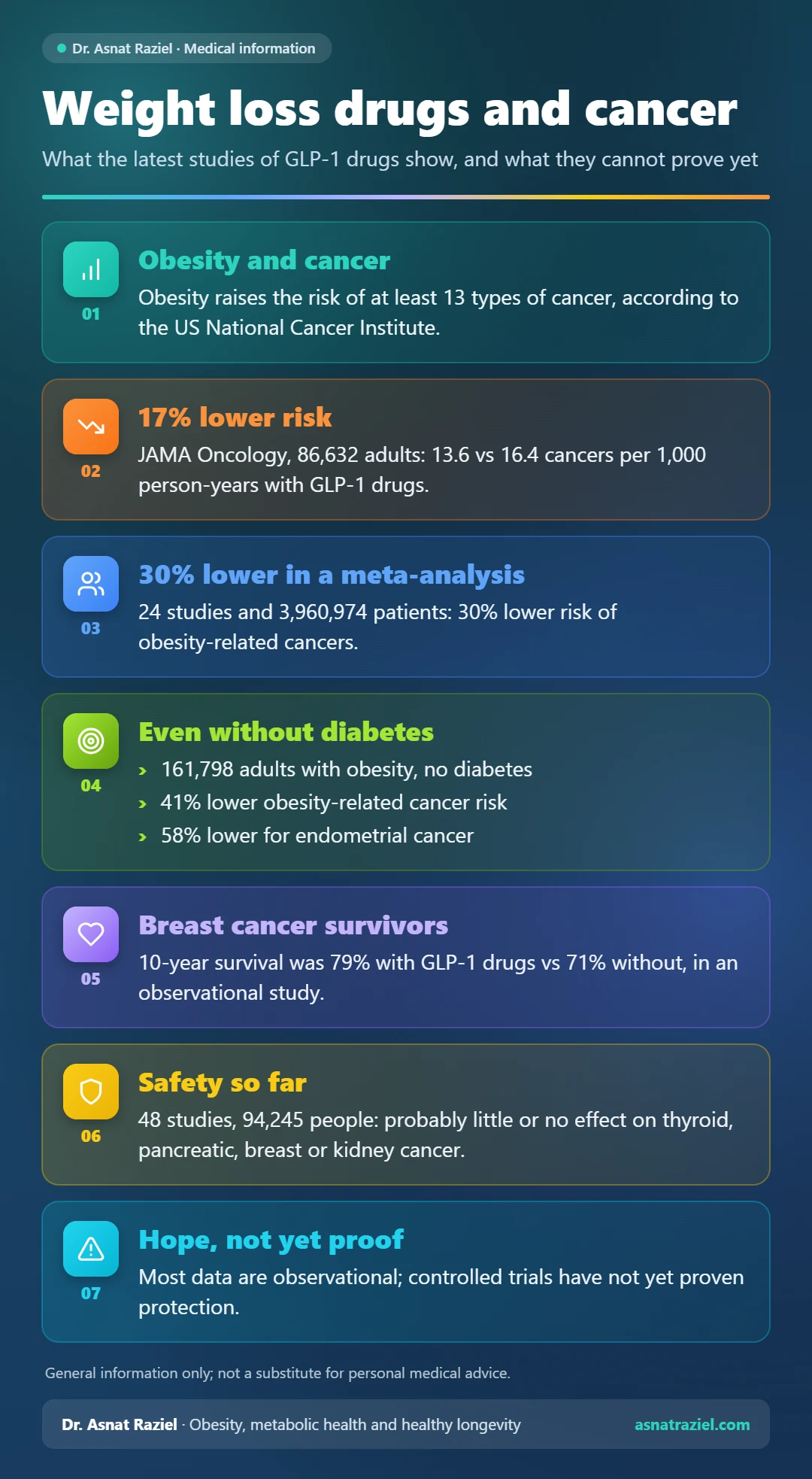
Ten years ago, most doctors would have been surprised to see weight loss drugs and cancer mentioned in the same sentence. For years, we saw obesity as a problem of weight or appearance, or at most as a risk factor for diabetes and heart disease. Today, however, it is clear that obesity is a biological, inflammatory and hormonal disease. According to the US National Cancer Institute, it raises the risk of at least 13 types of cancer.
Now, with the new GLP-1 and GIP medications such as Wegovy, Ozempic and Mounjaro, a new hope is emerging in oncology as well. Perhaps treating obesity effectively is also a way to lower cancer risk. Still, it is important to separate hope from proof.
Obesity and cancer: a link we cannot ignore
Obesity affects almost every system in the body. Fat tissue is not just an energy store. In fact, it is an active hormonal organ that releases inflammatory substances, hormones and growth factors. Deep belly fat, also called visceral fat, is especially active in these processes.
When obesity lasts for years, several changes develop in the body: high insulin levels, insulin resistance, chronic low-grade inflammation, hormonal shifts and a weakened immune system. Together, they create an environment that may encourage tumors to grow. That is why obesity is linked to breast cancer after menopause, as well as to cancers of the colon, uterus, liver, kidney, esophagus, pancreas, ovaries and more.
New data on weight loss drugs and cancer
Over the past two years, large and intriguing studies have been piling up. A study published in JAMA Oncology in 2025 followed 86,632 adults with obesity or overweight. Among people taking GLP-1 drugs, the rate of the 14 cancer types the researchers tracked was 13.6 per 1,000 person-years of follow-up, compared with 16.4 among non-users. In other words, the risk was 17% lower. The drop stood out for endometrial cancer, ovarian cancer and meningioma, a tumor of the membranes around the brain. On the other hand, the researchers saw a signal of a slight rise in kidney cancer, so they called for continued monitoring.
In addition, a 2026 meta-analysis pooled 24 studies with 3,960,974 patients. Patients who used GLP-1 drugs had a 30% lower risk of obesity-related cancers. The reduction appeared in cancers of the liver, colon, pancreas, endometrium, esophagus, gallbladder and ovaries, and also in multiple myeloma. By contrast, the researchers found no link with thyroid cancer.
Even without diabetes
Most of the early studies looked at people with diabetes. In June 2026, however, Annals of Oncology published a study of adults with obesity but no diabetes. The researchers compared 161,798 patients: those who received GLP-1 drugs and those who received diet and exercise counseling. In the medication group, the risk of obesity-related cancers was 41% lower. For endometrial cancer, the reduction reached 58%.
There is another interesting finding on colorectal cancer. In a study of people with diabetes who had not taken diabetes medication before, the risk was 44% lower with GLP-1 drugs than with insulin. Among patients with overweight or obesity, it was 50% lower.
More than weight loss: possible mechanisms
Researchers believe the effect does not come from weight loss alone. GLP-1 drugs reduce chronic inflammation and improve insulin sensitivity. They also shrink the fat around the internal organs and influence metabolic pathways linked to cell growth. You can read more about the inflammation connection in my article on how body fat fuels inflammation.
What’s more, labs around the world are testing whether GLP-1 receptors themselves act directly on the tumor environment and the immune system. At this stage, though, these are research hypotheses, not clinical facts.
What about cancer survivors?
One of the most interesting developments is the use of obesity medications after cancer. Many women who take hormonal therapy for breast cancer gain weight. Obesity itself may raise the risk of recurrence, metabolic damage and heart disease.
A study published in September 2026 looked at women aged 45 and older with breast cancer and a BMI of 35 or higher. Among GLP-1 users, 10-year survival was 79%, compared with 71% among non-users. The risk of local recurrence was also roughly half as high. However, this was an observational study, and the researchers themselves stress that proving cause and effect will require controlled trials.
Are weight loss drugs safe when it comes to cancer?
In the early years, there was concern about medullary thyroid cancer. That concern came mainly from studies in rodents. So far, no study has shown such a link in humans. Even so, these drugs are still off-limits for anyone with a personal or family history of medullary thyroid cancer or MEN2 syndrome.
The data from controlled trials are reassuring. A meta-analysis in Annals of Internal Medicine included 48 studies with 94,245 participants. The researchers concluded that the drugs probably have no effect, or only a very small one, on the risk of thyroid, pancreatic, breast and kidney cancer. On the other hand, nobody designed these trials to look at cancer, and their follow-up was short. For this reason, the conversation about weight loss drugs and cancer should stay cautious. The observational studies are encouraging, but controlled trials have not yet proven protection. I discuss long-term safety in more detail in my article on Wegovy side effects.
Weight loss drugs and cancer: the future is taking shape
One of the biggest shifts in modern medicine is the move from treating disease once it appears to preventing it. In the future, we may come to see obesity treatment as part of preventing cancer, heart disease, dementia and other chronic illnesses. That idea, however, still awaits long-term studies.
The message from research around the world is an optimistic one. When we treat obesity properly, it is not just the number on the scale that changes. Metabolic health, quality of life and physical function change too. And perhaps, in the future, so will cancer risk.
The bottom line
The link between obesity and cancer is well established. The data on GLP-1 weight loss drugs and cancer are very encouraging, but most of them come from observational studies. Ultimately, you and your care team should make treatment decisions together, based on your personal and family medical history.
This article provides general information and is not a substitute for personal medical advice.
References
GLP-1 Receptor Agonists and Cancer Risk in Adults With Obesity
GLP-1 receptor agonist use and cancer risk in obese nondiabetic adults




