By Dr. Asnat Raziel, bariatric surgeon specializing in obesity treatment, metabolic health and healthy longevity; Director of the Multidisciplinary Center for Obesity Treatment, Assia Medical, Assuta Ramat HaChayal, Tel Aviv
Health risks of obesity: why they matter
The health risks of obesity are not about appearance. Instead, they are about the health of your heart, liver, joints and even your brain. According to the World Health Organization, 2.6 billion adults worldwide live with overweight, and 940 million of them live with obesity. The good news is that even modest weight loss removes a large share of these risks. In this article, I will explain the main risks, how we assess them and what you can do about them.
Overweight or obesity: what’s the difference?
The standard definition is based on body mass index (BMI), which is your weight in kilograms divided by your height in meters squared. A value of 25 to 29.9 indicates overweight, and a value of 30 or more indicates obesity. However, BMI cannot tell fat from muscle, and it does not show where fat is stored. That is why, at our clinic, we also measure waist circumference, because belly fat is especially linked to metabolic risk. In addition, we check blood sugar, blood lipids and blood pressure.
For this reason, an international commission that published its recommendations in Lancet Diabetes & Endocrinology proposed a new definition of clinical obesity. According to the commission, excess fat should be confirmed by at least one additional measure, such as waist circumference. It also distinguishes between “preclinical” obesity, in which the organs still function normally, and clinical obesity, in which excess fat is already impairing how the body works. You can read more in my article on obesity as a chronic disease.
Health risks of obesity: the heart, blood sugar and blood vessels
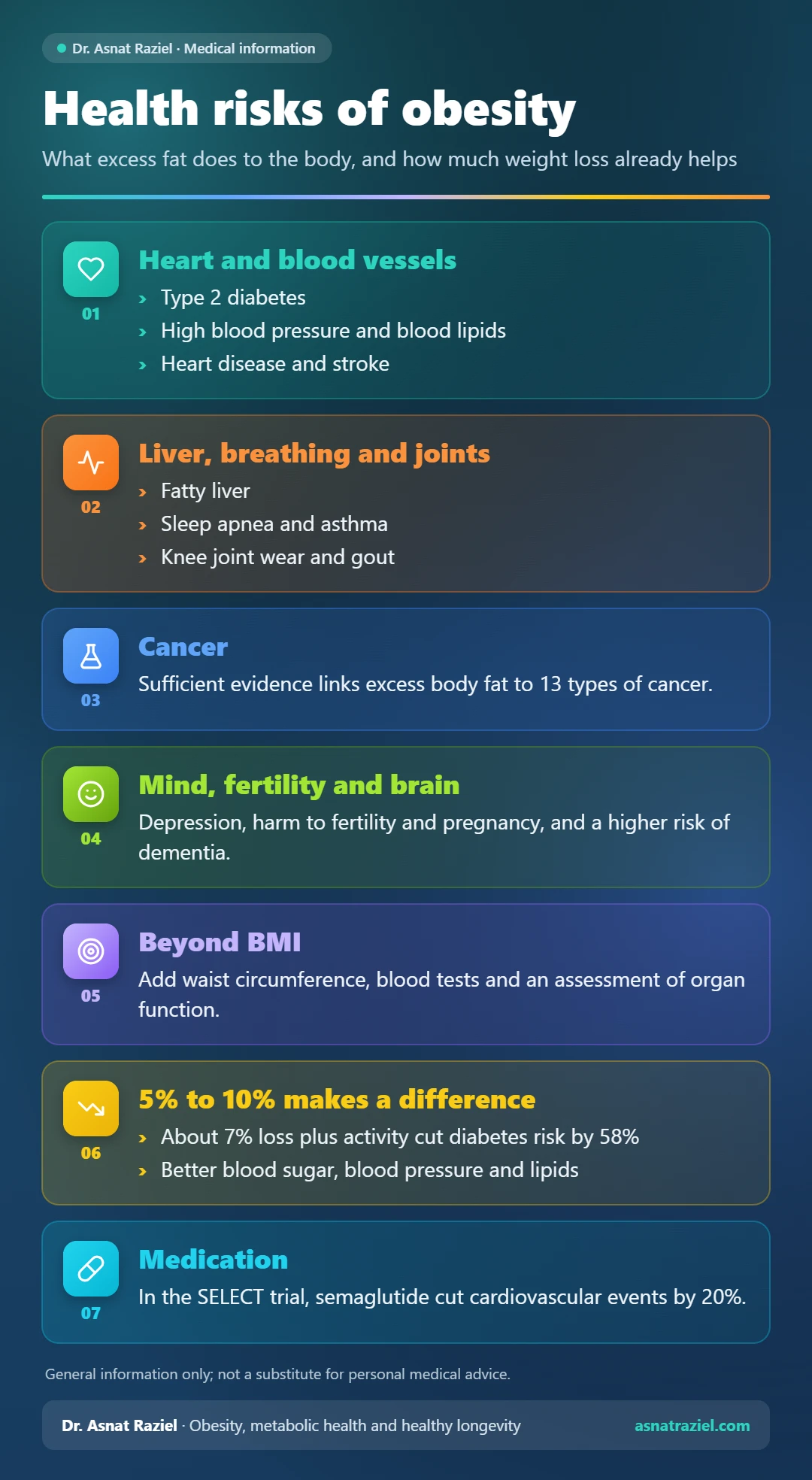
Fat tissue, and belly fat in particular, is not a quiet storage depot. In fact, it releases hormones and inflammatory substances that affect the entire body. As a result, the risk of several major diseases goes up:
- Type 2 diabetes and insulin resistance.
- High blood pressure and elevated blood lipids.
- Heart disease and stroke.
- Metabolic syndrome, a cluster of several risk factors occurring together.
The link between obesity and the heart is especially close, so I devoted an entire article to cardiovascular risk in obesity.
Health risks of obesity: the liver, breathing and joints
Beyond the heart and blood sugar, the U.S. National Institute of Diabetes and Digestive and Kidney Diseases lists a long series of other conditions. Among them:
- Fatty liver disease, which can progress to liver inflammation and scarring.
- Sleep apnea and asthma.
- Joint wear, mainly in the knees, as well as gout.
- Gallstones and pancreatitis.
- Kidney disease.
Sleep apnea, for example, is very common in obesity and often goes undiagnosed. In my article on obesity and sleep apnea, you will find the warning signs worth knowing. I have also put together a dedicated guide to the full picture of the diseases that accompany obesity.
Health risks of obesity: cancer
The link between obesity and cancer is less familiar to the public, but it is well established. An expert working group of the International Agency for Research on Cancer (IARC) found sufficient evidence linking excess body fat to 13 types of cancer. These include cancers of the colon, liver, pancreas, kidney, uterine lining (endometrium) and ovary, as well as breast cancer after menopause. You will find more details in my article on obesity-related cancer.
Mental health, fertility and the brain
The impact goes beyond the body itself. Obesity is linked to depression, stress and eating disorders, partly because of stigma and judgment. In addition, it can impair fertility, complicate pregnancy and affect sexual function.
The brain is affected too. Studies link obesity in midlife to a higher risk of dementia, as I explained in my article on Alzheimer’s and obesity. In children and teens, obesity often continues into adulthood, so it is important to treat it at a young age. I covered this in more depth in my article on obesity in teens. Prevention also starts at home, for example by reducing teen screen time.
How to reduce the health risks of obesity
Here is the most important message: you do not need to reach an “ideal weight” to benefit. Below are some findings from the major studies:
- In the Diabetes Prevention Program (DPP), losing about 7% of body weight along with 150 minutes of activity a week reduced the risk of diabetes by 58%.
- In the Look AHEAD study, losing 5% to 10% of body weight improved blood sugar, blood pressure and blood lipids, and greater weight loss brought even more benefit.
- For fatty liver, according to the same U.S. institute, losing 3% to 5% of body weight may reduce liver fat.
What about medication?
In many cases, lifestyle changes alone are not enough. In these situations, medication for obesity can help. The SELECT trial, for example, included 17,604 people with heart disease and overweight or obesity, but without diabetes. Semaglutide at a dose of 2.4 mg a week reduced the risk of cardiovascular events by 20% compared with placebo. In absolute terms, such an event occurred in 6.5% of patients on the drug, compared with 8.0% in the placebo group.
The bottom line
The health risks of obesity touch almost every system in the body: the heart, the liver, the joints, mental health and even cancer risk. Still, losing 5% to 10% of your body weight already improves many measures. That is why it is worth assessing your personal risk with a doctor, and not just by the number on the scale. The assessment includes waist circumference, blood tests, blood pressure and questions about sleep and daily functioning. If you would like to learn about my approach to treatment, you can read more about me here.
The information in this article is general and does not replace personal medical advice.
Frequently asked questions
What are the main health risks of obesity?
The main ones are type 2 diabetes, high blood pressure, heart disease and stroke, fatty liver, sleep apnea, joint wear and 13 types of cancer. Moreover, obesity often affects mental health and fertility as well.
Is BMI enough to assess risk?
No. BMI is only a screening tool. It is worth adding waist circumference, blood tests and an assessment of organ function.
How much weight do I need to lose to see a difference?
Losing 5% to 10% of your body weight already improves blood sugar, blood pressure and blood lipids. For example, for a person who weighs 100 kg, that means 5 to 10 kg.
Does mild overweight also raise the risk?
Risk rises gradually as body fat increases, especially belly fat. Therefore, even with mild overweight, it is worth checking measures such as blood sugar and blood pressure.
Sources
Health Risks of Overweight & Obesity
Definition and diagnostic criteria of clinical obesity
Body Fatness and Cancer – Viewpoint of the IARC Working Group
Reduction in the incidence of type 2 diabetes with lifestyle intervention or metformin
Semaglutide and Cardiovascular Outcomes in Obesity without Diabetes




