By Dr. Asnat Raziel, bariatric surgeon specializing in obesity treatment, metabolic health and healthy longevity; Director of the Multidisciplinary Center for Obesity Treatment, Assia Medical, Assuta Ramat HaChayal, Tel Aviv
Obesity and cancer risk: a proven risk factor
The link between obesity and cancer risk is no longer a hypothesis. In fact, obesity is a proven, common and significant risk factor. It is not only a metabolic disease or a heart disease, but also a major driver of cancer. For doctors, this calls for a shift in thinking. For patients, it is an opportunity to understand the real risk and to act to reduce it.
In this article, I focus on the clinical meaning: what doctors should look for, what patients should ask and what the data say about treatment. A broader overview of the risk itself appears in my article on obesity-related cancer.
Which cancers are linked to obesity?
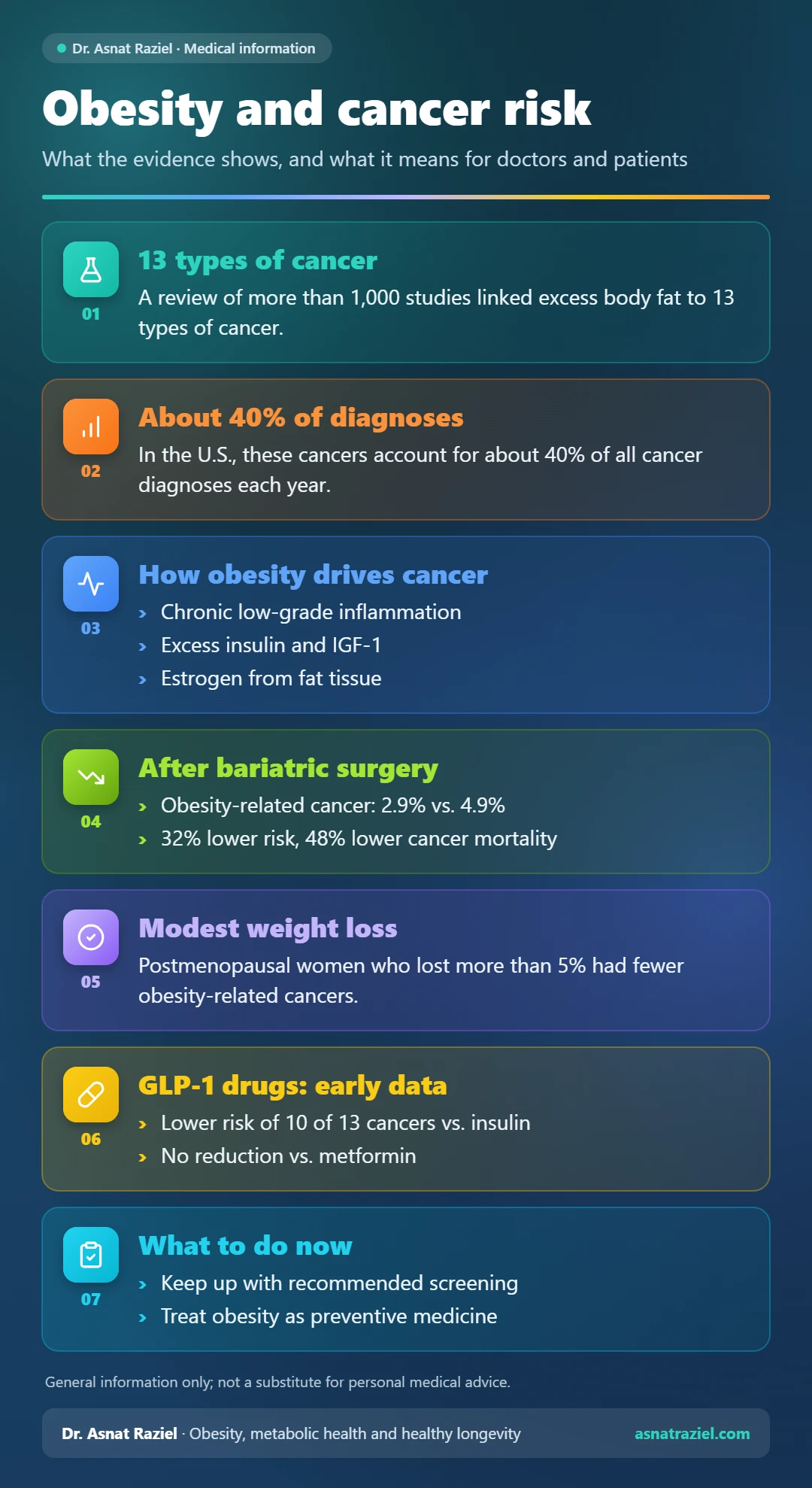
In 2016, a working group of the International Agency for Research on Cancer reviewed more than 1,000 studies. Its conclusion was that excess body fat is clearly linked to 13 types of cancer. According to the U.S. Centers for Disease Control and Prevention, these are:
- Colorectal cancer.
- Breast cancer after menopause.
- Cancer of the uterus, ovary and kidney.
- Cancer of the liver, pancreas and gallbladder.
- Adenocarcinoma of the esophagus and cancer of the upper part of the stomach.
- Thyroid cancer, meningioma (a tumor of the membranes around the brain) and multiple myeloma.
In the United States, these cancers account for about 40% of all cancer diagnoses each year. In addition, for some of them, obesity is also linked to diagnosis at a more advanced stage and to a poorer prognosis.
Why does obesity promote cancer?
Obesity creates a biological environment that encourages tumors to develop. It does so through several pathways at the same time:
- Chronic low-grade inflammation: fat tissue releases inflammatory substances that damage DNA.
- Excess insulin and insulin resistance: insulin and IGF-1, an insulin-like growth factor, stimulate cell division.
- Hormonal changes: fat tissue produces estrogen, mainly after menopause.
- Fatty liver: an inflammatory environment that affects the whole body.
- Changes in the microbiome: effects on the immune system and on the inflammatory response.
So obesity is not just a background condition. Rather, it is an active player in the development of cancer. I have also written separately about the role of inflammation and the microbiome in obesity.
Obesity and cancer risk: what it means for doctors
For doctors, this understanding requires a change in approach. Obesity is not just a “comorbidity” in a cancer patient or in someone coming in for a screening test. Instead, it is a risk factor that should be treated proactively. Specifically, in the clinic, it is worth paying special attention to several situations:
- Obesity together with diabetes or insulin resistance.
- Obesity with advanced fatty liver disease.
- Abdominal obesity, even in people whose weight looks normal.
- Rapid metabolic deterioration or new-onset diabetes at an older age, both of which warrant a workup.
In these situations, treating obesity is part of a preventive cancer assessment, not a luxury. In addition, it is important to make sure the patient is up to date on the screening tests recommended for their age.
What it means for patients
For patients, the goal is not to frighten but to empower. This understanding lets you see obesity treatment as a way to lower the risk of serious disease, and not only as a way to improve your appearance. When patients understand that treatment may lower their risk of colon, breast or uterine cancer, their motivation changes. As a result, treatment takes on a deeper meaning.
Questions to ask at your doctor’s visit
A focused conversation with your doctor can turn general information into a personal plan. Here are some questions worth bringing to your visit:
- Does my family history raise my risk of a particular type of cancer?
- Which screening tests are right for my age, and when did I last have them?
- Do I have fatty liver, diabetes or prediabetes that needs follow-up?
- How much weight loss would meaningfully improve my numbers?
- Which obesity treatment is right for me: lifestyle changes, medication or surgery?
Keep in mind that the topic stays relevant even after a cancer diagnosis. Therefore, it is worth talking with your oncology team about weight, nutrition and physical activity as part of your follow-up plan.
Does weight loss reduce the risk?
The accumulated data suggest that it does. In the SPLENDID study from Cleveland Clinic, researchers compared 5,053 bariatric surgery patients with 25,265 patients who did not have surgery. After ten years, the rate of obesity-related cancer was 2.9% among those who had surgery, compared with 4.9% in the comparison group. In other words, the risk was 32% lower. In addition, cancer mortality was 48% lower.
Moreover, even modest weight loss may help. According to the U.S. National Cancer Institute, postmenopausal women who intentionally lost more than 5% of their body weight had fewer obesity-related cancers, especially uterine cancer. However, these are observational data and should be interpreted with caution.
The protective effect does not come from weight loss alone. Reduced inflammation, improved insulin sensitivity and favorable hormonal changes also contribute. You can find a comparison of the options in my article on obesity treatment with diet, medication and surgery.
GLP-1 drugs, obesity and cancer risk
Do the new weight loss drugs also lower the risk? A medical records study of 1,651,452 patients with type 2 diabetes looked at this question. Compared with insulin, GLP-1 drugs were linked to a lower risk of 10 of the 13 obesity-related cancers. In contrast, compared with metformin, no reduction was found, and for kidney cancer the risk was 54% higher.
In other words, the findings are encouraging but preliminary. After all, this was an observational study, not a controlled trial. I explain why observational studies and trials on GLP-1 and cancer disagree in a separate article. For this reason, GLP-1 drugs should not yet be recommended as a preventive treatment for cancer. More details appear in my article on obesity, cancer and GLP-1 drugs.
Treating obesity as preventive medicine
The broader message is that treating obesity is also preventive cancer care, much like quitting smoking or controlling blood pressure. Medication, surgery and lifestyle changes, delivered within a professional and supervised framework, are not just “weight treatment.” Instead, they are a long-term investment in health. Obesity, cancer, diabetes and heart disease are not separate diseases. Rather, they are different expressions of a deep metabolic disruption, and effective obesity treatment targets the junction where these pathways meet.
The bottom line on obesity and cancer risk
The link between obesity and cancer risk changes the rules of the game. For doctors, it is a broad clinical responsibility. For patients, it is a real opportunity to reduce risk. Ultimately, treating obesity is no longer just a “personal choice.” It is part of modern, precise and humane preventive medicine.
The information in this article is general and does not replace personal medical advice.
References
Body Fatness and Cancer – Viewpoint of the IARC Working Group
Association of Bariatric Surgery With Cancer Risk and Mortality in Adults With Obesity




