By Dr. Asnat Raziel, bariatric surgeon specializing in obesity treatment, metabolic health and healthy longevity; Director of the Multidisciplinary Center for Obesity Treatment, Assia Medical, Assuta Ramat HaChayal, Tel Aviv
Normal weight obesity: why the number on the scale can mislead
A normal weight is no guarantee of good health, and normal weight obesity shows exactly why. For years, we learned to treat BMI as a gatekeeper. Anyone in the normal range was “healthy,” and anyone above it “needed treatment.” Today, however, modern medicine understands that health depends on body composition, metabolic function and the level of inflammation. So sometimes a “normal” weight actually hides significant metabolic risk.
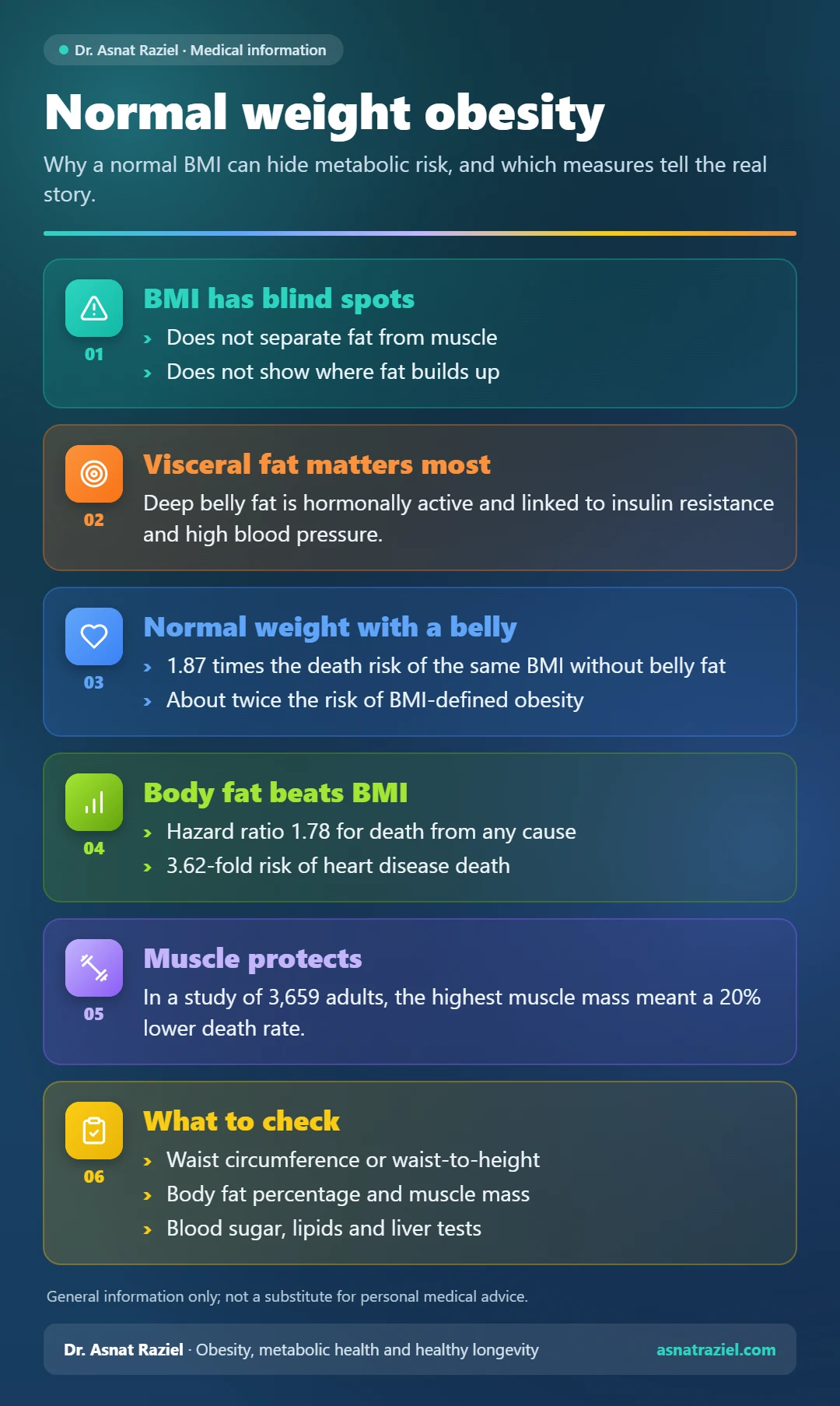
BMI is a simple calculation: weight divided by height squared. It is easy to measure, but it does not distinguish between fat and muscle. In addition, it does not show where fat builds up in the body. You can calculate your BMI with a BMI calculator, but it is just as important to understand its limits.
When BMI gets it wrong
Two people with the same BMI can be in completely different states of health. One has good muscle mass, good insulin sensitivity and normal test results. The other, by contrast, has belly fat, insulin resistance, fatty liver and chronic inflammation. Yet on paper, both belong to the same group.
This phenomenon is sometimes called “metabolically obese normal weight,” or normal weight obesity. These are people who do not look overweight. Even so, their risk of diabetes, heart disease and early death is high.
In January 2025, an international commission of the journal Lancet Diabetes & Endocrinology published a new definition of obesity. Fifty-eight experts signed it, and 76 organizations endorsed it. The commission concluded that BMI is suitable for screening and population studies, but not as a health measure for an individual. Therefore, it recommends confirming excess fat with direct measurement, or at least with an additional measure such as waist circumference.
The fat you can’t see
Not all fat is alike. The most dangerous type is visceral fat, which builds up around the internal organs in the abdomen. It is often the hidden driver of normal weight obesity. This fat is hormonally and inflammatorily active. It releases inflammatory substances (cytokines) and is linked to insulin resistance, high blood pressure and abnormal blood lipids. You can read more in my article on visceral fat and what to do about it.
A position statement from the International Atherosclerosis Society summarized 30 years of research on the subject. According to the statement, visceral fat measured by CT or MRI is an independent risk marker for heart and metabolic disease. Ectopic fat, meaning fat in the liver and around the heart, probably also contributes to atherosclerosis.
On the other hand, subcutaneous fat, mainly in the thighs and buttocks, is less harmful and is sometimes even protective. BMI cannot tell the two apart. That is why it cannot serve as the only measure of risk.
Normal weight obesity with a belly: what the studies show
A study published in Annals of Internal Medicine followed 15,184 adults in the United States. The researchers found that people with a normal weight and abdominal obesity had the lowest survival. A man with a BMI of 22 and abdominal obesity had a 1.87 times higher risk of death than a man with the same BMI without abdominal obesity. Moreover, his risk was about twice that of men whom BMI alone classified as overweight or obese. In women, the picture was similar, although the differences were slightly smaller.
In 2025, another study in Annals of Family Medicine came out. It followed adults aged 20 to 49 for 15 years. A high body fat percentage roughly doubled the risk of death from any cause (hazard ratio 1.78 after adjustment). It also raised the risk of death from heart disease 3.62-fold. BMI, by contrast, had no significant link to death from any cause. The researchers’ conclusion is clear: body fat percentage predicts risk far better than BMI.
The role of muscle: the forgotten component
Low muscle mass is a risk factor in its own right, even in people of normal weight. Muscle is active metabolic tissue. It uses glucose and supports stability, strength and function. When muscle mass is low, the risk of insulin resistance, falls, functional decline and even death goes up.
For example, a study of 3,659 adults looked at the muscle mass index. Among those with the highest muscle mass, the death rate was 20% lower than among those with the lowest. Low muscle mass is especially common in older adults, in women after menopause and in people who have lost weight repeatedly without protecting their muscle. Here again, weight alone does not tell the whole story. I wrote about this at length in my article on why body composition is more important than weight.
Measures that tell the truth
If weight is not enough, what should we check? Modern medicine combines several measures:
- Waist circumference or waist-to-height ratio.
- Body composition: body fat percentage and muscle mass.
- Blood pressure.
- Blood sugar and blood lipid levels.
- Inflammatory markers and liver function tests.
- Physical fitness and daily functioning.
Sometimes a person with normal weight obesity, meaning a normal BMI, a large waist and borderline blood sugar, is at higher risk than someone with a high BMI and normal metabolic markers. In addition, fatty liver also appears in lean people. You can read about it in my guide to diagnosing and treating fatty liver.
What normal weight obesity means in the clinic
Understanding that a normal weight does not necessarily mean health changes our clinical approach. It requires doctors to look beyond the number. At the same time, it teaches us that “I haven’t gained weight” is no reason to skip tests and follow-up.
Prevention, tailored nutrition, physical activity and preserving muscle mass matter for everyone. In other words, they are not only for people defined as having obesity. Strength training, for example, improves body composition even when the scale barely moves. That is why early diagnosis that looks at the full picture is worthwhile.
What can you do right now? First, measure your waist at home, at the level of your navel. Second, at your routine checkup, ask for fasting blood sugar, blood lipids and liver function tests as well. It is also worth asking about a body composition test. Finally, if diabetes or heart disease runs in your family, don’t settle for the number on the scale.
The bottom line on normal weight obesity: a new view of health
Health is not a fixed state, and no single number can measure it. Instead, it results from the balance between body composition, metabolic function, inflammation and lifestyle. A normal weight is important information, but it is only part of the picture. When we adopt this broader view, we can spot risks early, tailor treatment precisely and avoid late surprises.
The information in this article is general and does not replace personal medical advice.
References
Definition and diagnostic criteria of clinical obesity
Visceral and ectopic fat, atherosclerosis, and cardiometabolic disease: a position statement
Normal-Weight Central Obesity: Implications for Total and Cardiovascular Mortality
Body Mass Index vs Body Fat Percentage as a Predictor of Mortality in Adults Aged 20-49 Years
Muscle mass index as a predictor of longevity in older adults




