By Dr. Asnat Raziel, bariatric surgeon specializing in obesity treatment, metabolic health and healthy longevity; Director of the Multidisciplinary Center for Obesity Treatment, Assia Medical, Assuta Ramat HaChayal, Tel Aviv
GLP-1 cancer prevention: the question everyone is asking
Can GLP-1 drugs help with cancer prevention? The idea shows up in many headlines today. Imagine a treatment that not only helps you lose weight but also lowers your risk of cancer. Studies from recent years raise this possibility seriously. Even so, the scientific picture is not settled yet. In this article, I review what we really know, what we don’t know yet, and how to read the headlines correctly. Above all, I explain why observational studies and controlled trials reach different conclusions.
The central point is simple. Obesity is a proven risk factor for 13 types of cancer. Drugs based on satiety hormones, such as semaglutide (in Ozempic and Wegovy) and tirzepatide (in Mounjaro), change the biology of obesity. The question is whether that change also translates into fewer cases of cancer.
Why obesity raises the risk of cancer
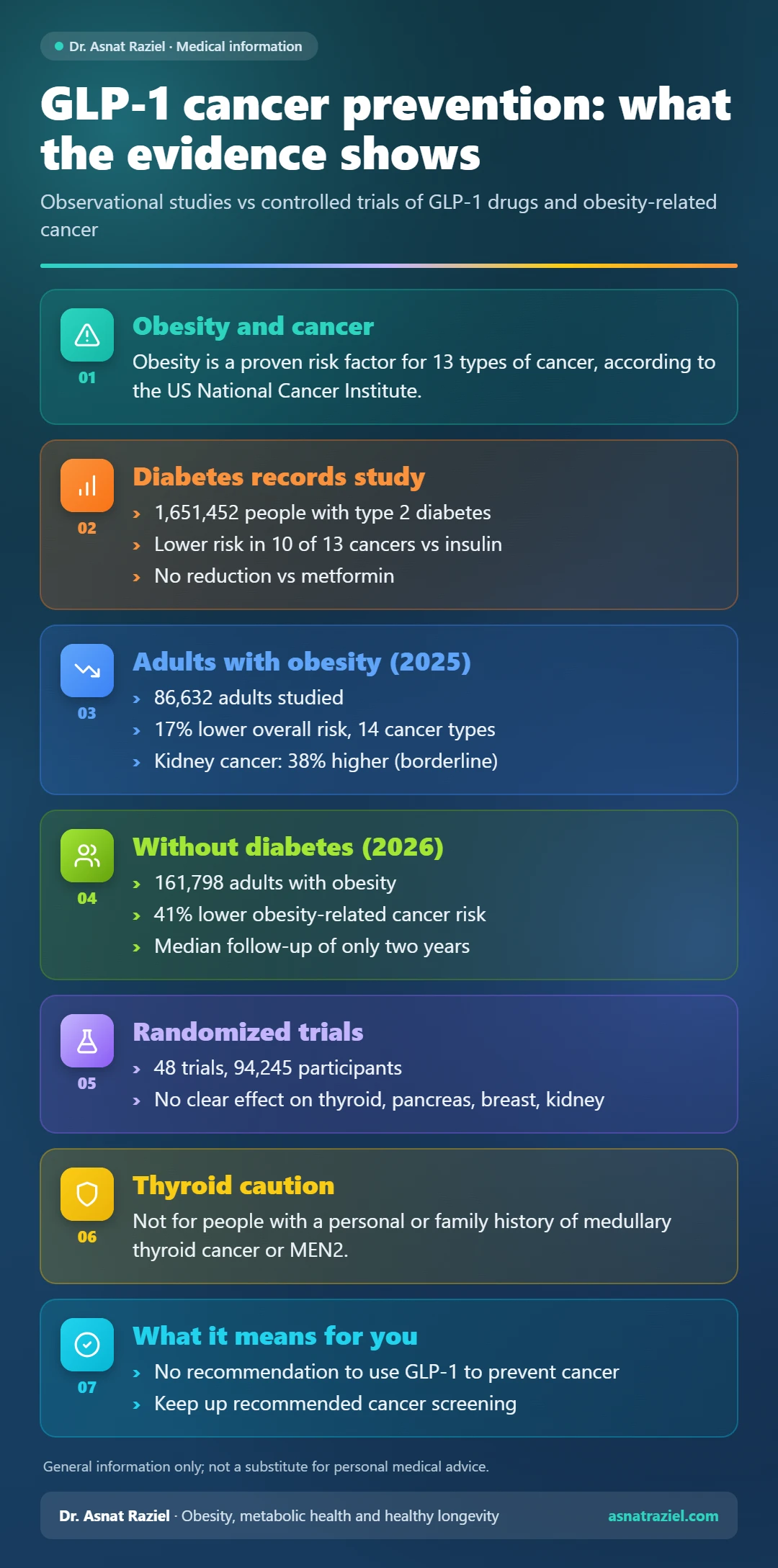
According to the US National Cancer Institute, obesity is linked to 13 types of cancer. These include cancer of the uterus, breast cancer after menopause, and cancers of the colon, liver, pancreas, kidney and ovaries. The link is especially strong for uterine cancer: in people with severe obesity, the risk is roughly seven times higher.
The mechanisms include chronic inflammation, high levels of insulin and of estrogen produced by fat tissue, and changes in the environment around cells. You can find a detailed explanation of this link in my article on obesity-related cancers and what they mean in the clinic.
How GLP-1 drugs work
GLP-1 is a natural hormone that the gut releases after a meal. It signals to the brain that the body is full. The drugs mimic this hormone. They slow stomach emptying, reduce appetite and improve blood sugar control. As a result, most patients lose a significant amount of weight.
Beyond that, weight loss reduces inflammation and lowers insulin levels. In addition, laboratory studies suggest direct effects on cells. So the hope for cancer prevention is not far-fetched. However, a plausible mechanism is not proof.
GLP-1 drugs and cancer prevention in observational studies
The encouraging data come mainly from studies that analyzed medical records. In a study of 1,651,452 people with type 2 diabetes, users of GLP-1 drugs had a lower risk of 10 of 13 cancer types compared with insulin users. For example, the risk of pancreatic cancer was 59% lower, liver cancer 53% lower and colorectal cancer 46% lower. On the other hand, compared with metformin, there was no reduction in any type of cancer. What’s more, the risk of kidney cancer was 54% higher.
In a 2025 study of 86,632 adults with obesity, people using GLP-1 drugs had a 17% lower overall risk across the 14 cancer types examined. The reduction stood out for uterine cancer (25%), ovarian cancer (47%) and meningioma, a tumor of the lining of the brain (31%). By contrast, kidney cancer showed the opposite trend, with a 38% higher risk of borderline statistical significance.
In June 2026, researchers published a study of 161,798 adults with obesity but without diabetes. They compared GLP-1 users with people who received only diet and exercise counseling. After a median follow-up of two years, the risk of obesity-related cancer was 41% lower. However, the link did not appear in Black patients, and the follow-up was short.
Colorectal cancer: data on survival
A different question is what happens to people who already have cancer. In a study from the University of California San Diego, researchers examined data on more than 6,800 patients with colorectal cancer. The five-year death rate was 15.5% among GLP-1 users, compared with 37.1% among non-users. Here too, the researchers themselves stress that this is an association, not proof, and that clinical trials are needed.
Controlled trials: a more modest picture
Here, the evidence is far more cautious. A meta-analysis published in the Annals of Internal Medicine included 48 randomized trials with 94,245 participants. The researchers found no clear effect of the drugs on thyroid, pancreatic, breast or kidney cancer. For the other obesity-related cancers, the effect was also small or nonexistent.
In other words, on the one hand, the controlled trials are reassuring: there is no overall increase in risk. On the other hand, they do not confirm the protection seen in the observational studies. The main reason is that researchers did not design these trials to look at cancer, and their follow-up was short. Cancer develops over many years.
Why observational studies and trials disagree
How can studies of the same drugs point in different directions? First, the comparison group matters. In the diabetes study, GLP-1 users did better than insulin users, but not better than metformin users. So part of the apparent benefit may reflect the drug they were compared with, not a direct protective effect. Second, record-based studies show an association, not cause and effect, as the researchers themselves point out. Third, the randomized trials were not designed to look at cancer, and they ran for a relatively short time. Finally, cancer takes many years to develop. That is why I read each headline with a simple question in mind: which kind of study is this, and who were the drug users compared with?
The risks and warning signs
Like any medication, these drugs have another side. Semaglutide and tirzepatide carry a warning about a rare type of thyroid cancer, based on findings in rodents. Therefore, they are not suitable for anyone with a personal or family history of medullary thyroid cancer or MEN2 syndrome. In a 2026 meta-analysis of 15 trials, researchers found no significant increase in thyroid cancer. Still, the number of cases was small, and they recommend long-term follow-up.
Kidney cancer is another point to watch. Some observational studies showed a trend toward higher risk, while the controlled trials did not. If you are weighing the safety question, you can read my article on whether obesity medication is safe, as well as my broader overview of weight-loss drugs and cancer in preventive medicine. This article focuses on a narrower question: how to read the evidence.
What GLP-1 cancer prevention research means for you
First, there is currently no recommendation to give GLP-1 drugs in order to prevent cancer. We base the decision to treat on obesity itself and on the conditions that come with it. Second, significant weight loss, by any route, probably lowers the risk. Bariatric surgery also shows encouraging data, as I explain in my article comparing medication and surgery. Third, recommended cancer screening remains a must, even during treatment. Finally, tell your doctor about any family history of cancer before you start treatment.
The bottom line on GLP-1 cancer prevention
The link between GLP-1 drugs and cancer prevention is promising, but it is not yet proven. Observational studies show less cancer among users. In contrast, the controlled trials mainly show that there is no increase in risk. Obesity itself remains the silent enemy, and treating it is already an important step for your health today. Science keeps moving forward, and I will update this article when long-term results are published.
The information in this article is general and does not replace personal medical advice.
References
GLP-1 Receptor Agonists and Cancer Risk in Adults With Obesity
GLP-1 receptor agonist use and cancer risk in obese nondiabetic adults
GLP-1 drugs linked to dramatically lower death rates in colon cancer patients




