By Dr. Asnat Raziel, bariatric surgeon specializing in obesity treatment, metabolic health and healthy longevity; Director of the Multidisciplinary Center for Obesity Treatment, Assia Medical, Assuta Ramat HaChayal, Tel Aviv
Survodutide and heart safety: the answer we were waiting for
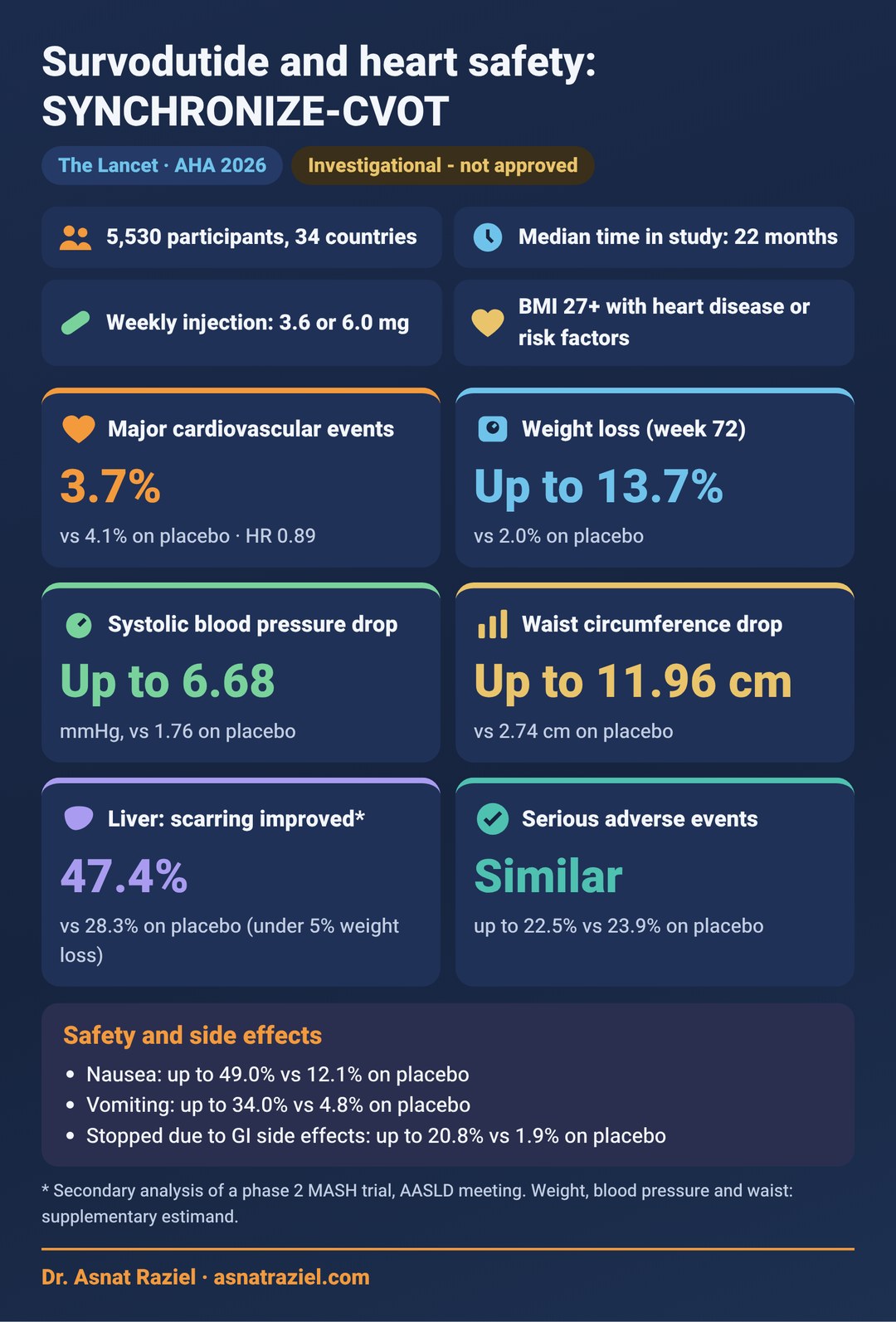
Survodutide and heart safety were an open question until this week. At the American Heart Association meeting in Chicago, researchers presented the SYNCHRONIZE-CVOT trial, published at the same time in The Lancet. The answer is reassuring: the investigational drug did not raise the risk of major cardiovascular events. In addition, patients lost up to 13.7% of their body weight.
This is important news. Survodutide is the first drug from a new class to pass a large cardiovascular safety trial. However, it is still not approved, either in the United States or in Israel.
What is survodutide and how is it different
Survodutide works on two receptors. The first is the GLP-1 receptor, the same one targeted by Wegovy and Ozempic. The second is the glucagon receptor, a hormone that increases energy use and acts directly on the liver.
Researchers therefore hope the combination will be especially helpful for fatty liver. On the other hand, glucagon slightly raises heart rate. That is why a large heart safety trial mattered so much. I have already written about survodutide results in type 2 diabetes.
Survodutide and heart safety: who took part in SYNCHRONIZE-CVOT
The trial ran at 524 sites in 34 countries and enrolled 5,530 adults with a BMI of 27 or higher. All had established heart disease, or at least two obesity complications or cardiovascular risk factors. People with chronic kidney disease and a BMI of 30 or higher could also join.
Participants were randomly assigned to three equal groups: survodutide 3.6 mg weekly, survodutide 6.0 mg weekly, or placebo. The median time in the study was 22 months.
Survodutide and heart safety: what the trial found
The main endpoint combined cardiovascular death, stroke, heart attack, urgent ischemia-related coronary revascularization, and heart failure events. These occurred in 3.7% of people on survodutide, compared with 4.1% on placebo.
The hazard ratio was 0.89, with a 95% confidence interval of 0.67 to 1.18. The result met the prespecified safety goal. To be precise, though, the trial showed safety. It did not prove heart protection.
Weight loss and other markers
At week 72, patients lost up to 13.7% of their body weight, compared with 2.0% on placebo. Systolic blood pressure fell by up to 6.68 mmHg, compared with 1.76 on placebo. Waist circumference dropped by up to 11.96 cm, compared with 2.74 cm. Triglycerides also went down.
Side effects: the point that needs attention
Digestive side effects were common. Nausea affected 48.0% to 49.0% of people on the drug, compared with 12.1% on placebo. Vomiting affected 31.7% to 34.0%, compared with 4.8%.
Moreover, 19.3% to 20.8% stopped treatment because of digestive side effects, compared with 1.9% on placebo. That is a high rate. In contrast, serious adverse events were similar across all groups. In practice, this is a reminder of how important slow dose escalation and close support are.
News from the liver: survodutide and fatty liver
At the same time, a secondary analysis of a phase 2 trial in inflammatory fatty liver disease (MASH) was presented at the American liver meeting. Among people who lost less than 5% of their weight, liver scarring improved in 47.4%, compared with 28.3% on placebo. Among those who lost 15% or more, liver inflammation resolved in 78.4%.
The researchers suggest the improvement in scarring may reflect a direct effect on the liver. This was a descriptive analysis, so we need phase 3 trials. I covered this in more detail in my article on survodutide and fatty liver.
Survodutide and heart safety: when will the drug arrive?
Boehringer Ingelheim has announced that it is moving forward with global regulatory submissions for obesity. As of today, the drug is not approved by the FDA and is not registered in Israel. So it is available only within clinical trials.
What you can do today
First, there is no need to wait for the next drug. Effective treatments are available in Israel today: Wegovy, the Wegovy pill, Mounjaro and Foundayo. Semaglutide already has proven heart protection, as I explained in my article on semaglutide and heart protection.
It is also worth checking your liver. Blood tests, ultrasound and FibroScan can detect fatty liver and scarring early. Likewise, check your blood pressure, blood lipids and HbA1c, the average blood sugar over the past three months.
Finally, medication works best inside a complete program. At our center, the dietitian builds a protein-rich eating plan, the exercise trainer adds strength and aerobic training, and the psychologist helps with emotional eating and sleep. This protects muscle and reduces side effects. Here you can read how to start weight loss medication.
Bottom line on survodutide and heart safety
Survodutide and heart safety passed an important test: no increase in cardiovascular events, meaningful weight loss and encouraging signs in the liver. On the other hand, the rate of stopping because of digestive side effects was high. The toolbox for treating obesity keeps growing, and that is exciting progress.
This article provides general information and is not personal medical advice. Any treatment decision should be made with your doctor.
References
SYNCHRONIZE-CVOT trial results presented at AHA
Survodutide Improves MASH Liver Endpoints Across Weight Loss Categories
The trial was funded by Boehringer Ingelheim.