By Dr. Asnat Raziel, bariatric surgeon specializing in obesity treatment, metabolic health and healthy longevity; Director of the Multidisciplinary Center for Obesity Treatment, Assia Medical, Assuta Ramat HaChayal, Tel Aviv
Stopping GLP-1 in diabetes: what the new study found
Stopping GLP-1 in diabetes may carry a higher risk of cardiovascular events. That is the finding of a large Italian study published this week in The Lancet Regional Health – Europe. Among people who stopped treatment, the rate of heart attack, stroke and death was nearly double that of people who continued.
This is an observational study, so it does not prove that stopping itself caused harm. Still, it adds to the evidence behind an important message: treating diabetes and obesity is long-term care.
Who was in the study
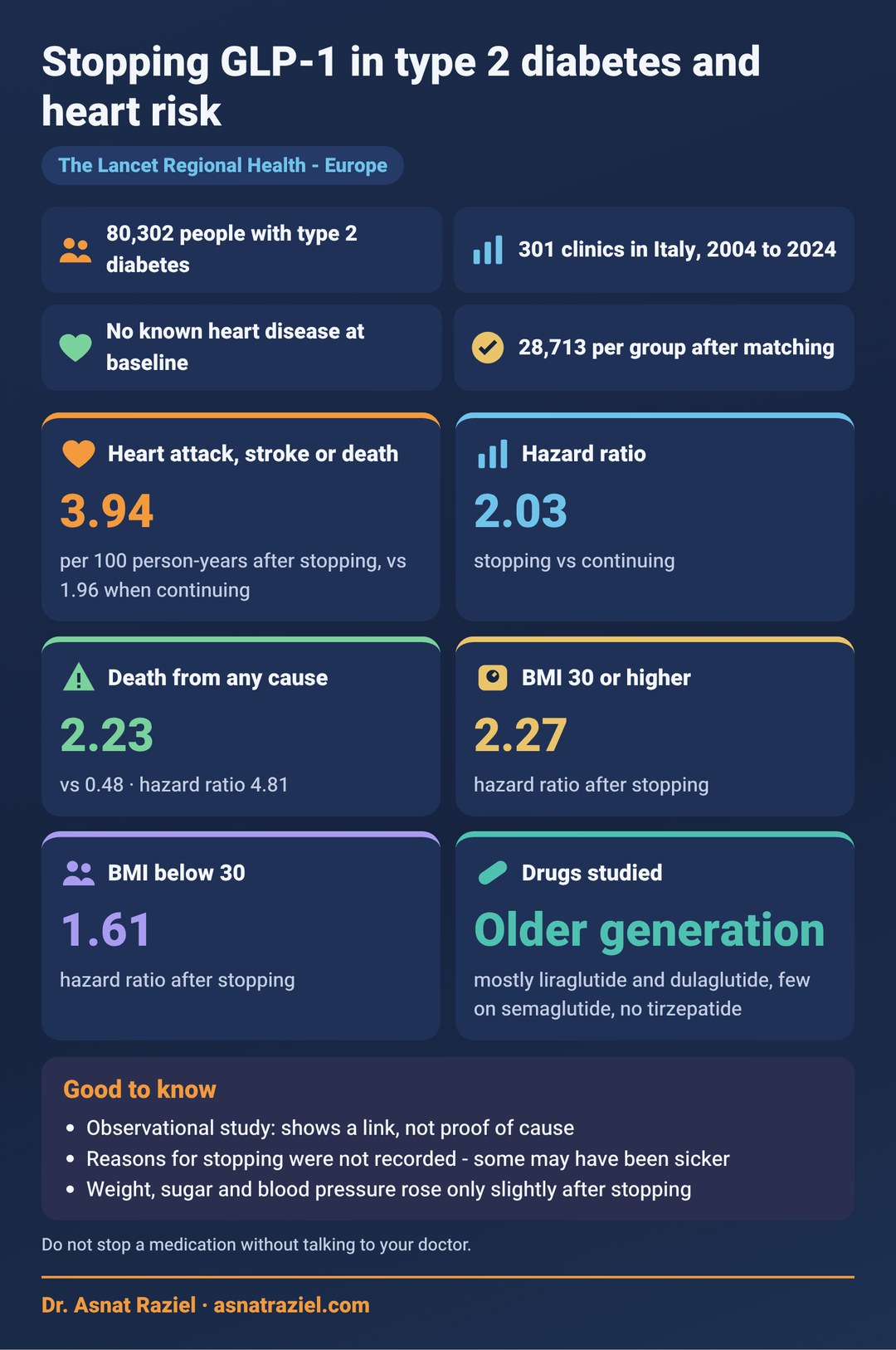
Led by Prof. Antonio Ceriello of IRCCS MultiMedica, the researchers analyzed data from 301 diabetes clinics in Italy. The study included 80,302 adults with type 2 diabetes and no known heart disease who started a GLP-1 drug between 2004 and 2024.
About 60% of participants stopped the drug at some point. For a fair comparison, the researchers matched 28,713 people who stopped with 28,713 people who continued and had similar characteristics.
Which drugs were studied
Notably, most participants took older drugs, liraglutide and dulaglutide. Only a small share took semaglutide. The study did not include tirzepatide (Mounjaro), because it reached the Italian market after the study period.
Stopping GLP-1 in diabetes and heart risk
The outcome combined heart attack, stroke or death from any cause. Among people who stopped, the rate was 3.94 events per 100 person-years. Among those who continued, it was 1.96. In other words, the hazard ratio was 2.03.
The gap was especially striking for death from any cause: 2.23 per 100 person-years among those who stopped, versus 0.48 among those who continued. The hazard ratio here was 4.81. A gap this large calls for caution, because some people who stopped may have been sicker to begin with.
Obesity raises the risk
In patients with a BMI of 30 or higher, the hazard ratio after stopping reached 2.27. In patients with a BMI below 30, it was 1.61. So people with obesity may be the ones who lose the most when treatment stops.
Not just weight and blood sugar
However, there was a surprising finding: after stopping, weight, blood sugar and blood pressure rose only slightly. These changes also did not differ between people who had an event and those who did not. So the researchers think these markers alone do not explain the higher risk.
In addition, the drugs may protect blood vessels in other ways too, for example by reducing inflammation. I wrote about this in my article on semaglutide and heart protection.
Stopping GLP-1 in diabetes: important limitations
First, this is an observational study, not a randomized trial. The researchers did not know why each patient stopped. Some may have stopped because of illness, hospitalization or declining health.
Second, the researchers had no socioeconomic data. Third, the study does not tell us whether starting and stopping is riskier than never starting. Prof. Clara Chow of the University of Sydney, who did not take part, commented that the core conclusion might be misleading. So we should read the finding with care.
What you can do today
First, do not stop a medication on your own. If you have side effects, high costs or another difficulty, talk with your doctor. Sometimes it is enough to adjust the dose, switch drugs or move to a pill. In Israel, Wegovy, Ozempic, the Wegovy pill, Mounjaro and Foundayo are available today.
Second, if you plan to stop, plan it well. I wrote a detailed guide on how to prepare for stopping Mounjaro or Wegovy. It is also worth reading about persistence in obesity treatment.
Third, keep up your follow-up after stopping: HbA1c, the average blood sugar over the past three months, blood pressure, blood lipids and kidney function. Finally, lifestyle is the foundation. At our center, the dietitian builds a protein-rich Mediterranean eating plan, the exercise trainer combines strength and aerobic training, and the psychologist helps with hunger and emotional eating. This protects the heart at every stage.
Bottom line
In a large study, stopping GLP-1 in diabetes went along with double the risk of heart events and death. This is an association, not proof of cause. But the message is clear: these are drugs for chronic care, so make any change together with your doctor. The more continuous and supported the treatment, the better it protects the heart.
This article provides general information and is not personal medical advice. Any treatment decision should be made with your doctor.
References
Study links stopping Ozempic-like drugs with poor heart health outcomes