By Dr. Asnat Raziel, bariatric surgeon specializing in obesity treatment, metabolic health and healthy longevity; Director of the Multidisciplinary Center for Obesity Treatment, Assia Medical, Assuta Ramat HaChayal, Tel Aviv
Obesity in serious mental illness: the group left out of research
Obesity in serious mental illness is a major health problem that gets little attention. People with schizophrenia, bipolar disorder or severe depression have high rates of obesity. Yet weight-loss trials used to exclude them from the start. The ACHIEVE trial changed that. It showed that they can lose weight when the program fits their needs.
At a key lecture at ObesityWeek 2026, Dr. Gail Daumit presented the next stage. Daumit is the principal investigator of ACHIEVE and a professor of medicine at Johns Hopkins University School of Medicine. Her goal now is clear: to move the program from the research team into the hands of community mental health staff.
Why this matters so much
Obesity is one of the leading preventable causes of death in people with serious mental illness. In addition, many psychiatric medications promote weight gain. So the heart and metabolic risk in this group is especially high.
However, standard lifestyle programs do not always fit. Psychiatric symptoms and cognitive challenges are common, so the program has to be adapted. Weight bias in health care also hurts patients who already face stigma.
What the ACHIEVE trial tested
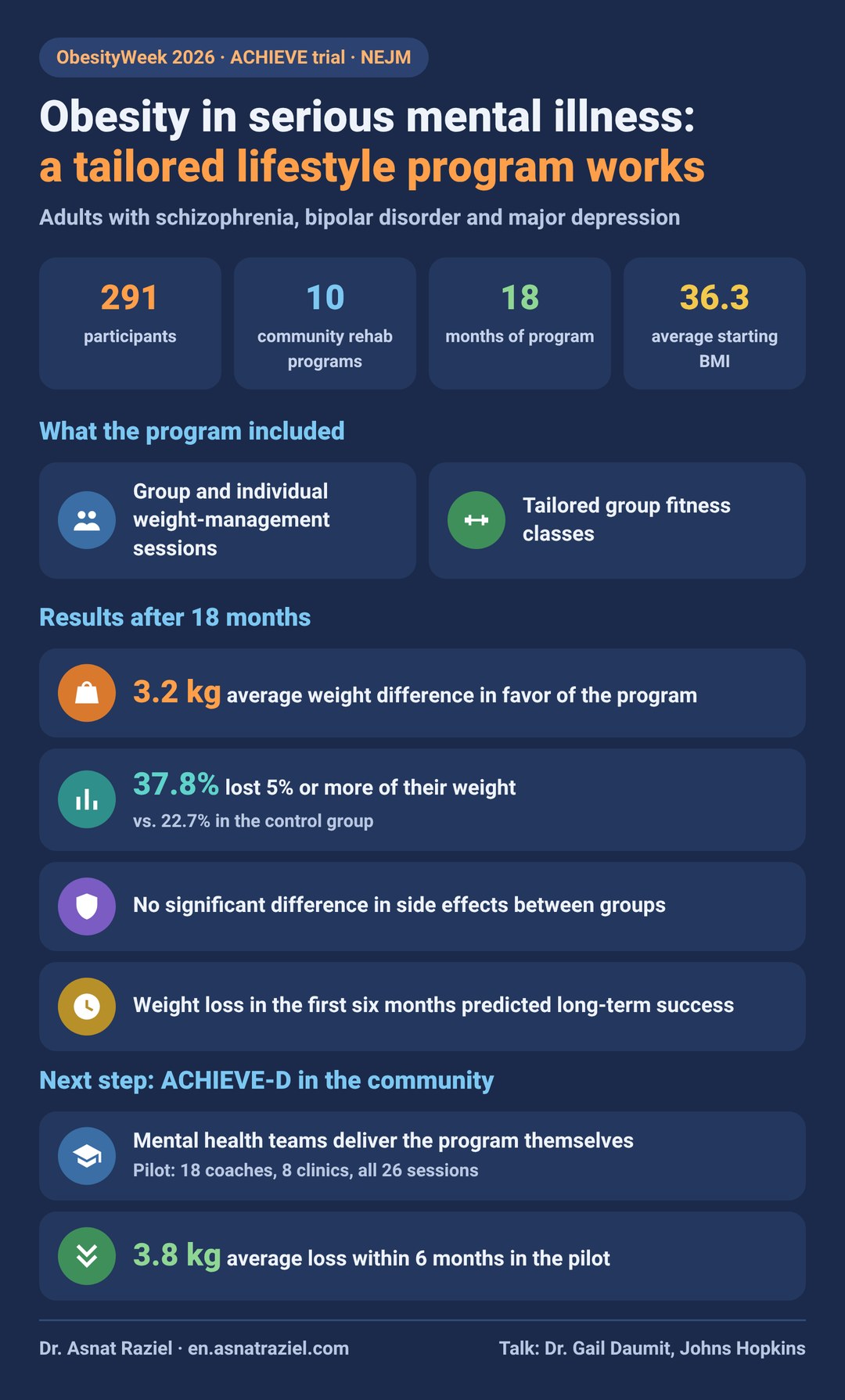
The trial was published in 2013 in the NEJM. Researchers enrolled 291 adults with overweight or obesity from 10 community psychiatric rehabilitation programs. Of these, 58.1% had schizophrenia or schizoaffective disorder, 22.0% had bipolar disorder and 12.0% had major depression.
At the start, the average body mass index (BMI) was 36.3, and the average weight was 102.7 kg. For 18 months, the intervention group received group and individual weight-management sessions plus group exercise. The team adapted all sessions for people with mental illness.
Obesity in serious mental illness: what the results showed
Weight loss in the intervention group grew over the full 18 months. The difference from the control group was significant at every measurement point. By the end, the average difference between the groups reached 3.2 kg.
In addition, 37.8% of program participants lost 5% or more of their starting weight, compared with 22.7% in the control group. In other words, out of 100 people in the program, about 38 lost at least 5%. Without the program, only about 23 did. There were no significant differences in side effects between the groups.
A follow-up analysis of the trial data added an interesting finding. Weight loss in the first six months best predicted who would lose at least about 2.3 kg by 18 months.
From research to practice: ACHIEVE-D
After publication, mental health programs across the US asked for the materials and facilitator guides. But in the trial itself, the research team led the sessions. So Daumit and her team developed an adapted version called ACHIEVE-D, based on partner feedback and pilots in several community clinics.
In the first pilot, 92.9% of participants said they would recommend the program. Later, a pilot trial published in 2024 tested the program when delivered by clinic staff. Eighteen coaches from 8 clinics delivered all 26 sessions. Their knowledge improved, and participants lost an average of 3.8 kg within six months.
Building a program that lasts
In the current stage, randomization moved from individual participants to whole clinics. All partner programs get training and basic technical support. Some also get intensive support, including close coaching and learning communities. The researchers expect that clinics with more support will implement the program more successfully.
In addition, the team works with community organizations, decision makers and Medicaid programs. The goal is a program that can be adopted, reimbursed and certified after the study ends. “For the program to spread, we need to train and empower community mental health teams,” Daumit explained.
The patient voice and a person-centered approach
Feedback from participants is another key part. Peer leaders, people with lived experience of mental illness who lead groups, helped design interventions that make participation easier. Daumit also stressed multimorbidity. Each person should be helped to choose the risk factors that matter most to them, with a person-centered approach.
What you can do today
First, talk to your psychiatrist. Report weight changes. Sometimes your doctor can adjust medication, but never stop a medication on your own.
Second, look for a structured group program. Regular sessions, goal setting and monitoring worked well in ACHIEVE.
Third, move together. Group exercise was a central part of the program. See also my physical activity prescription.
Also, watch the first six months. Early success predicted long-term success. If progress is slow, that is the time to add support.
Finally, do not give up on comprehensive care. When appropriate, your doctor may consider obesity medication, in coordination with the psychiatric team. In our multidisciplinary center, a dietitian, psychologists and coaches work together, because mental health and lifestyle are linked.
Further reading: psychiatric medications and weight gain and lifestyle and mental health in young people. See also staying stable on psychiatric treatment.
Bottom line on obesity in serious mental illness
More than a decade ago, ACHIEVE proved that people with serious mental illness can adopt healthy habits and lose weight. Today the challenge is no longer to prove that the program works. The challenge is to bring it to everyone who needs it. This is a message of health equity: good obesity care belongs to everyone, including people living with mental illness.
This article is general information and does not replace personal medical advice.
References
A behavioral weight-loss intervention in persons with serious mental illness
A Key Lecturer Discusses Lessons and Recent Developments From the ACHIEVE Trial
The US National Institute of Mental Health (NIMH) funded the ACHIEVE trial.