By Dr. Asnat Raziel, bariatric surgeon specializing in obesity treatment, metabolic health and healthy longevity; Director of the Multidisciplinary Center for Obesity Treatment, Assia Medical, Assuta Ramat HaChayal, Tel Aviv
Weight loss drugs across the lifespan: more than a number on the scale
Weight loss drugs across the lifespan were the focus of one of the most interesting sessions at ObesityWeek. Three experts offered three perspectives: teens, access and cost, and older adults. The shared message was simple. The goal is to prevent complications and protect function, not just to lower a number on the scale.
Teens: thinking a whole life ahead
The pediatrician opened with the story of a young patient with class 2 obesity, shared with her permission. She dreams of becoming an astronaut, running a 5K and flying comfortably to Japan. Most of all, she wants to become a grandmother. Her father, who also lived with class 2 obesity and had no known complications, died during the COVID pandemic when she was 10.
That is why, she said, treating children is not about body size. It is about preventing complications that shorten life. GLP-1 prescribing in young people is also rising fast, because the newer drugs work well and are easier to use. The question is no longer whether they work. It is how to treat over time, how to monitor, and when, if ever, to stop.
Who is a good fit for treatment?
The decision rests on several layers. First, the BMI trajectory and metabolic disease, even when it has not been diagnosed yet. Second, functional impairment, such as a child who hurts when walking on the playground. Then come the goals, preferences and readiness of the teen and family, and finally clinical fit and real-world access.
What the studies in teens show
Liraglutide studies showed a drop in BMI, but also weight regain after treatment stopped. In contrast, a secondary analysis of the STEP TEENS trial in 12- to 18-year-olds showed a clear metabolic benefit with semaglutide. Fasting insulin fell by 33.6%, compared with 10.1% on placebo. The HOMA-IR insulin resistance score fell by 35.0%, compared with 5.3%. Blood lipids and liver enzymes improved as well. In other words, treatment improves the metabolic profile, not just weight.
Bone, growth and eating habits
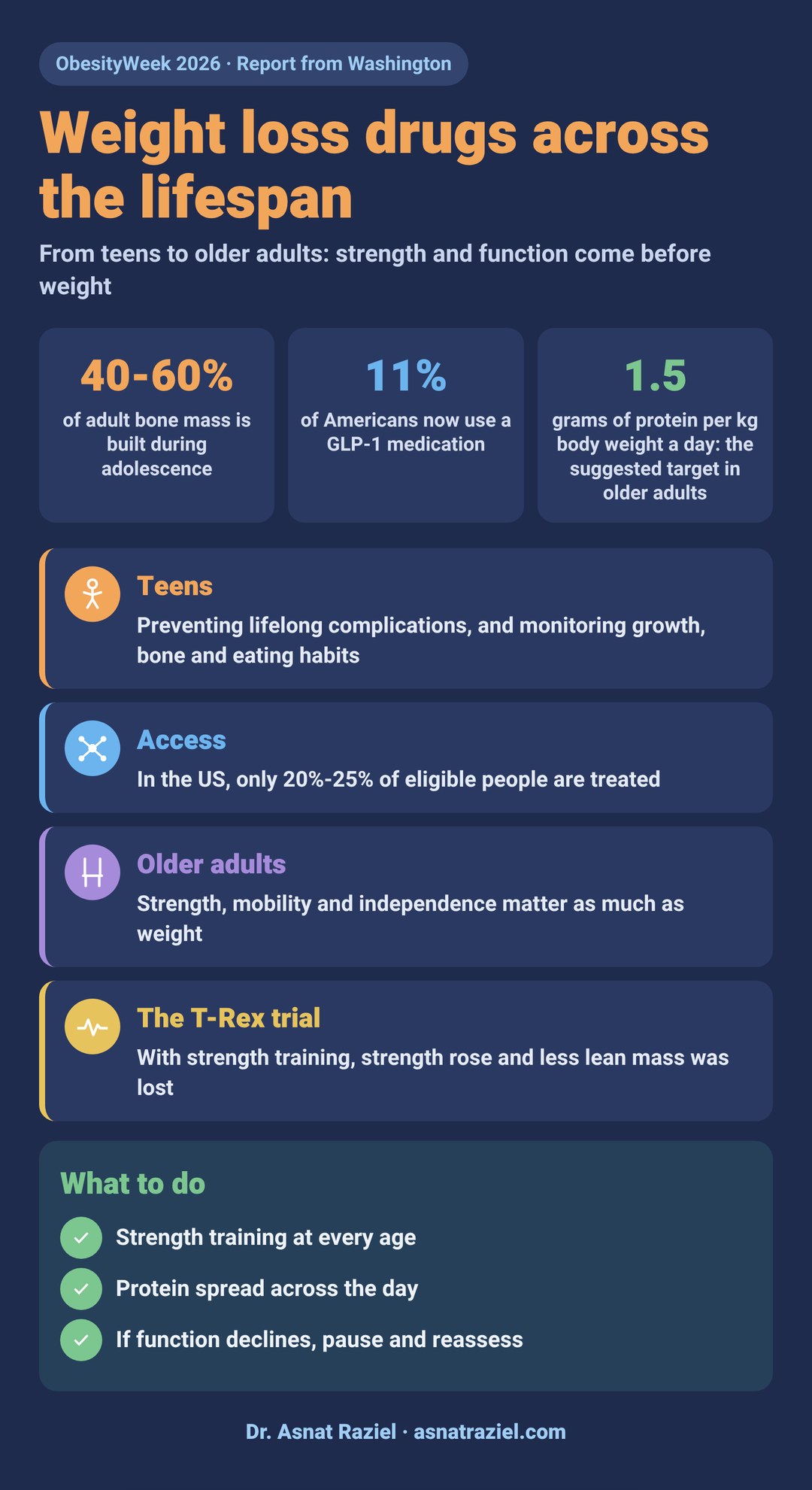
Adolescence is a critical window for building bone: 40% to 60% of adult bone mass is built during these years. However, direct body composition data in teens on GLP-1 drugs are still limited. Bariatric surgery studies show that bone density declines slightly, while estimated bone strength stays stable. Fat also falls faster than lean mass.
What does this mean in practice? At the start of treatment, screen for eating patterns and signs of eating disorders. Then follow diet quality at every visit. Also monitor growth, puberty and bone age. Finally, encourage strength training and protein, which many teens are already interested in.
Weight loss drugs across the lifespan: the access gap
The second speaker, Dr. Tim Church, argued that the problem is not overtreating healthy people. Rather, it is undertreating those who need treatment. By his estimate, about 60% of Americans meet even the strict definition for drug treatment. Yet only about 11% use one. That means only 20% to 25% of eligible people are treated.
He stressed that cost is also a volume problem. When most employees qualify, the total cost is enormous. So, in his view, only lower prices will allow broad coverage. The situation in Israel is different, but cost is a major barrier here too.
Older adults: strength matters more than weight
Dr. John Batsis, a geriatrician and obesity medicine specialist, presented a new framework from the American Geriatrics Society. He applied geriatrics’ “5 Ms” to it: what matters most, mobility, mind, medications and multicomplexity. The aim is to protect independence, not just improve lab numbers.
Weight loss improves obesity complications, but it also reduces muscle and bone. Keep in mind that sarcopenia is not just low muscle mass. It also includes a loss of strength. So the open question is how to balance metabolic benefit with preserving strength and function.
What we know about weight loss drugs across the lifespan in older adults
A systematic review found similar weight loss and blood sugar benefits in younger and older adults. In a semaglutide trial in heart failure, with a mean age of 69, the 6-minute walk test improved with statistical significance. However, its clinical importance is unclear, since a meaningful change is usually 30 to 50 meters. Quality of life, on the other hand, improved beyond the meaningful threshold.
Batsis also urged caution in reading DXA scans. The scan measures lean mass, not skeletal muscle directly. I covered this in my article on body composition on weight loss drugs. In the SURMOUNT-1 substudy, according to the talk, average weight loss was 23 kg: 17 kg of fat and 6 kg of fat-free mass. But only 6% of participants were over 65.
Moreover, in Batsis’s review, 65% of GLP-1 studies crossed a rough benchmark for lean mass loss. Yet 38% of lifestyle studies crossed it too. In his view, the amount of weight lost explains much of the loss, not just the drug itself.
Strength training and protein: what works
The good news comes from the T-Rex trial, published in Nature Medicine. Researchers treated 120 adults with tirzepatide for 40 weeks. Half did strength training three times a week. Weight and fat loss were similar in both groups. However, strength training reduced lean mass loss: 3.57 kg versus 4.67 kg. Moreover, strength fell in the drug-only group and rose in the group that trained.
That said, the average age was about 57, and training took place on site. So the protocol is not always easy to apply as is. Batsis also suggested a target of 1.5 grams of protein per kilogram of body weight a day, spread across the day.
What to check before and during treatment
In older adults, a few things deserve focus. First, strength and mobility. Second, nutrition and malnutrition risk. Also medication burden and symptoms such as dizziness, low blood pressure, dehydration and digestive side effects. The decision should be shared. For example, can a grandmother play with her grandchildren on the floor, or walk around the block? If function declines, pause and reassess.
What this means for you
At every age, drug treatment starts with a conversation, not a prescription. Ask what matters to you, what your goals are, and how function will be tracked. In teens, the focus is on growth, bone and eating. In older adults, it is on strength, mobility and independence. At every age, strength training and protein are part of the treatment, not an add-on.
Bottom line on weight loss drugs across the lifespan
Weight loss drugs across the lifespan can change the course of the disease, from adolescence to older age. Still, the goal is not only weight loss. It is preventing complications, protecting muscle and function, and reaching older age in good health. In the end, the decision should be shared and tailored to each person.
This article is general information and does not replace personal medical advice.