By Dr. Asnat Raziel, bariatric surgeon specializing in obesity treatment, metabolic health and healthy longevity; Director of the Multidisciplinary Center for Obesity Treatment, Assia Medical, Assuta Ramat HaChayal, Tel Aviv
Hypothalamic obesity: what’s new from ObesityWeek
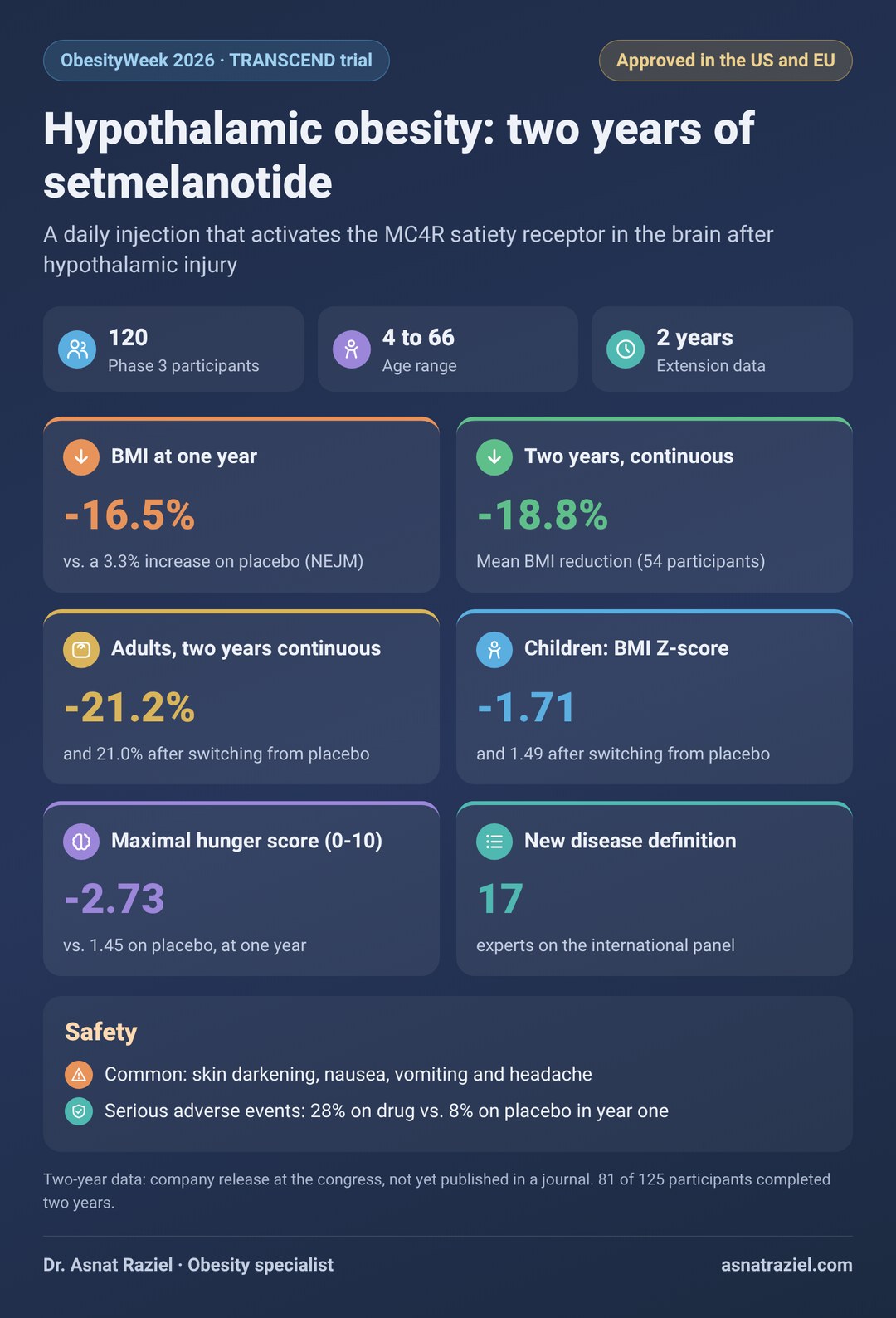
Hypothalamic obesity is weight gain that develops after damage to the part of the brain that controls hunger and fullness. At ObesityWeek, the American obesity congress held this week in Washington, researchers presented two updates. First, two-year data on the daily injection setmelanotide. In addition, an international expert panel presented a new definition of the disease. According to the company, people treated continuously for two years saw their BMI drop by 18.8% on average.
What is hypothalamic obesity?
The hypothalamus is a small area at the base of the brain. It controls appetite, fullness and how much energy the body burns. So when a tumor, surgery, radiation or injury damages it, the satiety system can break down. For example, children treated for a tumor called craniopharyngioma are at high risk.
The result is often relentless hunger, called hyperphagia, along with rapid weight gain. What’s more, diet and exercise alone barely help in this situation. I’ve written in depth about how the brain controls hunger and fullness in my article on the physiology of satiety.
How does setmelanotide work?
Setmelanotide, sold as Imcivree, is a daily injection under the skin. It activates the MC4R receptor, a key switch on the brain’s satiety pathway. In other words, it bypasses the damaged link and restores the fullness signal to the brain.
In the US, the FDA has approved the drug for acquired hypothalamic obesity from age 4. The approval also covers Bardet-Biedl syndrome (BBS) and rare genetic deficiencies from age 2. However, it is not meant for common, everyday obesity.
The TRANSCEND trial: the first year
The phase 3 TRANSCEND trial enrolled 120 children and adults aged 4 to 66. Researchers randomly assigned 81 to setmelanotide and 39 to placebo. The results were published in July in the NEJM.
After 52 weeks, BMI fell by 16.5% in the drug group. By contrast, it rose by 3.3% in the placebo group. Hunger also eased: the maximal hunger score dropped by 2.73 points, versus 1.45 points on placebo, on a 0 to 10 scale.
Hypothalamic obesity after two years of treatment
After the first year, all participants switched to open-label setmelanotide. In total, 125 participants entered the extension, and 81 completed two years. Of these, 54 received the drug continuously and 27 switched from placebo.
What the two-year data showed
According to the company, BMI fell by 18.8% on average with continuous treatment. Among those who switched from placebo after one year, the drop reached 16.5%. In adults the picture is even stronger: 21.2% with continuous treatment and 21.0% after switching from placebo.
In children, researchers measured the BMI Z-score, meaning the distance from the average for age and sex. The score fell by 1.71 with continuous treatment and by 1.49 after switching from placebo. As for safety, the company reports a profile similar to earlier trials.
A new definition of hypothalamic obesity
At the same time, a panel of 17 experts from around the world presented a new definition and diagnostic criteria. Under the definition, this is a distinct, rare neuroendocrine disease. It covers weight gain that follows injury to the hypothalamus or pituitary gland, in children and adults.
Diagnosis requires hypothalamic injury or dysfunction, plus one of three weight-gain patterns:
- Rapid and steep gain.
- Alternatively, slow and steady gain.
- Finally, delayed gain after an initially stable period.
Notably, hyperphagia may be present, but it is not required. Also, someone who already carried extra weight before the injury can still receive the diagnosis, if their weight trajectory clearly changed afterward.
Side effects to know about
In TRANSCEND, 100% of those on the drug and 90% of those on placebo reported adverse events. The most common were skin darkening, nausea, vomiting and headache. In addition, serious adverse events occurred in 28% of the drug group versus 8% on placebo.
Moreover, the label carries warnings about depression and suicidal thoughts and about acute adrenal insufficiency. That’s why treatment requires follow-up by a physician experienced in rare obesity.
What this means for you
If a child or adult in your family had surgery, radiation or injury near the hypothalamus, and their weight then climbed, consider hypothalamic obesity. That is exactly the goal of the new definition: to spot people who fall through the cracks earlier. In that case, see an endocrinologist or a multidisciplinary obesity clinic.
On the other hand, keep the limitations in mind. The two-year data come from a company release, not a peer-reviewed paper. Also, some participants did not complete two years. I’ve written about treating obesity at a young age in my articles on childhood obesity treatment and obesity in teens.
Further reading: MC4R and activin E research.
The bottom line
Hypothalamic obesity is a disease of the brain, not a failure of willpower. Ultimately, the two-year setmelanotide data show a BMI reduction that holds over time. In addition, the new definition should help diagnose the disease earlier.
This article is general information and does not replace personal medical advice.
References
Rhythm Pharmaceuticals Announces Presentation of New Data at ObesityWeek® 2026
Setmelanotide for the Treatment of Acquired Hypothalamic Obesity
Rhythm Pharmaceuticals, the drug’s manufacturer, funded the research.