By Dr. Asnat Raziel, bariatric surgeon specializing in obesity treatment, metabolic health and healthy longevity; Director of the Multidisciplinary Center for Obesity Treatment, Assia Medical, Assuta Ramat HaChayal, Tel Aviv
The MC4R receptor and activin E: a look inside the lab
The MC4R receptor is the brain’s main satiety switch, and this week two companies presented lab studies targeting it and a hormone called activin E. At ObesityWeek, the American obesity congress held in Washington, Palatin and iBio presented posters. Both drugs have so far been tested only in animals and in the lab. So these are interesting directions for the future, not a treatment available today.
Why does the MC4R receptor matter?
The brain has a pathway that turns fullness signals into the feeling of “that’s enough.” At the end of that pathway sits the MC4R receptor. When it is damaged, by a genetic defect or by injury to the hypothalamus, intense hunger and rapid weight gain follow.
An approved drug that activates this receptor already exists: setmelanotide. I wrote about it and its two-year data in my article on hypothalamic obesity. However, setmelanotide has a known drawback: it also activates the MC1R receptor in the skin, causing skin darkening.
Palatin: a selective take on the MC4R receptor
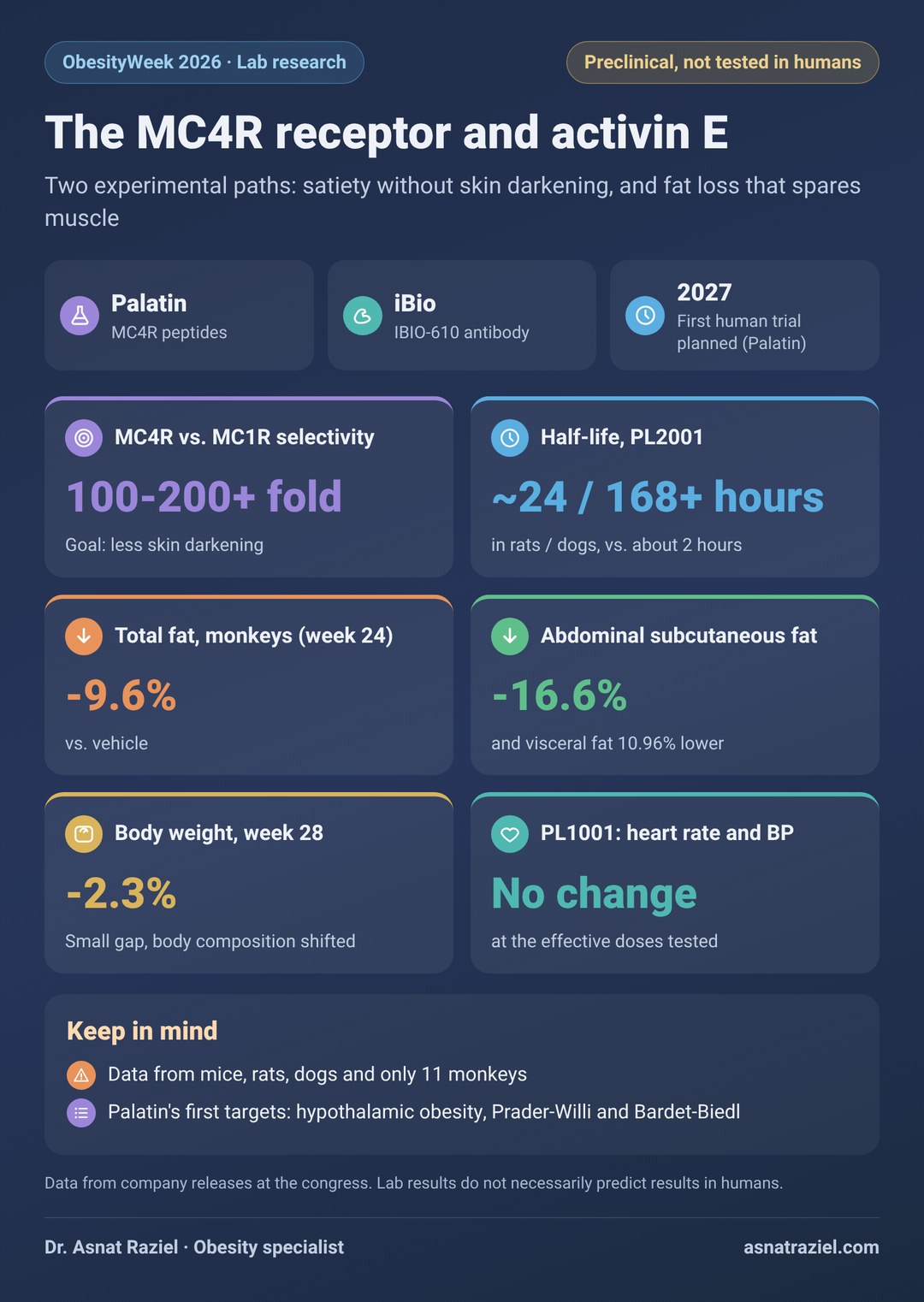
Palatin has developed peptides, short proteins, that activate the MC4R receptor while barely touching the skin receptor. According to the company, they are more than 100- to 200-fold selective. In other words, the goal is fullness without changes in skin color.
What they found in mice and dogs
In mice with diet-induced obesity, the peptides reduced body weight and food intake as the dose went up. The company did not publish the exact numbers. In addition, for the long-acting version, PL2001, researchers attached a fatty chain to the peptide. This extended the half-life to about 24 hours in rats and over 168 hours in dogs, versus about two hours for the short version.
What’s more, one peptide, PL1001, did not change heart rate or blood pressure at the effective doses tested. That matters, because older drugs in this family raised blood pressure.
What’s next
The company chose PL2001 as its candidate for human trials. A first trial is planned for the first half of 2027, with initial data expected in the second half of that year. The first targets are rare diseases: hypothalamic obesity, Prader-Willi syndrome and Bardet-Biedl syndrome. In the future, it may become a weekly injection.
iBio: an antibody against activin E
Activin E is a protein that affects how the body stores fat. iBio has developed an antibody called IBIO-610 that blocks it for a long time. So the idea is to reduce mainly fat while preserving muscle.
The monkey study
Researchers tested the antibody in monkeys with obesity on a high-fat diet: five received the antibody and six received a vehicle. At week 24, total body fat was 9.6% lower in the treated group. Abdominal fat under the skin was 16.6% lower, and visceral fat, the risky fat around the organs, 10.96% lower.
By contrast, body weight itself changed little: the gap versus the untreated group appeared only around week 18 and reached 2.3% by week 28. In addition, lean mass was largely maintained. In other words, the main change was in body composition, not the number on the scale.
Why it matters: the MC4R receptor, fat and muscle
Both approaches try to solve problems with current treatments. On one hand, selective MC4R receptor drugs may help people with intense hunger of brain origin. On the other hand, drugs like IBIO-610 aim to preserve muscle while fat comes off.
Still, keep the limitations in mind. All the data come from company releases, lab studies and small groups of animals. Also, the companies themselves note that lab results don’t always predict results in humans.
What this means for you
In the near term, neither drug will reach patients. So anyone who needs treatment today can rely on approved drugs, nutrition, physical activity and surgery when needed. Read about more investigational directions from the congress in my article on future obesity drugs.
The bottom line
The MC4R receptor and activin E are two new targets in obesity research. Palatin hopes to start a first human trial in 2027, and iBio is continuing lab studies. Ultimately, only human trials will tell whether these directions become treatments.
This article is general information and does not replace personal medical advice.
References
The data were released by the companies developing the drugs.