By Dr. Asnat Raziel, bariatric surgeon specializing in obesity treatment, metabolic health and healthy longevity; Director of the Multidisciplinary Center for Obesity Treatment, Assia Medical, Assuta Ramat HaChayal, Tel Aviv
Experimental obesity drugs: what’s new from the lab
Experimental obesity drugs keep arriving at ObesityWeek, the American obesity meeting in Washington, held November 14-17. This week, two small companies announced early-stage studies. The first is developing a pill that mimics the hormone amylin. The second is developing a drug meant to protect muscle during weight loss on semaglutide. It’s important to say up front: neither drug has FDA approval, and neither company has released any numbers yet.
In an earlier article I covered other lab-stage drugs that companies will show at the meeting. Here are the next two candidates, and what you should know about them.
ECC1542: a pill that mimics amylin
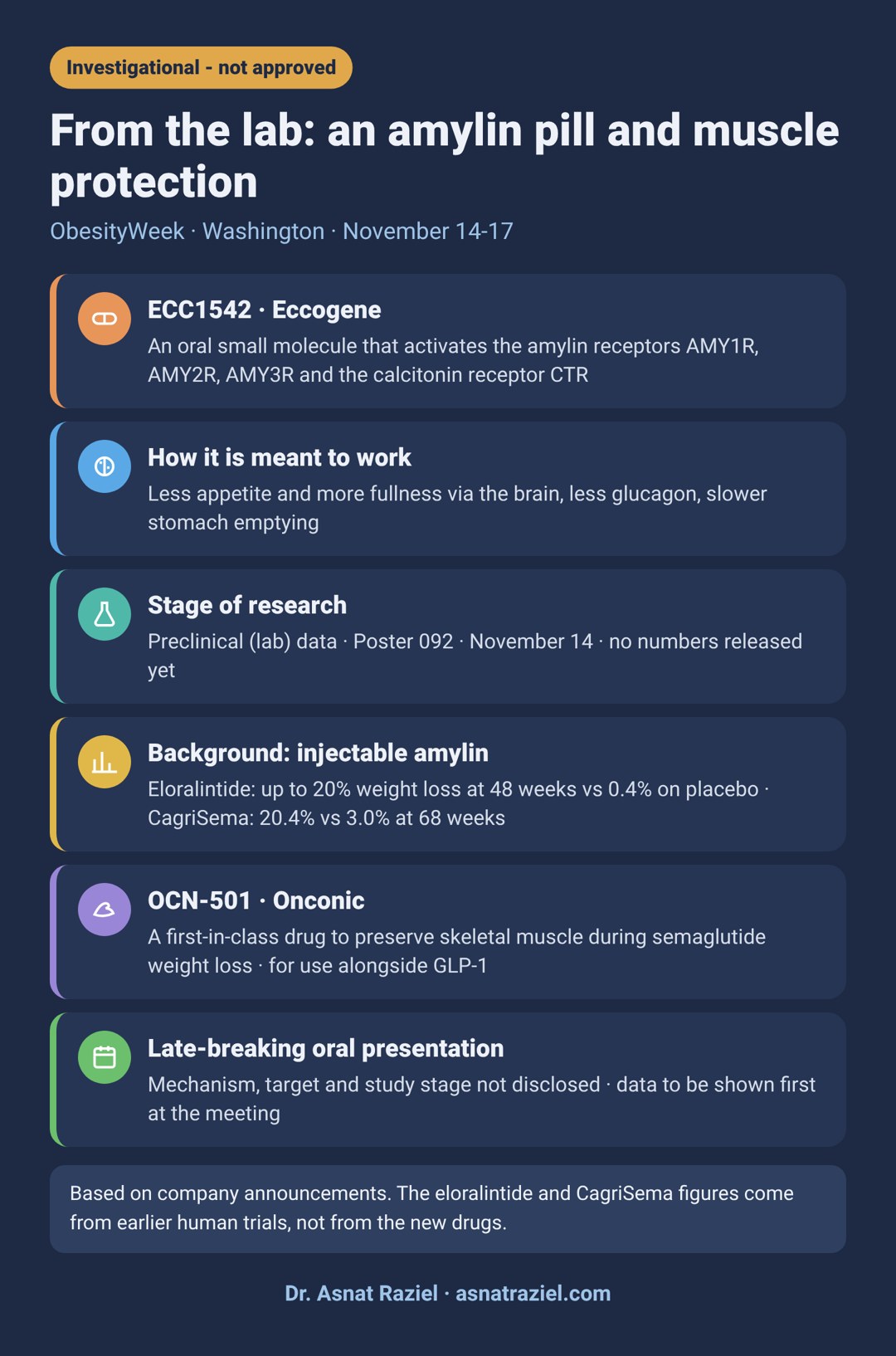
Eccogene started in 2018 and operates from Boston and Shanghai. According to its press release, it has three drugs in clinical development and several earlier programs. At the meeting, it will present preclinical data, meaning laboratory research, on a drug called ECC1542.
ECC1542 is a small molecule that people would take by mouth. It activates the amylin receptors (AMY1R, AMY2R, AMY3R) and the calcitonin receptor (CTR). Amylin is a hormone the pancreas releases together with insulin after a meal. So activating its receptors reduces appetite and increases fullness through the brain. In addition, according to the company, it lowers glucagon release and slows stomach emptying.
Why a pill and not an injection?
Most amylin drugs in development are injections. For example, Novo Nordisk’s CagriSema combines cagrilintide with semaglutide in a weekly shot. The company argues that a pill could make it easier to stay on treatment, to store the drug, and to combine it with other pills. However, these are the company’s claims, and there are no human data yet.
What injectable amylin drugs have shown so far
Eccogene’s release cites two injection trials to explain the promise of this approach. First, a phase 2 trial of Lilly’s eloralintide enrolled 263 participants. After 48 weeks, mean weight loss reached up to 20% at the higher doses, compared with 0.4% on placebo. Nausea and fatigue were the most common side effects. You can read about Lilly’s plans in my article on Lilly at ObesityWeek.
Second, the REDEFINE 1 trial tested cagrilintide plus semaglutide. After 68 weeks, weight fell by an average of 20.4%, compared with 3.0% on placebo. In other words, injectable amylin drugs have already shown results in people. The open question is whether a pill can match them.
OCN-501: protecting muscle during weight loss
The Korean company Onconic Therapeutics will present OCN-501 in a talk at the meeting. The meeting selected its abstract as a late-breaking abstract, a new study that organizers take after the regular deadline because of its importance. The talk’s title describes a first-in-class drug that preserves skeletal muscle during weight loss with semaglutide, the active ingredient in Wegovy.
OCN-501 is also one of the experimental obesity drugs at the meeting, but its direction is different. The problem OCN-501 targets is familiar to anyone who treats obesity. GLP-1 drugs reduce fat, but part of the weight lost is lean body mass, including muscle. That’s why the company is developing the drug for use alongside GLP-1 medications, not instead of them.
What we still don’t know
The company has not disclosed the drug’s mechanism of action or its target. It also hasn’t said whether the study involved animals or people. According to the company, it will show the data for the first time in the November talk, because of the meeting’s embargo policy. This is the company’s third program, after a heartburn drug that is already on the market and an experimental cancer drug.
Experimental obesity drugs: what this means for you
Both announcements show where the field is heading. On one hand, companies are looking for amylin drugs in pill form. On the other, they are looking for ways to improve the quality of weight loss, not just its size. Still, these are very early stages. Most drugs at this stage never reach approval.
In the meantime, the proven way to protect muscle during drug treatment is enough protein and regular strength training. If you are looking for a pill today, you can also read about the experimental aleniglipron pill, which is being shown at the same meeting.
The bottom line on experimental obesity drugs
Experimental obesity drugs such as ECC1542 and OCN-501 are interesting, but they are still far from the clinic. I will update here once the companies share their data at the meeting. This article is general information and does not replace personal medical advice.
References
Onconic Therapeutics Unveils Obesity Drug Candidate to Be Presented at US Conference in November
“살 빼고 근육 지킨다”…온코닉, 비만 병용신약 첫 공개
Coadministered Cagrilintide and Semaglutide in Adults with Overweight or Obesity
The eloralintide trial was funded by Eli Lilly.