By Dr. Asnat Raziel, bariatric surgeon specializing in obesity treatment, metabolic health and healthy longevity; Director of the Multidisciplinary Center for Obesity Treatment, Assia Medical, Assuta Ramat HaChayal, Tel Aviv
BMF-650 pill: what’s new at ObesityWeek
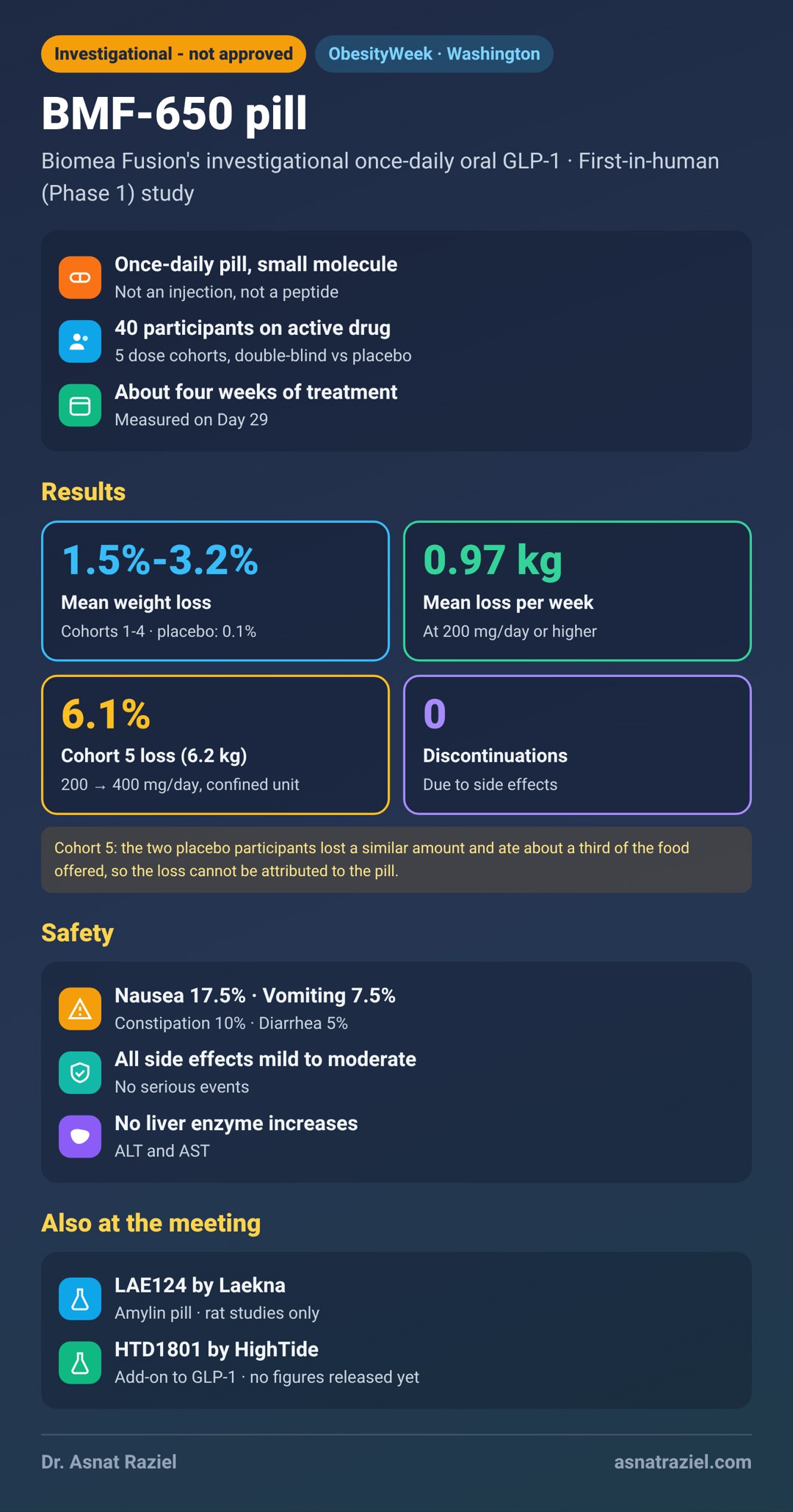
The BMF-650 pill is an investigational once-daily GLP-1 pill, and it has just completed its first test in humans. The US company Biomea Fusion will present the results at ObesityWeek, the American obesity meeting in Washington. Over four weeks of treatment, participants lost an average of 1.5% to 3.2% of their body weight. In the placebo group, by contrast, the loss was just 0.1%. One thing up front: this drug is experimental, and no regulator has approved it.
Two other companies will also present oral drugs in development at the meeting. Together, they give a broad picture of what is coming in obesity pills.
Why is everyone looking for a pill instead of a shot?
Many of my patients prefer a pill to an injection. Some are afraid of needles, and others simply want a treatment that fits easily into daily life. That is why companies are developing pills that work like the well-known weight-loss injections.
For example, Foundayo is a “small molecule” GLP-1 pill, meaning a chemical drug rather than a protein. The BMF-650 pill belongs to the same family. The advantage of a small molecule is clear: the gut absorbs it well, and companies can make it at scale.
How the BMF-650 pill study worked
The trial, GLP-131, was a randomized, double-blind, placebo-controlled Phase 1 study. Participants were adults with overweight or obesity and no other underlying conditions. First, they received single doses at rising strengths. After that, the researchers tested five groups who took the pill once a day for about four weeks.
In all, 40 participants received the active drug in these five groups. The main goal of a Phase 1 study is safety and tolerability. Weight loss is a secondary goal at this stage.
BMF-650 pill results: how much weight people lost
In the first four groups, treated as outpatients, the average loss on Day 29 was 1.5% to 3.2%. At doses of 200 mg a day or higher, participants lost about 0.97 kg a week on average. The company did not release the result for each dose separately.
The fifth group: an impressive number with a big caveat
The fifth group stayed at the research center for the whole study. Participants took 200 mg a day for one week, then 400 mg a day for three weeks. In this group, the average loss reached 6.1%, or 6.2 kg.
However, the two placebo participants in this group lost almost as much. They ate only about a third of the 2,100 calories the center offered them each day. The company itself notes that staying at the center changed eating behavior. In other words, this group cannot tell us how much of the loss came from the pill.
BMF-650 pill safety and side effects
All side effects were mild to moderate. No participant stopped treatment because of side effects, and the company reported no serious events. As with all GLP-1 drugs, the main complaints involved the digestive system:
Nausea: 17.5% of participants. Vomiting: 7.5%. Constipation: 10%. Diarrhea: 5%.
In addition, there were no reported increases in the liver enzymes ALT and AST. This matters, because liver problems have stopped the development of other GLP-1 pills in the past. In the fifth group, which moved quickly to 400 mg, all digestive side effects were Grade 1, the mildest grade.
What else is coming: two early-stage pills
Laekna’s LAE124: an amylin pill still in the lab
The Chinese company Laekna will present LAE124, an investigational pill that acts on the receptors for the hormone amylin and for calcitonin. Amylin is a hormone that signals fullness to the body. In a study in rats with obesity, a single dose reduced food intake in a dose-dependent way. In addition, 28 days of daily treatment lowered body weight, also in a dose-dependent way.
However, the company did not publish numbers. No one has tested the pill in humans yet. The company is still running the studies that come before an application for a clinical trial. I wrote about other amylin pills in my article on the Eccogene amylin pill.
HighTide’s HTD1801: an add-on to GLP-1 injections
HighTide will present a poster on HTD1801, an oral compound of berberine and ursodeoxycholate (berberine ursodeoxycholate). Researchers are already testing the drug in clinical trials in type 2 diabetes. At the meeting, the company will present it as an add-on to incretin drugs such as Wegovy and Mounjaro.
According to the poster title, the add-on boosted weight loss, preserved muscle mass and reduced weight regain after treatment stopped. However, the company did not release any figures. The announcement also does not say whether the study involved humans or animals.
BMF-650 pill: what it means for you
First, the BMF-650 pill is still at the very beginning of its path. Four weeks of treatment in 40 participants is not enough to know how well it works over time. Moreover, the company says it needs longer safety studies in animals before later stages. In addition, it is looking for a partner to continue development.
Second, LAE124 and HTD1801 show where the field is heading: pills that act on amylin, and combinations that protect muscle and prevent weight regain. You can read about more drugs like these in my review of the lab innovations at the meeting and my article on Kailera’s news.
Finally, if you are looking for treatment today, there are already approved and effective medications. It is best to choose a treatment together with a doctor who knows the field, based on your own health.
The bottom line
In its first human study, the BMF-650 pill led to a 1.5% to 3.2% weight loss over four weeks, with mild side effects. It is an interesting start, but still far from an available treatment. All the drugs in this article are investigational and not approved for use.
This article is general information and does not replace personal medical advice.
References
Study of BMF-650 in Otherwise Healthy Overweight or Obese Adult Participants
ObesityWeek 2026|HighTide Therapeutics To Present HTD1801 Findings in Obesity Management
The studies and announcements were funded and released by the developing companies.