By Dr. Asnat Raziel, bariatric surgeon specializing in obesity treatment, metabolic health and healthy longevity; Director of the Multidisciplinary Center for Obesity Treatment, Assia Medical, Assuta Ramat HaChayal, Tel Aviv
Ribupatide heads to ObesityWeek
Ribupatide is an investigational once-weekly injection for obesity. Kailera will feature it at ObesityWeek, the American obesity congress in Washington, held November 14-17. Alongside it, the company will share data on a daily pill called safiglipron. Keep in mind that both drugs are still investigational, and regulators have not approved them in Israel or the United States.
In this article, I explain what the company announced, what the trials have already shown and what it means for you today. I also review two early lab developments: a once-weekly pill and an injection that might last a whole quarter.
What Kailera announced ahead of the congress
On November 10, Kailera issued a press release about four presentations at the congress. First, two describe the design of the drug’s global Phase 3 trials. The other two cover how well obesity medications work in the real world, and the unmet need in people with class II and III obesity.
At the same time, Kailera’s Chinese partner Hengrui will present two posters from the HARBOR-1 trial of safiglipron. One of them looks at the pill’s effect in people with prediabetes. However, the release itself contains no new numbers. So the data below come from results the companies published earlier.
How ribupatide works
Ribupatide activates two gut hormone receptors, GLP-1 and GIP. This is a similar mechanism to tirzepatide, the active ingredient in Mounjaro. Specifically, these hormones increase fullness and slow stomach emptying. As a result, they lower appetite and the amount people eat.
Hengrui developed the drug in China, under the name HRS9531. Meanwhile, Kailera holds the rights outside Greater China. According to the company, more than 3,000 trial participants have received the injection, for up to 52 weeks. In addition, Hengrui has filed for approval in China, and a once-daily pill version is also on the way.
Ribupatide results in a Phase 3 trial in China
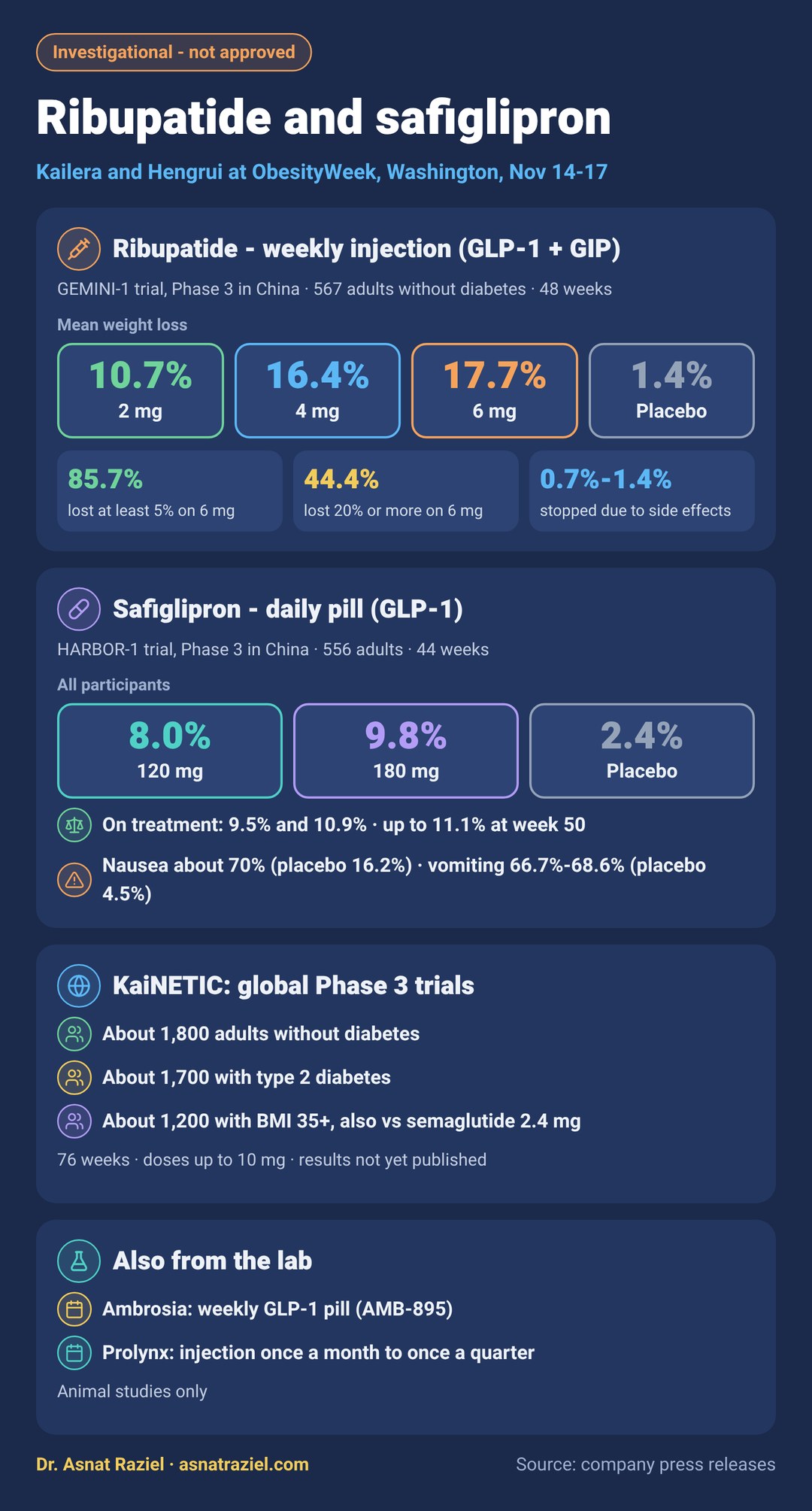
The GEMINI-1 trial enrolled 567 adults without diabetes. All had obesity, or overweight with a related health condition. On average, their starting weight was 93 kg (205 lb). Participants received a weekly injection of 2, 4 or 6 mg, or placebo, for 48 weeks. The full data came out at last year’s ObesityWeek.
These are the results of the main analysis, which includes all participants:
- 2 mg: average weight loss of 10.7%.
- 4 mg: average weight loss of 16.4%.
- 6 mg: average weight loss of 17.7%.
- Placebo: only 1.4%.
What’s more, 85.7% of people on the 6 mg dose lost at least 5% of their weight. Almost half of them, 44.4%, lost 20% or more. Most side effects were mild to moderate, mainly digestive. Only 0.7% to 1.4% stopped treatment because of side effects.
The KaiNETIC trials: ribupatide goes global
At the congress, Kailera will present the design of the three KaiNETIC trials. Each trial lasts 76 weeks and tests doses of up to 10 mg. The trials are taking place in North America, Europe, Oceania and South America.
- KaiNETIC-1: about 1,800 participants with obesity, or overweight and a related condition, without diabetes.
- KaiNETIC-2: about 1,700 participants with overweight and type 2 diabetes.
- KaiNETIC-3: about 1,200 participants with a BMI of 35 or higher, also compared with semaglutide 2.4 mg.
In other words, the third trial will put ribupatide head to head with Wegovy. However, the companies have not yet published results from these trials.
Safiglipron: what the HARBOR-1 trial showed
Safiglipron is a daily small-molecule pill that activates the GLP-1 receptor. In that sense, it resembles Foundayo (orforglipron) rather than an injection. The HARBOR-1 trial enrolled 556 adults in China, with an average weight of 94.1 kg. They took 120 or 180 mg a day, or placebo.
According to the trial results, after 44 weeks people lost an average of 8.0% and 9.8% of their weight. On placebo, by contrast, weight loss was 2.4%. Among those who stayed on treatment, weight loss reached 9.5% and 10.9%. At 50 weeks, it reached 11.1% on the higher dose.
On the other hand, digestive side effects were very common. About 70% reported nausea, compared with 16.2% on placebo. Vomiting occurred in 66.7% to 68.6%, compared with 4.5% on placebo. Even so, only 3.1% to 4.1% stopped treatment because of side effects. Also, the researchers saw no signs of liver harm.
Also from the lab: a weekly pill and a quarterly shot
Ambrosia: a once-weekly obesity pill
Ambrosia will present two posters at the congress. The first describes AMB-895, a small-molecule GLP-1 pill that the company designed for once-weekly use. The second describes AMB-131, a pill that blocks the GIP receptor. So far, the company has tested both only in the lab, and the release includes no numerical data.
Prolynx: an injection once a month to once a quarter
Prolynx has developed tiny gel microspheres that release a drug slowly. Thus, the goal is an injection once a month, or even once a quarter. In one poster, a single injection of an amylin-like drug led to sustained weight loss over 12 weeks in rats. This, too, is an early step, in animals only.
I have covered similar developments in my articles on lab advances at the congress and on an investigational monthly injection.
What this means for you today
Ribupatide and safiglipron may widen treatment options in the future. Still, the road to approval in Israel is long. Meanwhile, effective approved treatments already exist today: Wegovy, Mounjaro, the Wegovy pill and Foundayo. You can also read about another investigational pill at the congress, and about what Novo and Lilly are presenting.
So if you are living with obesity, don’t wait for the next drug. A personalized treatment plan, together with good nutrition, physical activity and good sleep, brings results right now. Therefore, it is worth talking to a doctor who specializes in obesity treatment.
The bottom line
Ultimately, ribupatide led to weight loss of up to 17.7% in a Phase 3 trial in China. Now global trials are testing it, including against Wegovy. Safiglipron showed weight loss of up to 11.1%, but with high rates of nausea and vomiting. The future looks promising, and today already offers good treatments.
This article is general information only and is not a substitute for personal medical advice.
Sources
Kailera Therapeutics to Present at ObesityWeek 2026
Ambrosia Biosciences Announces Late-Breaking Poster Presentations at ObesityWeek 2026
The data are based on press releases from the developing companies, not on peer-reviewed papers.