By Dr. Asnat Raziel, bariatric surgeon specializing in obesity treatment, metabolic health and healthy longevity; Director of the Multidisciplinary Center for Obesity Treatment, Assia Medical, Assuta Ramat HaChayal, Tel Aviv
Psoriatic arthritis and obesity: a trial that links the two
Psoriatic arthritis affects the joints of some people with psoriasis, and it usually comes together with excess weight. A new trial, TOGETHER-PsA, tested what happens when obesity treatment is added to a biologic drug. The answer: the combination brought meaningful improvement in joints, fatigue and weight, compared with the biologic alone.
According to the company announcement, the researchers presented the full one-year results at ACR Convergence, the American rheumatology meeting. They also published them in Arthritis & Rheumatology. To me, this is a clear example that obesity is part of the inflammatory disease, not just its background.
What is psoriatic arthritis?
Psoriatic arthritis (PsA) is a chronic inflammatory disease of the joints. It causes pain, swelling and stiffness, and it can also affect tendons and the spine. In fact, between 72% and 82% of patients live with overweight or obesity. I wrote about how fat tissue fuels inflammation in my article on obesity and inflammation.
Two drugs, two mechanisms
Taltz, whose active ingredient is ixekizumab, is a biologic drug. It blocks IL-17A, a key protein in the inflammation of psoriasis and of the joints. Tirzepatide acts on the GLP-1 and GIP receptors. It reduces appetite and leads to substantial weight loss. In the United States, Lilly markets it for obesity as Zepbound, and in Israel it goes by Mounjaro. Eli Lilly makes both drugs.
Psoriatic arthritis: how the trial was designed
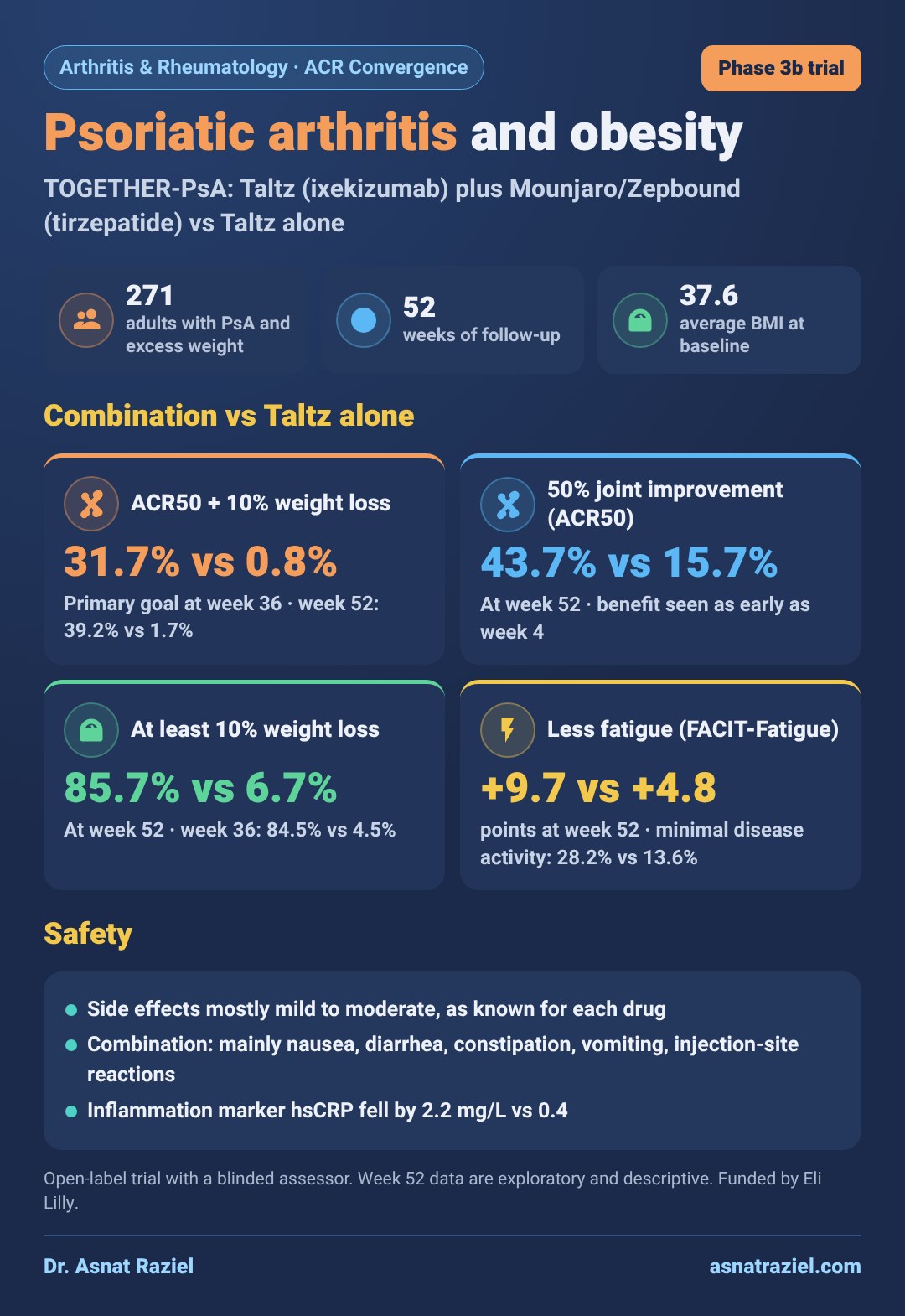
The trial enrolled 271 adults with active psoriatic arthritis. All had a BMI of at least 30, or a BMI of 27 to 30 with a weight-related condition. The average BMI was 37.6. The researchers randomly assigned participants to Taltz alone or to Taltz plus tirzepatide. Both groups also received counseling on a reduced-calorie diet and physical activity.
The researchers measured the main goal at week 36, and it had two parts. First, at least a 50% improvement in disease measures (ACR50, a standard score that includes tender joints, swollen joints, pain and function). Second, at least 10% weight loss. The trial lasted 52 weeks.
Results at week 36
In the combination group, 31.7% of patients reached both goals together. By contrast, only 0.8% did so on Taltz alone. Even when looking at the joints alone, the combination led: 33.5% reached ACR50, compared with 20.4% on Taltz alone.
Moreover, the joint benefit appeared as early as week 4. At that point, patients had not yet lost a meaningful amount of weight. Therefore, the researchers suggest that tirzepatide may also have an anti-inflammatory effect beyond weight loss. In the combination group, 84.5% lost at least 10% of their weight, compared with 4.5% on Taltz alone.
Psoriatic arthritis: what happened after one year
By week 52, the gap between the groups kept growing. In the combination group, 43.7% reached ACR50, compared with 15.7% on Taltz alone. In addition, 39.2% reached both ACR50 and 10% weight loss, compared with 1.7%. Likewise, 28.2% reached minimal disease activity (MDA), meaning almost no signs of disease, compared with 13.6%.
Daily well-being improved too. The fatigue score (FACIT-Fatigue) rose by 9.7 points with the combination, compared with 4.8 on Taltz alone, and a higher score means less fatigue. The inflammation marker hsCRP, a blood protein that rises with inflammation, fell by 2.2 mg/L compared with 0.4. At the same time, the combination improved blood pressure, glucose, HbA1c (average blood sugar over the past three months), blood fats and physical function.
Safety and side effects
Side effects were generally mild to moderate and matched what we already know about each drug. In the combination group, the most common were nausea, diarrhea, constipation, vomiting and injection-site reactions. Some patients also reported urinary tract infections, sinusitis, dizziness and headache. To reduce digestive side effects, we raise the tirzepatide dose gradually. You can read more in my Mounjaro dosage guide.
What to keep in mind about the trial
This was an open-label trial, meaning patients and doctors knew which treatment each person received. However, the person who assessed the joints did not know the group. In addition, the researchers planned the week 52 analyses in advance, but they are exploratory, so we should read them as descriptive. Finally, Eli Lilly funded the trial and makes both drugs.
Psoriatic arthritis: what it means for you
The core message is simple: for people with psoriatic arthritis and excess weight, treating obesity is part of treating the disease. These results fit what we see in psoriasis of the skin. They also fit the research on knee pain and obesity medications.
What you can do today
First, if you take a biologic drug and carry excess weight, ask your rheumatologist about obesity treatment. Both drugs are available today, but make the decision to combine them together with your treating doctors. Second, a Mediterranean diet, suitable exercise and good sleep help lower inflammation. I wrote more about the link between skin, joints and weight in my article on psoriasis and obesity.
Bottom line
The TOGETHER-PsA trial shows that in psoriatic arthritis with excess weight, combining a biologic with tirzepatide beats the biologic alone. The joint benefit appeared early, lasted through one year and came with weight loss and metabolic gains. This is encouraging progress that shows how much combined care can change quality of life.
This article provides general information and does not replace personal medical advice.
References
Eli Lilly funded the trial.