By Dr. Asnat Raziel, bariatric surgeon specializing in obesity treatment, metabolic health and healthy longevity; Director of the Multidisciplinary Center for Obesity Treatment, Assia Medical, Assuta Ramat HaChayal, Tel Aviv
Retatrutide and knee osteoarthritis: a new era in obesity treatment
Retatrutide and knee osteoarthritis are the focus of TRIUMPH-4, the first completed phase 3 trial of this new drug. In recent years, we have been living through a revolution in obesity treatment. Drugs such as semaglutide and tirzepatide have already shown that medication can achieve significant weight loss. Now an especially promising drug is joining the picture: retatrutide.
Eli Lilly is developing the drug. It belongs to a new generation of treatments that act on several hormonal mechanisms at once. In the TRIUMPH-4 trial, participants on the high dose lost an average of 28.7% of their body weight. Keep in mind, though, that the drug is not yet approved anywhere in the world.
An advanced mechanism of action
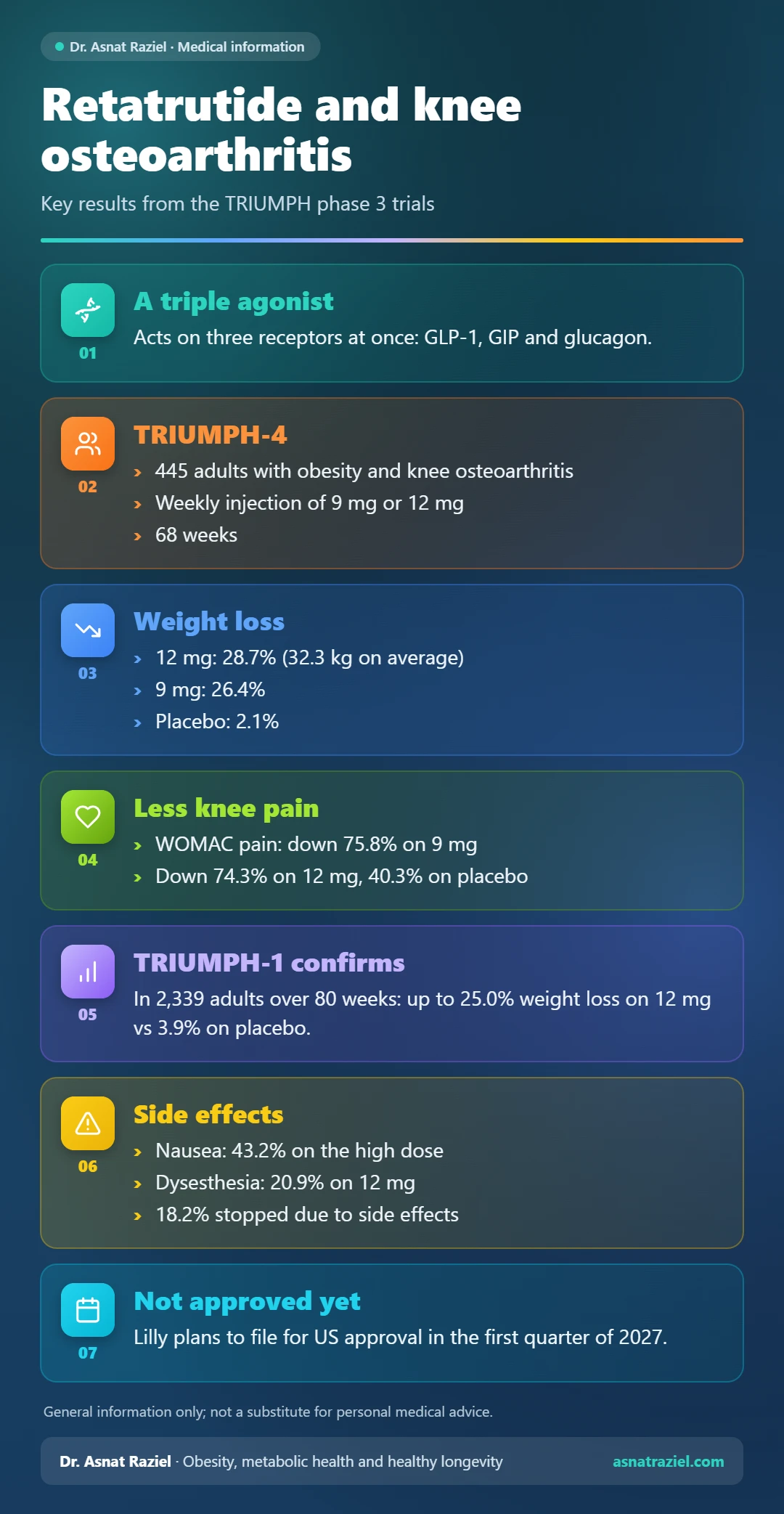
Retatrutide works differently from existing drugs. Semaglutide acts on one receptor, GLP-1. Tirzepatide acts on two, GLP-1 and GIP. The new drug, by contrast, activates three receptors at once: GLP-1, GIP and glucagon. That is why doctors call it a triple agonist.
This combination has a broad metabolic effect. It reduces appetite, slows stomach emptying and improves metabolism. In addition, the glucagon component appears to raise the body’s energy expenditure. Together, these mechanisms may explain the large weight loss. Already in the phase 2 trial, published in 2023, participants on the high dose lost 24.2% of their body weight after 48 weeks. These results led to the large TRIUMPH phase 3 program. You can read about another retatrutide trial in my article on the TRANSCEND trial.
The TRIUMPH-4 trial: retatrutide and knee osteoarthritis
The TRIUMPH-4 trial is a randomized, double-blind phase 3 study. It included 445 adults with obesity or overweight who also had knee osteoarthritis, that is, wear of the joint cartilage. Their average weight at the start was 112.7 kg. Participants received a weekly injection of retatrutide, 9 mg or 12 mg, or a placebo. The trial lasted 68 weeks.
The results were impressive. On the 12 mg dose, participants lost 28.7% of their body weight, or 32.3 kg on average. On the 9 mg dose, the loss was 26.4%. In the placebo group, by contrast, it was only 2.1%.
In addition, many participants on the high dose reached especially large losses:
- 58.6% lost at least 25% of their body weight.
- 39.4% lost at least 30% of their weight.
- 23.7% lost at least 35% of their weight.
These results are exceptional in the world of obesity drugs.
The effect on knee pain
The trial looked not only at weight loss, but also at knee pain and function. On the WOMAC index, a standard questionnaire for assessing joint pain and function, pain fell by 75.8% on the 9 mg dose. On the 12 mg dose, it fell by 74.3%. In the placebo group, pain fell by 40.3%.
Beyond that, 14.1% of patients on 9 mg and 12.0% on 12 mg reported that their pain had disappeared completely. On placebo, the rate was 4.2%. However, the company noted that some of these analyses were not planned in advance. Weight loss eases the mechanical load on the knee. Perhaps the metabolic and anti-inflammatory effects also contribute to the improvement.
The TRIUMPH-1 trial: the bigger picture
In September 2026, the TRIUMPH-1 trial appeared in the NEJM. It included 2,339 adults with obesity and without diabetes, over 80 weeks. According to the report, weight loss was 17.6% on 4 mg, 23.7% on 9 mg and 25.0% on 12 mg. In the placebo group, it was 3.9%.
Here, too, the researchers looked at retatrutide and knee osteoarthritis pain, and the pain eased much more than with placebo. Likewise, in participants with sleep apnea, the number of breathing pauses per hour went down. I described a similar link between weight loss and sleep apnea in my article on obesity and sleep apnea.
Safety and side effects
Like other drugs that act on gut hormones, retatrutide mainly causes digestive side effects. In TRIUMPH-4, 43.2% of patients on the high dose reported nausea, compared with 10.7% on placebo. Common side effects also included diarrhea, constipation, vomiting and loss of appetite. In most cases, they were mild to moderate.
In addition, a less familiar side effect called dysesthesia appeared: an unpleasant or abnormal sensation in the skin. It occurred in 20.9% of patients on 12 mg, compared with 0.7% on placebo. According to the company, it was usually mild.
Even so, 18.2% of patients on the high dose stopped treatment because of side effects. On 9 mg, the rate was 12.2%, and on placebo 4.0%. Some of these patients stopped because they felt they were losing too much weight. So adjusting the dose will be an important part of treatment. You will find ways to cope with side effects in my article on GLP-1 nausea.
Who could benefit most from retatrutide for knee osteoarthritis
Knee osteoarthritis is very common in people with obesity. Every extra kilogram adds load to the joint with every step. Large weight loss may therefore transform the quality of life of people living with chronic pain. For now, however, the drug is only available within clinical trials. If you live with obesity and knee pain today, you can already explore the approved medications with your doctor, along with physical therapy and suitable exercise.
Is this a real revolution?
The results are generating great interest in the medical community. Weight loss of close to 30% approaches what bariatric surgery achieves, such as a sleeve gastrectomy or gastric bypass. I compare the approaches in my article on bariatric surgery in the drug era.
That said, the drug is still in the research phase. According to Lilly, the company plans to file for approval in the United States in the first quarter of 2027. Until then, we need long-term data: whether the weight loss holds, and what the safety profile looks like after years of use. Also, with large weight loss it is important to preserve your muscle mass.
The bottom line on retatrutide and knee osteoarthritis
Retatrutide represents the next generation of obesity drugs. Drugs that act on several mechanisms at once may change the way we treat this chronic disease. The data on retatrutide and knee osteoarthritis show that the benefit goes beyond weight itself. Ultimately, obesity treatment is no longer just diet and exercise. It is becoming an advanced medical field, built on a deep understanding of hormones and metabolism.
The information in this article is general and does not replace personal medical advice.
References
Retatrutide, a Triple Hormone Receptor Agonist, for Treatment of Obesity
Retatrutide Improves Weight Loss, Knee Osteoarthritis Pain, Sleep Apnea Versus Placebo
Lilly plans Q1 2027 filing for obesity triple retatrutide
Triple-Hormone-Receptor Agonist Retatrutide for Obesity – A Phase 2 Trial
Eli Lilly, the drug’s manufacturer, funded the studies.




