By Dr. Asnat Raziel, bariatric surgeon specializing in obesity treatment, metabolic health and healthy longevity; Director of the Multidisciplinary Center for Obesity Treatment, Assia Medical, Assuta Ramat HaChayal, Tel Aviv
A father’s diet before pregnancy: dad matters too
A father’s diet before pregnancy is drawing growing attention from researchers. For years, we focused almost entirely on the mother’s health. Today we know more. The father’s weight, diet and metabolic health may also affect his children. At ObesityWeek 2026, researchers presented a new mouse study. It asked whether fish oil in the father’s diet protects offspring from a high-fat diet. The answer is interesting, but not clear-cut.
How fathers pass on a metabolic "memory"
Beyond the genes themselves, sperm also carry epigenetic information: chemical "marks" that determine which genes will be active. A Danish study published in Cell Metabolism found clear differences between the sperm of lean men and men with obesity. The differences appeared in DNA methylation patterns and in small RNA molecules.
Moreover, the researchers followed men who underwent gastric bypass surgery. After weight loss, the methylation pattern in their sperm changed markedly. The changes stood out especially in regions linked to appetite control in the brain. In other words, the information sperm carry is not fixed, and it responds to lifestyle change.
In addition, a systematic review of 66 studies identified paternal risk factors before conception. They include obesity, a high-fat diet, diabetes, high blood sugar, older age and smoking. However, most of the evidence still comes from animal models.
The earlier study: fish oil for fathers with obesity
The lab of Dr. Latha Ramalingam at Syracuse University had already explored this question. In a study published in Biomolecules, 30 male mice received one of three diets for 10 weeks. The first was low fat (13% fat), the second high fat (45%), and the third high fat with added fish oil (36 grams per kilogram).
Next, the researchers mated the males with lean females, and all offspring ate regular chow. The male offspring of fish oil fathers gained less weight. In addition, their insulin sensitivity improved and their fat cells were smaller. Markers of inflammation and fat production in their fat tissue also fell. In females, the effect was much milder.
A father’s diet before pregnancy: the new ObesityWeek study
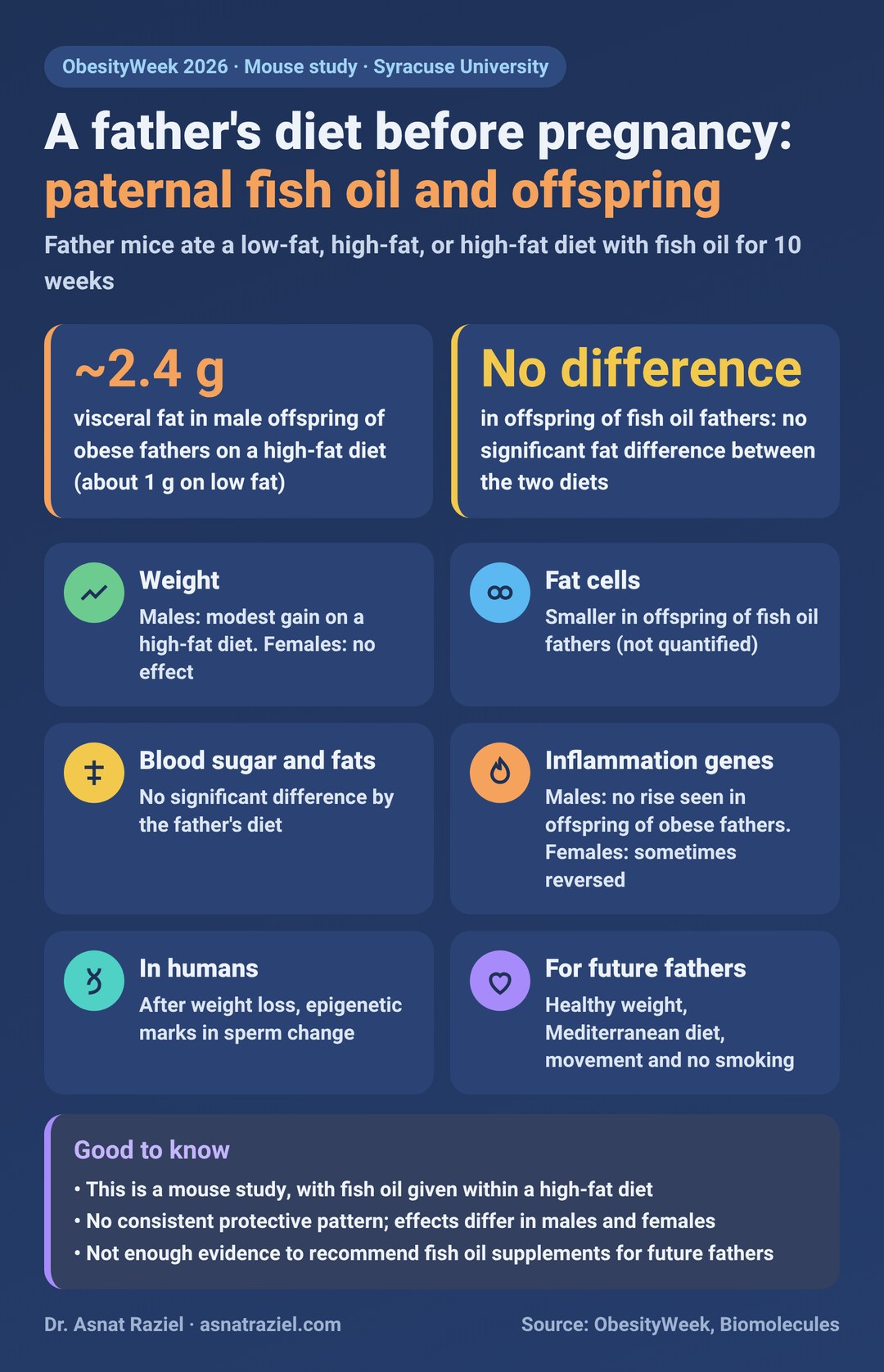
In the new study, presented by Mariana I. Pérez Lugo, the researchers went a step further. This time the offspring themselves also ate a low-fat or a high-fat diet. That created six groups, defined by the father’s diet and the offspring’s diet.
Weight and fat tissue
In male offspring of fish oil fathers, weight gain on a high-fat diet was modest. In fact, the researchers found no significant difference between them and their brothers on a low-fat diet. By contrast, no such effect appeared in females.
Fat tissue told a similar story. Look first at male offspring of lean and of obese fathers. On a high-fat diet, their visceral fat around the reproductive organs rose to about 2.0 and 2.4 grams. On a low-fat diet, it was about 1 gram. In offspring of fish oil fathers, however, the researchers found no significant difference between the two diets, in males or females.
Blood sugar, blood fats and inflammation
The glucose tolerance test was not affected by the father’s diet. Levels of adiponectin, triglycerides and free fatty acids also did not change significantly. Gene activity told a similar story. Male offspring of obese fathers on a high-fat diet showed the highest expression of inflammation genes and of fat production and uptake genes. In offspring of fish oil fathers, this rise did not appear.
However, in females the picture was different, and in some measures even reversed. For example, the inflammation gene TNF-α rose specifically in daughters of fish oil fathers. So the researchers themselves stressed that there is no consistent protective pattern.
A father’s diet before pregnancy: what the study cannot tell us yet
These findings need careful reading. First, this is a mouse study. The researchers gave fish oil as part of a high-fat diet. Second, the number of animals per group was not shown. Also, the fat cell analysis was not quantified. In addition, a study with six groups and many measures raises the chance of chance findings. Finally, gene expression does not necessarily reflect actual metabolic activity. As a next step, the researchers plan to examine the epigenetic marks in the sperm itself.
Omega-3 and men’s health: what we know in humans
No human study has yet tested fish oil in future fathers and followed their children’s health. However, there are data on men’s own reproductive health. A Danish study of 1,679 young men found a link between taking fish oil and better testicular function. Men who took fish oil for at least 60 days had 0.64 ml higher semen volume. Their testicular volume was 1.5 ml larger. However, this is an observational study, so it shows an association, not cause and effect.
At the same time, fish oil supplements do not always deliver on their promise. So it is better to build a good diet first, rather than rely on a capsule.
A father’s diet before pregnancy: what you can do today
The good news is that sperm respond to change. So a man planning to become a father can act now, months before conception:
Lose weight if you have obesity: the Danish study showed that sperm "update" after weight loss.
Eat a Mediterranean diet: fish, vegetables, legumes and olive oil, with less processed food and saturated fat.
Keep blood sugar in check: diabetes and high blood sugar are on the list of paternal risk factors.
Quit smoking and move regularly: two simple steps that improve overall metabolic health.
Plan together: couples planning a pregnancy while on weight-loss medication should also review the guidance on incretins and pregnancy with their doctor.
Further reading: fish oil and brain health and weight loss drugs and pregnancy.
Bottom line on a father’s diet before pregnancy
A father’s diet before pregnancy is a promising field of research. The new mouse study offers a hint. Fish oil in the father may soften some of the effect of a high-fat diet on offspring, mainly in males. However, the findings are inconsistent. There is not enough evidence to recommend fish oil supplements for future fathers. In the end, the child’s own diet remains the most important factor. Luckily, the best advice for future fathers is already available. Keep a healthy weight, eat a Mediterranean diet and move regularly.
This article is general information and does not replace personal medical advice.
References
Fish Oil Improves Offspring Metabolic Health of Paternal Obese Mice by Targeting Adipose Tissue
Obesity and Bariatric Surgery Drive Epigenetic Variation of Spermatozoa in Humans
Paternal metabolic and cardiovascular programming of their offspring: A systematic scoping review
Associations of Fish Oil Supplement Use With Testicular Function in Young Men