By Dr. Asnat Raziel, bariatric surgeon specializing in obesity treatment, metabolic health and healthy longevity; Director of the Multidisciplinary Center for Obesity Treatment, Assia Medical, Assuta Ramat HaChayal, Tel Aviv
Wegovy for heart failure: what the new trial found
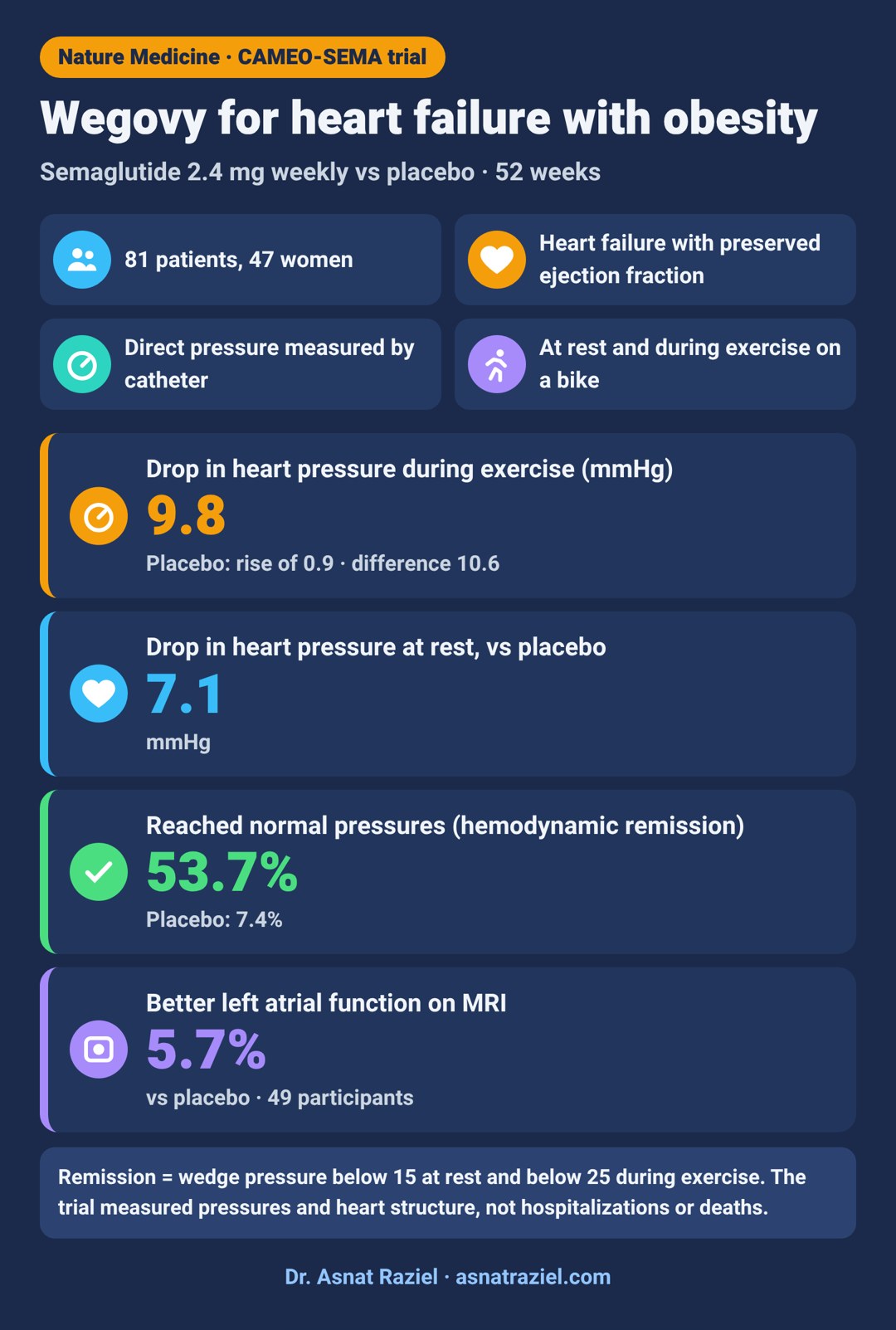
Wegovy for heart failure with obesity lowered the pressure inside the heart, not just how patients felt. In a new controlled trial, more than half of the patients on the drug reached normal heart pressures, both at rest and during exercise. In contrast, only 7.4% of the placebo group did. The researchers call this “hemodynamic remission” – a remission of the pressure measures of the disease.
What is heart failure with preserved ejection fraction?
Doctors call heart failure with preserved ejection fraction HFpEF. In this condition the heart squeezes well, but it is stiff and fills poorly. As a result, pressure builds up inside it, especially during exertion. Patients know the symptoms well: shortness of breath on the stairs, fatigue and swollen legs.
Moreover, obesity is one of the main drivers of the disease. Belly fat and fat around the heart increase inflammation and stiffness. So for many people with HFpEF, the extra weight is part of the problem itself.
How Wegovy for heart failure was tested
The Mayo Clinic in the United States ran the trial, called CAMEO-SEMA, and the team reported it in Nature Medicine. The researchers randomly assigned 81 patients with obesity and HFpEF, 47 of them women. Some received semaglutide 2.4 mg once a week and some received placebo, for 52 weeks.
What makes this trial unique is how it measured the heart. Instead of relying on questionnaires alone, the team placed a catheter in the heart and measured pressure directly, at rest and while pedaling an exercise bike. The main measure was the pulmonary artery wedge pressure (PAWP), a direct gauge of congestion on the left side of the heart.
The results: heart pressure fell sharply
At the start, average pressure was 17.5 mmHg at rest and 31.7 mmHg during exercise. After one year, exercise pressure in the Wegovy group fell by 9.8 mmHg. Meanwhile, in the placebo group it rose by 0.9. The difference between the groups was 10.6 mmHg in favor of the drug.
In addition, resting pressure also fell, by 7.1 mmHg compared with placebo. Finally, 53.7% of patients on Wegovy reached hemodynamic remission, compared with 7.4% on placebo. The researchers defined remission as a pressure below 15 at rest and below 25 during exercise.
What the heart MRI showed
At the same time, the team released a cardiac MRI substudy of the same trial, covering 49 participants. The researchers found a 5.7% improvement in left atrial strain compared with placebo. Left ventricular filling also improved, left ventricular mass decreased and right ventricular function got better. In other words, the heart itself changed, not just the catheter numbers.
These findings add to the STEP-HFpEF trials, which showed better symptoms and longer walking distance with semaglutide.
A signal in another type of heart failure
At ObesityWeek, the Mayo Clinic also presented an observational study in heart failure with reduced ejection fraction (HFrEF). It compared 146 patients with obesity treated with semaglutide or tirzepatide with 237 similar untreated patients. After one year, left ventricular size, shape and function improved in the treated group. However, this is a congress abstract without a full paper yet, so we still need a controlled trial.
Limitations worth knowing
The trial was relatively small, with 81 participants, and lasted one year. It measured pressures and structure, not hospitalizations or deaths. Also, not every participant completed the second catheter test. Novo Nordisk supplied the drug and the placebo, and the US Department of Defense funded the study.
Wegovy for heart failure: what you can do today
First, Wegovy is approved in Israel and the United States for treating obesity. Mounjaro is also available in Israel, and in the SUMMIT trial it reduced worsening of heart failure with preserved ejection fraction. You and your cardiologist decide on treatment together, based on your other conditions and medications.
Second, a structured workup is worthwhile: an echocardiogram, an NT-proBNP blood test (a marker of strain on the heart), kidney function, blood sugar and a waist measurement. Anyone who snores or wakes up tired should also have a sleep study for sleep apnea.
Third, lifestyle remains the foundation. A low-salt Mediterranean diet, gradual walking and light strength training twice a week improve endurance. That is why, in our multidisciplinary center, a dietitian, a psychologist and an exercise trainer work alongside drug treatment. When appropriate, bariatric surgery is also an option. It is also important to stay on treatment over time, because stopping usually brings the weight back.
The bottom line
Wegovy for heart failure with obesity reduces congestion in the heart, at rest and during exercise. In more than half of patients, pressures returned to the normal range. This is an encouraging step toward treatment aimed at the root of the disease. Still, we need larger studies on hospitalizations and deaths. For people with obesity and shortness of breath on exertion, it is a good reason for a heart workup and a conversation about treatment. You may also want to read about atrial fibrillation and GLP-1 drugs.
This article is general information and does not replace personal medical advice.
References
CAMEO-SEMA – ClinicalTrials.gov NCT05371496
Health Rounds: GLP-1 drugs tied to heart improvements in patients with obesity and heart failure
Funding: Congressionally Directed Medical Research Programs of the US Department of Defense; Novo Nordisk supplied the drug and placebo. The lead investigator reports research grants and consulting for drug companies, including Novo Nordisk and Eli Lilly.