By Dr. Asnat Raziel, bariatric surgeon specializing in obesity treatment, metabolic health and healthy longevity; Director of the Multidisciplinary Center for Obesity Treatment, Assia Medical, Assuta Ramat HaChayal, Tel Aviv
Primary care and lifestyle medicine: the message from LM2026
Primary care is where health begins, not just where disease gets treated. That was the message from Dr. Kyu Rhee at LM2026, the annual conference of the American College of Lifestyle Medicine (ACLM) in Orlando. Dr. Rhee is president and CEO of the National Association of Community Health Centers (NACHC). His talk focused on one question: how do we bring lifestyle medicine to every patient, in low-income neighborhoods and remote rural towns alike?
Who is Dr. Kyu Rhee?
Dr. Rhee was born in Korea and came to the United States at age one. His mother was a nurse, and his father was an economist at the World Bank. He is trained in both internal medicine and pediatrics, and completed his residency at Cedars-Sinai in Los Angeles. He began his career as a physician at community health centers in Washington, DC, and Baltimore. Later, he held senior roles at the National Institutes of Health (NIH) and the Health Resources and Services Administration (HRSA). After that, he served as chief medical officer at IBM and at CVS Health/Aetna.
He candidly admitted that in 15- to 20-minute visits, he focused mostly on the diagnosis, the medication and numbers such as blood pressure and HbA1c (average blood sugar over the past three months). In his view, our health system focuses far too much on treating disease and far too little on prevention and wellness.
Primary care in the community: America’s health centers
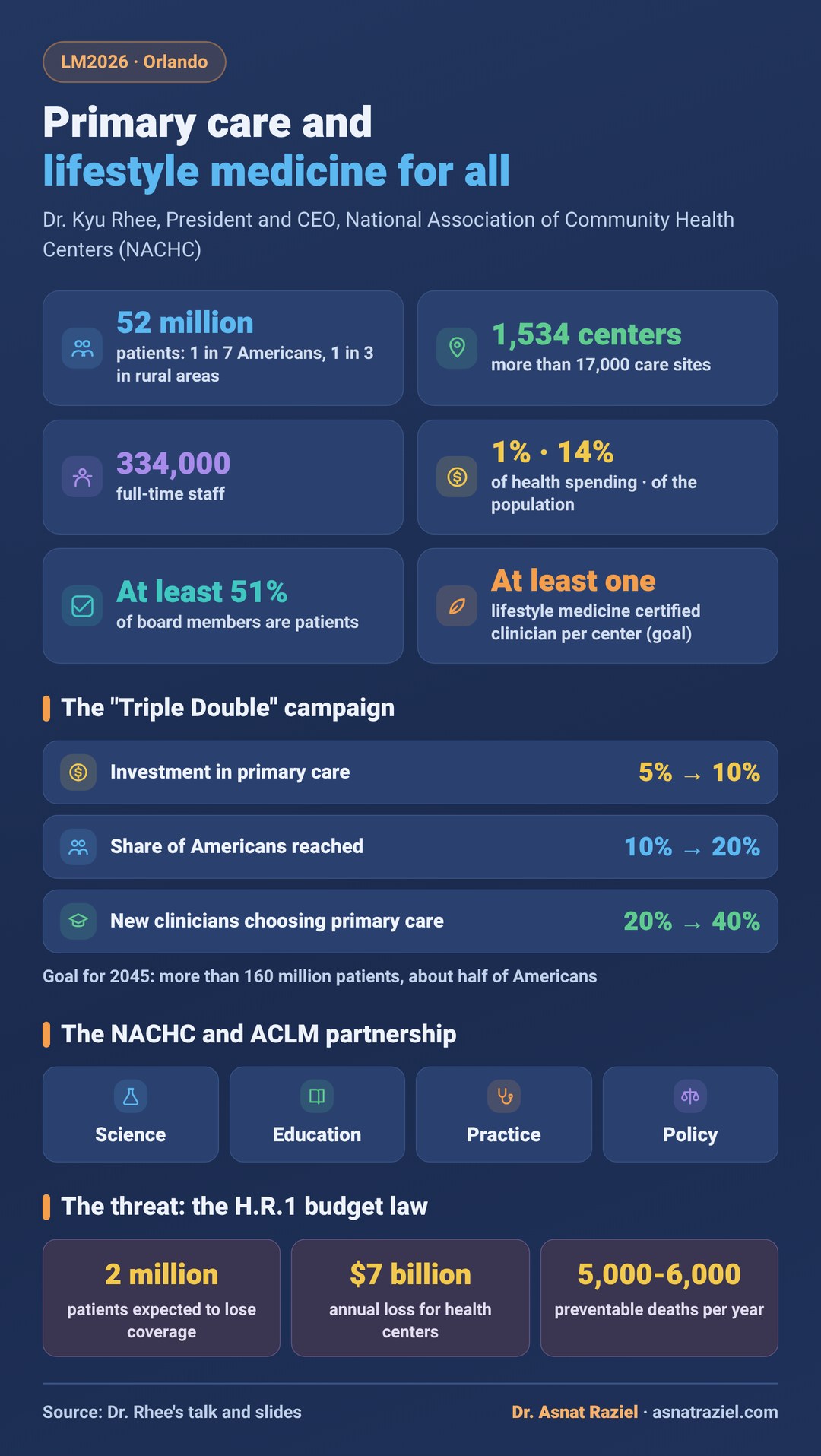
The community health center movement was born in 1965. Physicians Jack Geiger and Count Gibson opened the first centers in a public housing project in Boston and in the Mississippi Delta. Today, they form the largest primary care system in the country. According to NACHC’s figures, the centers serve 52 million patients. That is one in seven Americans, and one in three in rural areas.
Dr. Rhee shared more striking figures. There are 1,534 centers, with more than 17,000 care sites. One in four sites is in a school, and one in ten is a mobile clinic. According to Dr. Rhee, about 90% of patients live below twice the poverty line. Moreover, the centers receive only about 1% of health spending, yet serve about 14% of the population.
Patients run the center
One unique feature is community governance. At least 51% of each center’s board members are patients of that center. Dr. Rhee explained that this builds trust and keeps care tailored to the community. Patients also travel to Congress to tell lawmakers how their health center changed their lives.
A team approach to primary care
The centers employ about 334,000 full-time staff. For every physician, there are on average 1.4 nursing staff, 1.3 mental health and addiction staff and 1.3 dental staff. There are also nutrition professionals, community health workers and staff who help patients access food assistance and social services. That is why Dr. Rhee wants to train the whole team in lifestyle medicine, not just the physicians.
One goal he set out is especially simple: at least one board-certified lifestyle medicine clinician in each of the 1,534 centers. The average center runs a $40 million budget, employs 300 people and cares for about 30,000 patients. This is exactly the whole-person approach of the six pillars: nutrition, physical activity, sleep, stress management, social connection and avoiding risky substances.
A new partnership for primary care and lifestyle medicine
NACHC and ACLM recently launched a formal partnership. Dr. Rhee described it along four tracks: science, education, practice and policy. First, a national assessment will map what health centers already do in this area. Second, scholarships will train health center clinicians in lifestyle medicine. According to his slides, ACLM has already invested more than $600,000 in this training.
Third, the partners will develop practical toolkits, including for shared medical appointments. These toolkits will be adapted for language, culture and place, from Nome, Alaska, to San Juan, Puerto Rico. In addition, NACHC is building a Food for Health initiative with Abbott, which includes a national certification for health centers. Dr. Rhee also floated the idea of a voluntary lifestyle medicine certification with three levels: bronze, silver and gold.
From schools to homes
Asked about school-based clinics, Dr. Rhee suggested a joint toolkit with the School-Based Health Alliance. In his view, the six pillars should be taught starting in elementary school. That way, children bring healthy habits home to their parents and grandparents.
Money: a threat and a hope
When Dr. Rhee visits health centers, he hears two main concerns: funding and workforce. On one hand, Congress approved $4.6 billion in health center funding this year, the largest increase in a decade. In addition, teaching health centers that train young physicians will receive $1.2 billion over several years. On the other hand, the H.R.1 budget law threatens the centers. By his estimate, about two million current health center patients will lose their health coverage. Health centers could lose about $7 billion a year, and according to his slides, about 34,000 jobs could disappear. Ultimately, he estimated 5,000 to 6,000 preventable deaths every year.
So how do you persuade decision-makers? In his view, numbers alone are not enough. Every statistic needs a human story behind it. In addition, a proposal needs solid data and a clear price tag. Congress sees about 10,000 bills a year, but only 20 to 30 of them pass.
Primary care goals: the Triple Double campaign
Finally, Dr. Rhee presented the Triple Double campaign, a basketball term, which NACHC leads together with the American Academy of Family Physicians. In the United States, only about 5% of health spending goes to primary care. Also, one in three Americans does not have a regular primary care clinician. The campaign therefore sets three goals:
- Double the investment in primary care, from 5% to 10% of health spending.
- Double the reach of primary care, from 10% to 20% of Americans, starting with health centers.
- Double the next generation, from 20% to 40% of new clinicians choosing primary care.
The long-term goal is even bigger. By 2045, NACHC wants health centers to serve more than 160 million patients, or about half of all Americans.
AI as part of the care team
At the end, the audience asked Dr. Rhee about technology. He believes AI could handle screenings, documentation and routine tasks, and support patients between visits. In the future, a clinician might care for 3,000 patients instead of 2,000, but he stressed that we are not there yet. He also called for AI systems to be safe, fair and transparent, with a “nutrition label” that shows what data they learned from. Clinicians must also have a seat at the table, so technology serves low-income and rural communities too.
What this means for patients in Israel
This talk connects to the opening keynote, which I covered in Lifestyle medicine: from movement to standard of care. Lifestyle medicine cannot remain a private service for the few. Its natural home is the neighborhood clinic, the health plan and the school.
At our multidisciplinary center, patients work with a dietitian and, when needed, with a mind-body team. Still, the greatest impact happens in the community, close to home. People living with type 2 diabetes can even reach remission through supported lifestyle change. To learn more, see my guide to obesity and type 2 diabetes.
Bottom line
Dr. Kyu Rhee’s message is simple: strong primary care is the foundation for lifestyle medicine for all. The partnership between community health centers and ACLM could bring the six pillars to millions of patients. Keep in mind that most figures in the talk are US data and the organizations’ own numbers, not results of controlled trials.
This article provides general information and is not personal medical advice. Please consult your physician before making any change to your treatment.
References
Lifestyle Medicine 2026 Online
PrimaryCare26 Introduces Triple Double Campaign to Strengthen Investment, Access and Workforce
Advancing Whole-person Care: NACHC and ACLM’s Growing Collaboration to Transform Community Health
The Triple Double: Investment. Access. Workforce. – Primary Care for America