By Dr. Asnat Raziel, bariatric surgeon specializing in obesity treatment, metabolic health and healthy longevity; Director of the Multidisciplinary Center for Obesity Treatment, Assia Medical, Assuta Ramat HaChayal, Tel Aviv
Eloralintide in diabetes: what was presented at ObesityWeek
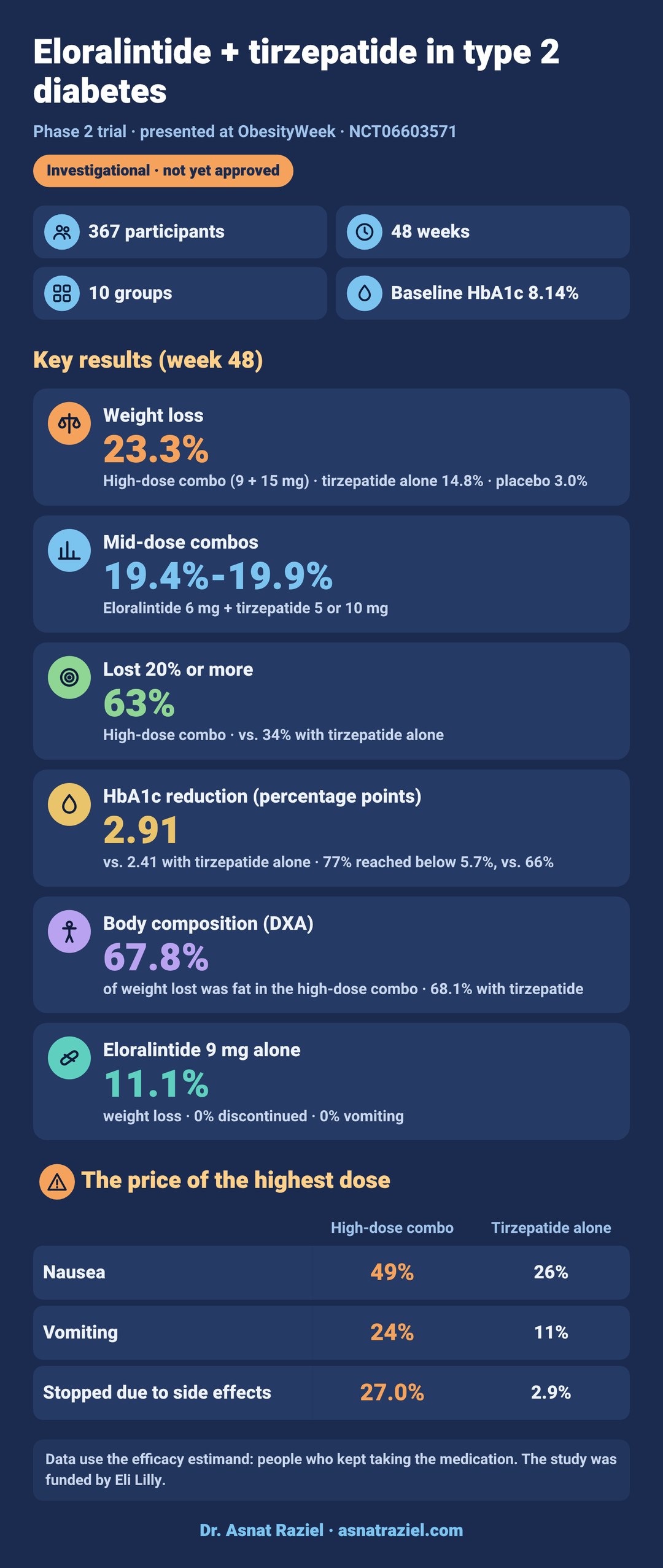
Eloralintide in diabetes, combined with tirzepatide, led to weight loss of up to 23.3% over 48 weeks in people with type 2 diabetes. That is the largest weight loss reported so far with medication in type 2 diabetes. At the recent ObesityWeek conference in the United States, four investigators presented the full trial data. However, the complete results show that the highest dose is not necessarily the best one.
I have already written about the first results of the eloralintide and tirzepatide combination. This time I focus on what only the full session revealed: body composition, quality of life, heart rate and side effects.
Why weight loss is harder with type 2 diabetes
People with type 2 diabetes lose less weight on the same medications. For example, in obesity without diabetes, incretin-based drugs lead to weight loss of 20% or more. In type 2 diabetes, by contrast, high-dose semaglutide lowered weight by 14.1% in the STEP UP T2D trial. Similarly, tirzepatide 15 mg lowered weight by 15.7% in SURMOUNT-2, after 72 weeks. That is why researchers are looking for a way past this ceiling.
What eloralintide is and how it works
Eloralintide is an investigational once-weekly injection from Eli Lilly. It mimics amylin, a hormone the pancreas releases together with insulin. Amylin increases fullness, slows stomach emptying and suppresses glucagon release. I explain more in my article on amylin and obesity.
Tirzepatide, known as Mounjaro, acts on two other hormones: GLP-1 and GIP. In other words, the combination works on three hunger and fullness pathways at once. In an earlier study published in The Lancet, in people without diabetes, eloralintide alone lowered weight by 9.5% to 20.1% after 48 weeks.
Eloralintide in diabetes: how the trial was designed
This was a randomized, double-blind, placebo-controlled phase 2 trial. It enrolled 367 adults with type 2 diabetes and obesity or overweight. The researchers split them into 10 equal groups, and treatment lasted 48 weeks. At the start, average weight was 105.4 kg and average HbA1c was 8.14%. HbA1c reflects average blood sugar over the previous three months.
The groups included placebo, eloralintide alone (3, 6 or 9 mg), tirzepatide 15 mg alone and four combinations. In addition, one group added eloralintide only from week 24, in people already taking tirzepatide 15 mg. In that group, the dose rose from 3 mg to only 6 mg.
Eloralintide in diabetes: the weight results
The high-dose combination, eloralintide 9 mg with tirzepatide 15 mg, lowered weight by 23.3%. By comparison, tirzepatide alone lowered weight by 14.8%, and placebo by 3.0%. Waist size dropped by 18.2 cm with the high-dose combination, compared with 11.6 cm with tirzepatide alone.
The middle combinations also performed strongly. Eloralintide 6 mg with tirzepatide 5 mg lowered weight by 19.4%, and with tirzepatide 10 mg by 19.9%. The low-dose combination lowered weight by 13.2%. Meanwhile, eloralintide alone lowered weight by 8.2%, 12.3% and 11.1% at 3, 6 and 9 mg. So 9 mg on its own did no better than 6 mg.
In the late add-on group, weight loss reached 20.6%. What is more, the pace of weight loss in this group sped up after week 24. In most combination groups, the weight curve had not yet leveled off at week 48.
With the high-dose combination, 63% of participants lost 20% or more, compared with 34% on tirzepatide alone. A quarter of participants (25%) lost 30% or more, compared with 12% on tirzepatide alone. Keep in mind that the data are reported using the efficacy estimand, a method that estimates the drug’s effect in people who actually kept taking it.
What happened to fat and muscle
In a substudy of 320 participants, the researchers measured body composition with DXA scans. In most groups, about two thirds of the weight lost came from fat. For example, with the high-dose combination, fat mass fell by 38.2% and lean mass by 14.1%. So 67.8% of the loss came from fat, similar to 68.1% with tirzepatide alone.
In the late add-on group, however, only 60.2% of the loss came from fat. This group also had the largest drop in lean mass, 16.6%. The presenters offered no explanation for this finding. Either way, it is a reminder of how important protein and strength training are during drug treatment.
Blood sugar control: a ceiling effect
With the high-dose combination, HbA1c fell by 2.91 percentage points. With tirzepatide alone, it fell by 2.41 points. In other words, the extra benefit was small, about half a percentage point. The reason is simple: 96% of people on tirzepatide alone already reached an HbA1c below 7%.
The difference stood out mainly at a stricter target, an HbA1c below 5.7%, which is the normal range. With the high-dose combination, 77% reached it, compared with 66% on tirzepatide alone. In addition, in the combination groups and on tirzepatide alone, home glucose readings showed no hypoglycemia, meaning a dangerous drop in blood sugar.
Eloralintide in diabetes: the price of the highest dose
Here comes the important part. With the high-dose combination, 49% of participants reported nausea and 24% reported vomiting. On tirzepatide alone, by contrast, 26% reported nausea and 11% vomiting. Moreover, 27.0% stopped treatment because of side effects, compared with 2.9% on tirzepatide alone. In the end, only 59.5% of participants in this group completed treatment.
Quality of life did not improve in this group either. On the SF-36 questionnaire, which measures physical function and quality of life, the improvement was only +0.1 points. For comparison, a clinically meaningful improvement starts at 3 to 5 points.
The eloralintide 6 mg plus tirzepatide 10 mg combination, on the other hand, lowered weight by 19.9%. In that group, 10.8% stopped because of side effects, and 11% reported vomiting. Physical function improved by 3.2 points. So the highest dose added about 4 percentage points of weight loss, but at a heavy price.
And what about eloralintide alone? At 9 mg it lowered weight by 11.1%. No one in this group stopped because of side effects, and no one reported vomiting. So it may have a place as a stand-alone treatment, for example for people who struggle with GLP-1 drugs.
Heart rate, blood pressure and fatigue
Tirzepatide alone raised heart rate by 4 to 6 beats per minute. Eloralintide alone, by contrast, lowered it by about 3 beats. In most combination groups, heart rate did not change meaningfully. For this reason, the trial excluded people with a resting heart rate below 60 or above 100.
In addition, systolic blood pressure fell by 2.1 to 6.4 mmHg in the combination groups, and by 11.1 mmHg in the late add-on group. On the other hand, 18.9% of participants on the high-dose combination reported low blood pressure, a drop in blood pressure on standing, or fainting. With placebo the rate was 2.8%. Fatigue appeared mostly early in treatment. With eloralintide and the combinations, it also reached moderate and severe levels.
Other findings worth knowing
In the low-dose combination group, 4 participants (11.1%) reported mood-related events, including one case of suicidal thoughts. No such events occurred in the other combination groups. In addition, the investigators reported two cases of acute pancreatitis, which led to stopping treatment.
Another interesting finding: some participants stopped treatment because their appetite or weight dropped more than they wanted. Dr. Ania Jastreboff noted that this is a new phenomenon that deserves attention.
Limitations of the trial on eloralintide in diabetes
First, this is a small phase 2 trial, with about 36 participants per group. As a result, single events change the rates a lot. Second, the main analysis covers only people who stayed on treatment. An analysis of all participants, which better reflects real life, was not presented.
In addition, follow-up lasted only 48 weeks. There are no data yet on keeping the weight off over time, or on heart events. Finally, Eli Lilly funded the trial, and the presenters are the trial’s investigators. The data were presented at a conference and have not yet been published in a peer-reviewed paper.
What you can do today
Eloralintide is not yet approved. Phase 3 trials, ENLIGHTEN and AMPLIFY, are expected to run until 2029. So there is no reason to wait for it. Today, tirzepatide and other medications already lower weight substantially and improve blood sugar.
In addition, focus on protein, strength training and close medical follow-up. Above all, the goal is a treatment you can stay on for the long term. I cover this in my article on continuing obesity treatment. You may also want to read about the drug’s effect on food noise and about other amylin-based drugs.
Bottom line: eloralintide in diabetes
The eloralintide and tirzepatide combination broke through the 15% ceiling in type 2 diabetes. However, the highest dose brought frequent nausea and led more than a quarter of participants to stop treatment. The middle combinations achieved about 19.5% weight loss, with much better tolerability and improved quality of life. Ultimately, the right dose is the one a person can stay on.
This article is general information and is not a substitute for personal medical advice.
References
Eloralintide Plus Tirzepatide, ObesityWeek 2026
The studies were funded by Eli Lilly, which makes both drugs.