By Dr. Asnat Raziel, bariatric surgeon specializing in obesity treatment, metabolic health and healthy longevity; Director of the Multidisciplinary Center for Obesity Treatment, Assia Medical, Assuta Ramat HaChayal, Tel Aviv
Who can take Mounjaro: the short answer
Who can take Mounjaro? It’s one of the questions I hear most often in my clinic. Mounjaro is a once-weekly injection of tirzepatide, and it is mainly intended for adults with obesity, or with overweight plus a weight-related condition. It is also approved for type 2 diabetes. However, there are situations where it isn’t the right choice, so the decision calls for a proper medical assessment.
What Mounjaro is and how it works
Tirzepatide mimics two natural gut hormones: GLP-1 and GIP. Both are released after a meal and signal fullness to the brain. As a result, appetite drops, “food noise” quiets down and eating becomes more balanced. In addition, the drug improves blood sugar control. You’ll find a broad scientific overview in the Wikipedia article on tirzepatide, and a practical guide in my article on starting treatment with Mounjaro.
Approved indications: who can take Mounjaro according to the label
According to the European product information for Mounjaro (EMA), it has two main indications:
- Obesity treatment in adults: a BMI of 30 or more, or a BMI of 27 to 30 with at least one related condition.
- Related conditions include high blood pressure, high blood lipids, sleep apnea, heart disease, prediabetes or type 2 diabetes.
- Poorly controlled type 2 diabetes, in adults and in children aged 10 and older, as an addition to diet and exercise.
BMI, or body mass index, is weight in kilograms divided by height in meters squared. It’s also worth knowing that in the United States the same drug is sold under two names. There, Mounjaro is approved for diabetes, while Zepbound is approved for obesity and for moderate to severe obstructive sleep apnea in adults with obesity. In addition, in August 2026 the FDA approved Mounjaro to lower the risk of major cardiovascular events in adults with type 2 diabetes who are at high risk.
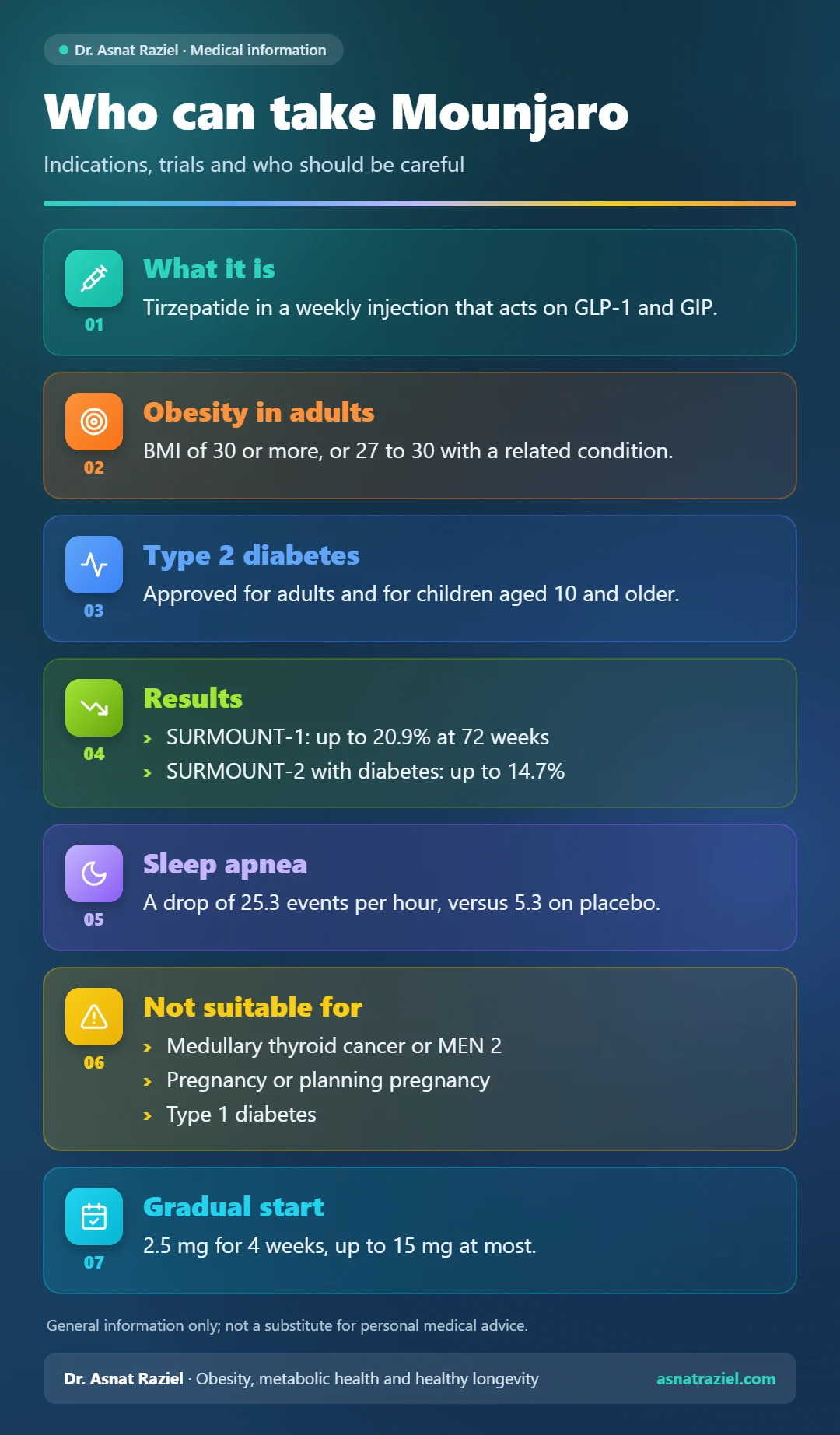
Who can take Mounjaro: what the trials showed
Obesity without diabetes
The SURMOUNT-1 trial enrolled 2,539 adults with obesity. After 72 weeks, average weight loss was 15.0% on 5 mg, 19.5% on 10 mg and 20.9% on 15 mg. In the placebo group, weight loss was only 3.1%. What’s more, 50% to 57% of patients on the 10 mg and 15 mg doses lost 20% or more of their body weight.
Obesity with type 2 diabetes
In the SURMOUNT-2 trial, in people with obesity and type 2 diabetes, weight loss was 12.8% on 10 mg and 14.7% on 15 mg, compared with 3.2% on placebo. In other words, the drug works in diabetes too, although the weight loss is slightly more modest.
Sleep apnea
The SURMOUNT-OSA trial included adults with obesity and moderate to severe sleep apnea. Among those not using a breathing device, breathing pauses fell by 25.3 events per hour, compared with 5.3 on placebo. I’ve written about this in my article on Mounjaro and sleep apnea.
Who can take Mounjaro and benefit most
In my clinic, I think of Mounjaro mainly in these situations:
- Obesity with metabolic disease, such as prediabetes, type 2 diabetes or fatty liver.
- Obesity with sleep apnea.
- People who need substantial weight loss and haven’t reached their goal with other treatments.
- People who prefer one injection a week over a daily pill.
On the other hand, choosing between Mounjaro and Wegovy also depends on heart protection, side effects and cost. You’ll find a head-to-head comparison in my article on the SHAPE study.
Who can take Mounjaro and who should not
There are situations in which the drug should not be used, or calls for great caution:
- A personal or family history of medullary thyroid cancer, or MEN 2 syndrome.
- A known allergy to tirzepatide.
- Pregnancy, or planning a pregnancy soon.
- Type 1 diabetes, which is not an indication for this drug.
- Past pancreatitis, which calls for an especially careful assessment.
There’s also a point many women don’t know about. According to the US label, tirzepatide may reduce the effectiveness of birth control pills. That’s why the advice is to switch to a non-pill method, or to add a barrier method, for 4 weeks after starting and after each dose increase. I’ve written about pregnancy and medication in my article on stopping weight-loss drugs before pregnancy.
How treatment starts
Treatment starts at 2.5 mg once a week for 4 weeks. This is an adjustment dose only. After that, the dose goes up to 5 mg and then rises gradually in steps of 2.5 mg, with at least 4 weeks at each step. Maintenance doses are 5, 10 or 15 mg, and the maximum dose is 15 mg.
The injection goes under the skin on the same day each week. You can inject into the abdomen, thigh or upper arm. It’s also important to combine treatment with a diet that has enough protein and with strength training, to preserve muscle mass. During treatment we meet for follow-up, check weight, health markers and side effects, and decide on the dose together.
And what about cost? All four of Israel’s health funds (HMOs), Clalit, Maccabi, Leumit and Meuhedet, offer Mounjaro and Wegovy through their supplementary insurance plans, at about half the market price or less, depending on the fund and the dose. Up-to-date prices are posted on the health funds’ websites. You’ll find more details in my article on Mounjaro in Israel.
The common side effects are nausea, diarrhea, constipation and vomiting. They are usually mild to moderate and mostly appear after a dose increase. In SURMOUNT-1, only 4.3% to 7.1% of patients stopped treatment because of them. For coping tips, see my guide to Mounjaro side effects. If you’re curious about what comes next, you can read about eloralintide and Mounjaro, a combination that is still being studied.
Bottom line
Mounjaro is mainly suited to adults with obesity, or with overweight plus a related condition, and also to people with type 2 diabetes. It is one of the most effective drugs available today, but it isn’t right for everyone. That’s why it’s important to review underlying conditions, pregnancy plans and other medications before you start.
The information in this article is general and does not replace personal medical advice.
Questions and answers
Who can take Mounjaro without diabetes?
Adults with a BMI of 30 or more, or 27 or more with a related condition such as high blood pressure or sleep apnea.
Can teenagers take Mounjaro?
According to the European label, the drug is approved for obesity treatment in adults only. For type 2 diabetes, it is approved from age 10.
How long does it take to see results?
Weight loss usually begins in the first few weeks, but the peak comes after many months on the maintenance dose.
What happens if you stop?
Many people regain some of the weight. That’s why it’s best to plan stopping with your doctor and to keep up healthy eating and activity habits.
Sources
Tirzepatide Once Weekly for the Treatment of Obesity
Mounjaro – EPAR – European Medicines Agency
Tirzepatide once weekly for the treatment of obesity in people with type 2 diabetes (SURMOUNT-2)
Zepbound (tirzepatide) Prescribing Information – FDA
Tirzepatide for the Treatment of Obstructive Sleep Apnea and Obesity
FDA approves Lilly’s Mounjaro (tirzepatide) to reduce cardiovascular risk – Eli Lilly




