By Dr. Asnat Raziel, bariatric surgeon specializing in obesity treatment, metabolic health and healthy longevity; Director of the Multidisciplinary Center for Obesity Treatment, Assia Medical, Assuta Ramat HaChayal, Tel Aviv
Knee osteoarthritis: more options than you think
Knee osteoarthritis is one of the leading causes of pain and disability after age 50. Many people are convinced the only path is painkillers, injections and finally joint replacement. In his keynote at the LM2026 Lifestyle Medicine Conference in Orlando, Dr. Michael Greger presented a different picture. He said diet, weight loss and movement are treatments with good evidence that do not always get their place. In this article I checked the studies at the source.
Weight loss as treatment
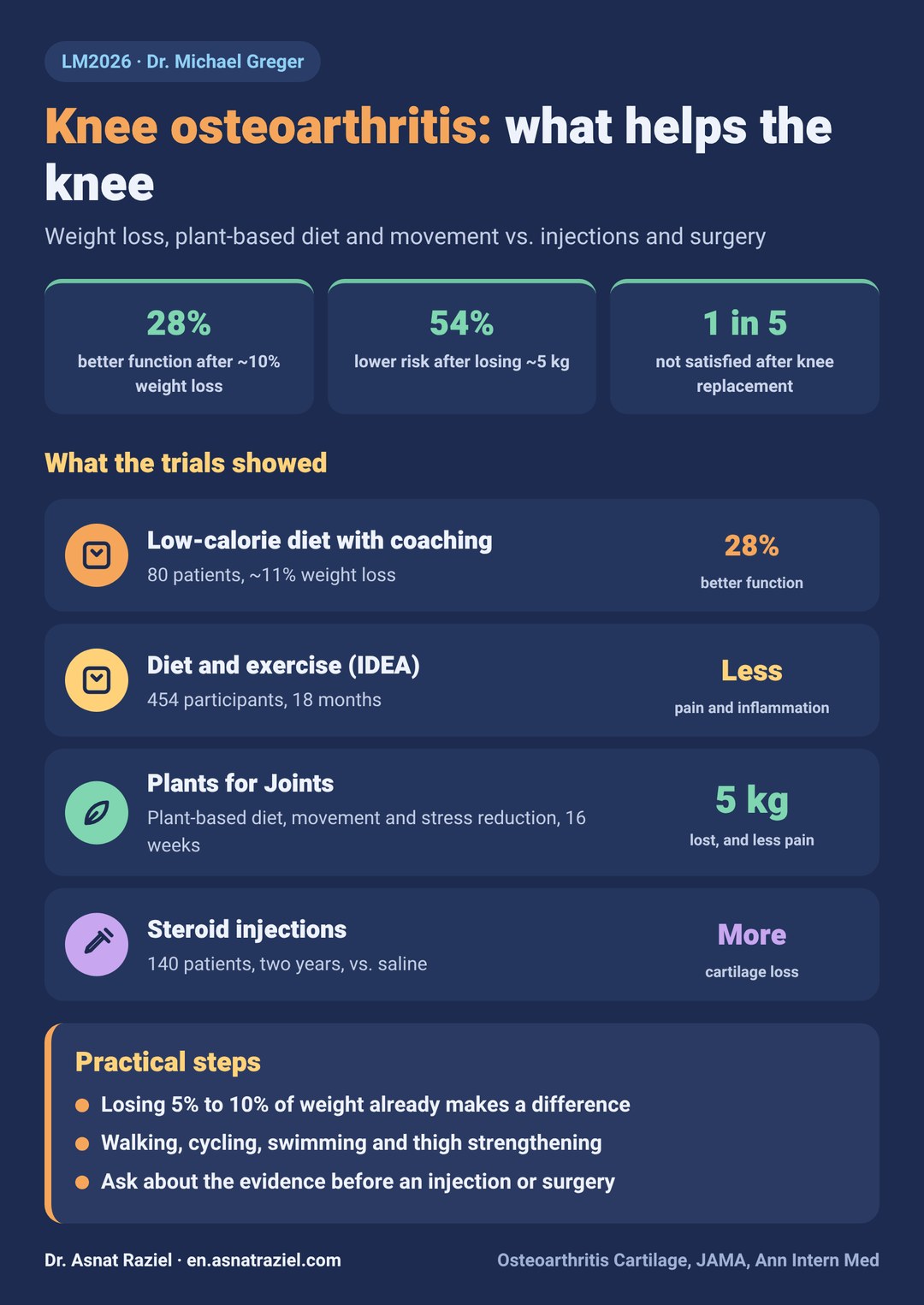
First, every extra kilogram adds load on the knee with each step. A controlled trial from Denmark included 80 patients with knee osteoarthritis and obesity. For example, one group got a low-calorie diet with weekly coaching. The other got an information booklet. In the coached group, participants lost about 11% of their weight. Their function improved by about 28%. The researchers calculated that treating three and a half patients is enough for one to improve by at least half.
The IDEA trial, published in JAMA, included 454 adults with overweight and knee osteoarthritis, for 18 months. Diet combined with exercise led to an average weight loss of about 11%. People in this group had less pain, better function and lower levels of the inflammatory marker IL-6, compared with exercise alone.
Preventing knee osteoarthritis
Moreover, weight loss may also prevent the disease. In the Framingham study, women who lost about 5 kg over ten years cut their risk of symptomatic knee osteoarthritis by more than half. This is an observational study, but it fits well with the trial results.
Knee osteoarthritis and a plant-based diet
Greger stressed that the type of food matters, not just the amount. In a small trial from Michigan, 40 patients switched to a whole-food, plant-based diet or kept their usual diet. As a result, within six weeks, pain, energy and function improved in the plant-based group.
The Dutch Plants for Joints trial took this further. Sixty-six patients with knee or hip osteoarthritis and metabolic syndrome joined a 16-week program: a plant-based diet, physical activity and stress reduction. Compared with usual care, pain and function improved. Participants also lost about 5 kg. Glucose, cholesterol and inflammatory markers also improved. According to Greger, in the follow-up year many participants reduced or stopped painkillers. This menu is very close to the Mediterranean diet I recommend.
What about steroid injections?
Meanwhile, steroid injections into the knee are very common, and Greger criticized them sharply. In a controlled trial in JAMA, 140 patients received a steroid or saline injection every three months for two years. Patients in the steroid group lost more cartilage. Their pain did not improve more than with saline. He added that arthroscopic surgery for knee osteoarthritis has not shown long-term benefit either.
Similarly, knee replacement also has its limits. A survey of 1,703 operations in Canada found that about one in five patients was not satisfied with the result. The operation helps many people, but it is worth trying conservative treatment first.
Dr. Greger explains: an alternative to knee replacement
Knee osteoarthritis: practical steps
Lose a little weight: just 5% to 10% of body weight already improves pain and function. If losing weight alone is hard, there are now ways to lose weight without losing muscle.
Add movement: walking, cycling, swimming and thigh strengthening protect the knee. See also building muscle after 60.
Base your menu on plants: vegetables, fruit, legumes and whole grains, with little processed food.
Ask before an injection or surgery: what is the expected benefit, what are the risks and what are the alternatives.
For more foods tested against pain, read the article on Dr. Greger’s keynote.
Bottom line
The evidence shows that weight loss, movement and a plant-based diet improve pain and function in knee osteoarthritis, sometimes more than injections and surgery. In the end, knee osteoarthritis is not a life sentence. Lifestyle change is a central part of treating it. Decide on every treatment together with your doctor.
This article provides general information and is not personal medical advice. Do not stop or change medication without consulting your physician.
References
Weight loss: the treatment of choice for knee osteoarthritis? A randomized trial
Weight loss reduces the risk for symptomatic knee osteoarthritis in women. The Framingham Study
Whole-foods, plant-based diet alleviates the symptoms of osteoarthritis
Patient satisfaction after total knee arthroplasty: who is satisfied and who is not?
Friday Favorites: The Best Knee Replacement Alternative for Osteoarthritis Treatment