By Dr. Asnat Raziel, bariatric surgeon specializing in obesity treatment, metabolic health and healthy longevity; Director of the Multidisciplinary Center for Obesity Treatment, Assia Medical, Assuta Ramat HaChayal, Tel Aviv
Switching from Wegovy to Mounjaro without losing ground
Switching from Wegovy to Mounjaro is one of the most common changes in obesity medication. Until now, the usual rule of thumb has been to start the new drug at its lowest dose. However, a new expert paper from Israel proposes a different approach. In many cases, the authors say, you can choose a starting dose that roughly matches the effect of the previous dose, and so limit weight regain.
The new review was published in Expert Opinion on Pharmacotherapy by Israeli pharmacists and physicians. The authors come from Ben-Gurion University, Clalit Health Services, Maccabi Healthcare Services, the Hebrew University and Rabin Medical Center (Beilinson). They built a practical framework: an approximate dose table and a five-step decision algorithm. The framework also works in the opposite direction, from Mounjaro to Wegovy.
Two drugs, two mechanisms
Wegovy and Ozempic contain semaglutide. Semaglutide acts on one receptor, the receptor for GLP-1. GLP-1 is a gut hormone that increases fullness and helps balance blood sugar. Mounjaro, by contrast, contains tirzepatide, which acts on two receptors: GLP-1 and GIP. GIP is another gut hormone, and it affects insulin release and fat tissue.
That is why you can’t simply convert milligram for milligram. For example, at the GLP-1 receptor itself, tirzepatide is about 13 times weaker than semaglutide. Even so, on average it leads to greater weight loss. To understand the differences between the two drugs, you can also read my article on Mounjaro vs. Wegovy.
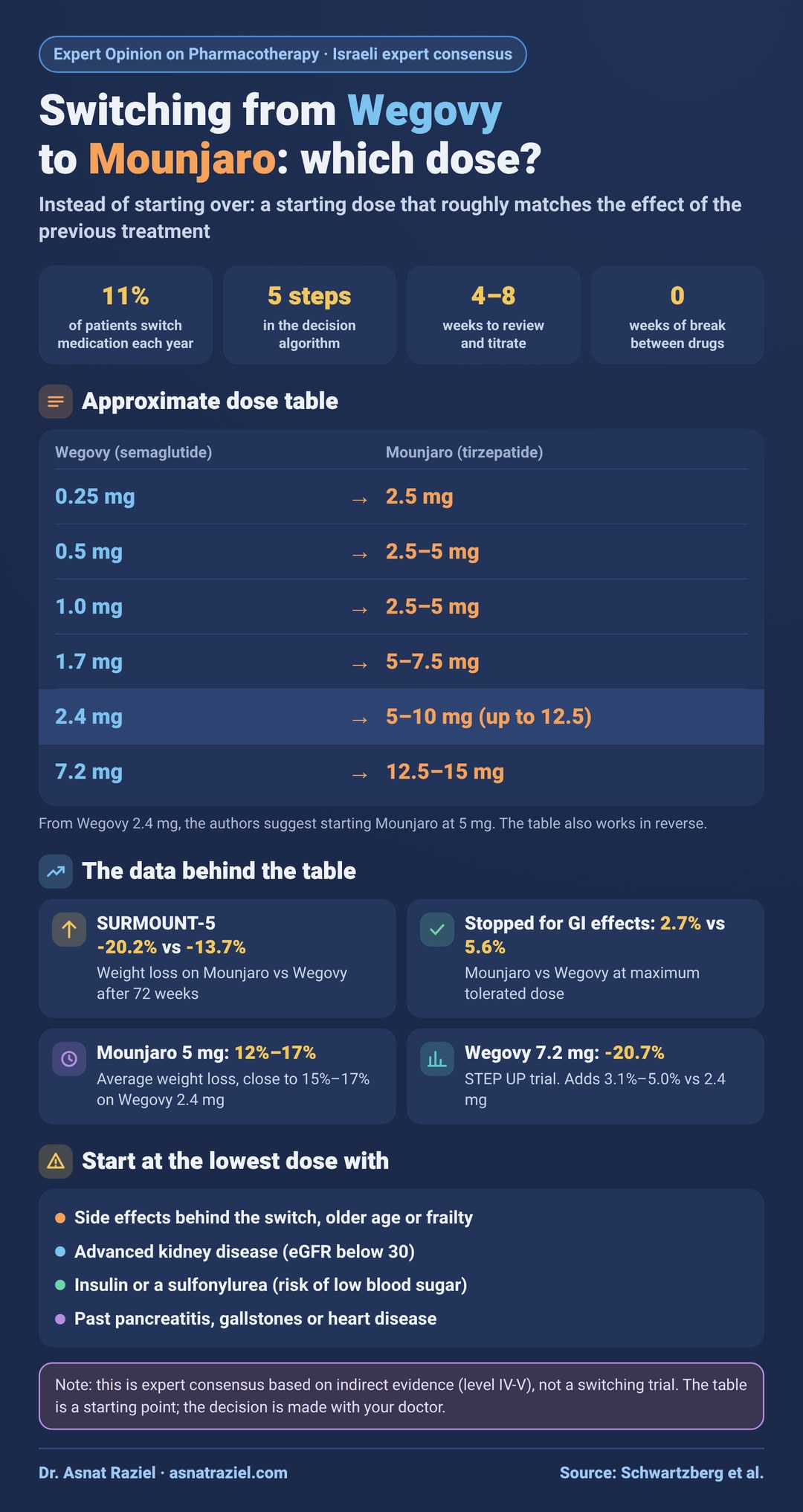
In the SURMOUNT-5 trial, researchers compared the two drugs head to head in people with obesity without diabetes. After 72 weeks, the Mounjaro group lost an average of 20.2% of body weight, compared with 13.7% in the Wegovy group. In addition, only 2.7% stopped Mounjaro because of digestive side effects, compared with 5.6% on Wegovy.
Why patients switch
According to the paper, about 11% of patients switch medication each year. Medical reasons include too little weight loss, a weight plateau at the top dose and digestive side effects. A new health condition may also favor a different drug. For example, sleep apnea or high blood pressure tips the balance toward tirzepatide. On the other hand, established heart disease tips it toward semaglutide, which has proven heart protection.
There are also non-medical reasons: cost, insurance changes, drug shortages and a personal preference for a type of pen. In the US, for instance, a formulary change at CVS early this year led to a 16-fold rise in switches between GLP-1 medications.
The problem: a treatment gap when you start over
Neither drug’s official label includes guidance on switching between them. The reason is not a known danger. Simply put, the companies never ran switching trials for regulators. So a rule of thumb took hold: start the new drug at the lowest dose, like a brand-new patient.
But this approach has a cost. Say a patient was on Wegovy 2.4 mg and switches to Mounjaro 2.5 mg. In practice, she starts on a weak dose compared with what she had. The authors call this a therapeutic gap. During this period, appetite, some of the weight and blood sugar control may come back. On top of that, climbing back up the doses takes months and sometimes hurts adherence.
Still, it’s important to note that no study so far has shown real harm from either approach. The data on the size of the gap come from a single cohort study that lasted 12 weeks. I’ve also written about why continuous treatment matters in what happens when you stop weight loss medication.
What experts suggest when switching from Wegovy to Mounjaro
The authors gathered efficacy data from the major trials. They looked at which doses of the two drugs produce similar weight loss. From this they built approximate equivalence bands, that is, a Mounjaro dose range that roughly matches each Wegovy dose:
Wegovy 0.25 mg to Mounjaro 2.5 mg (a titration dose with no exact equivalent)
At Wegovy 0.5 mg, Mounjaro 2.5-5 mg
From Wegovy 1.0 mg, Mounjaro 2.5-5 mg
Wegovy 1.7 mg corresponds to Mounjaro 5-7.5 mg
After Wegovy 2.4 mg, Mounjaro 5-10 mg (up to 12.5 mg)
For Wegovy 7.2 mg, Mounjaro 12.5-15 mg
When switching from Wegovy 2.4 mg, the authors suggest Mounjaro 5 mg as the starting point. In studies, Mounjaro 5 mg produced average weight loss of 12%-17%. That is similar to, and slightly below, the 15%-17% seen with Wegovy 2.4 mg. In their view, this is the practical and safe balance between the risk of weight regain and the risk of nausea. From there, you continue with the usual Mounjaro dose steps.
Please note: in many countries, starting Mounjaro above 2.5 mg in such a switch is off-label use, meaning a use not listed on the official label. So the doctor should discuss it with the patient and document that conversation.
When you should still start at the lowest dose
The paper names groups who should start at the lowest dose and be followed closely, even if their previous dose was high. These include older adults and frail patients, and people with advanced kidney disease. Kidney function is measured by eGFR, the estimated glomerular filtration rate, and the cutoff here is below 30. The list also includes diabetes treated with insulin or a sulfonylurea, because of the risk of low blood sugar. It also covers a history of pancreatitis, gallstones or existing heart disease.
Anyone switching because of Wegovy side effects should also start Mounjaro at 2.5 mg. By contrast, someone who tolerated Wegovy 1.7 mg or higher for at least 12 weeks may sometimes start at 5 mg. This applies when the switch is for another reason.
Timing and follow-up after switching from Wegovy to Mounjaro
Both drugs are weekly injections. So there’s no need for a break between them. You inject the new drug the week after the last injection of the old one. Semaglutide’s half-life is about seven days, and tirzepatide’s is about five days.
After the switch, the doctor checks tolerability and the response in weight and blood sugar after 4-8 weeks. Then the dose is raised as needed. People with diabetes should monitor their blood sugar closely in the first weeks. Sometimes the dose of other diabetes medicines also needs to come down.
Weight plateau: Wegovy 7.2 mg or Mounjaro?
If your weight has stalled on Wegovy 2.4 mg, you now have two options. The first is to raise Wegovy to the 7.2 mg dose, approved in the US and Europe. In the STEP UP trial, this dose led to an average weight loss of 20.7%. According to the paper, going from 2.4 to 7.2 mg adds about 3.1% to 5.0% weight loss on average. It also keeps the same mechanism and the heart protection proven for semaglutide.
The second option is switching to Mounjaro 10-15 mg, which adds the GIP mechanism. Mounjaro 15 mg keeps a small edge in the share of patients who lose 25% of their weight or more. About 36.0% reach that on Mounjaro 15 mg, compared with 31.2%-33.2% on Wegovy 7.2 mg.
Meanwhile, if you respond well to Wegovy, you don’t need to switch. According to the paper, a rapid responder is someone who loses 5% or more of their weight by week 12-16. For such responders, the benefit of switching is likely to be modest. I’ve written about why responses differ in why the same injection works for one person but not another.
The reverse switch: from Mounjaro to Wegovy
Switching from Mounjaro to Wegovy is less common, but it happens. Reasons include cost, availability and pregnancy planning. Another important reason is semaglutide’s established heart data. In the SELECT trial, semaglutide reduced major cardiovascular events by 20% in people with obesity without diabetes.
For example, a patient on Mounjaro 10 mg can move to Wegovy 1.7-2.4 mg if they have tolerated Wegovy before. If they have never taken Wegovy, they can start at 1.0 mg and go up to 2.4 mg within 4-8 weeks. It’s worth preparing for a heavier load of nausea and digestive symptoms, and for some drop in average efficacy.
For physicians: the five-step algorithm
First, establish the reason for switching: intolerance, inadequate efficacy or a plateau, cost and availability, a comorbidity or patient choice.
Second, assess safety: frailty, advanced kidney disease, insulin or a sulfonylurea, prior pancreatitis or heart disease. If any of these is present, start at the lowest dose and monitor, regardless of the previous dose.
In step three, review the previous dose and tolerability: intolerance to semaglutide means starting tirzepatide at 2.5 mg. On the other hand, tolerating semaglutide 1.7 mg or more for at least 12 weeks allows a 5 mg start.
Fourth, identify the response pattern: a rapid responder on semaglutide gains little from switching. With a plateau on 2.4 mg, choose between escalating to 7.2 mg and switching to tirzepatide 10-15 mg.
Finally, start, monitor and titrate: assess tolerability, weight and HbA1c, the average blood sugar over the past three months, after 4-8 weeks. Document the reason for the switch and the starting dose, if it is off-label.
What to know before switching from Wegovy to Mounjaro
The choice of starting dose is a personal decision, made together with your doctor. So it helps to come to the visit with clear information: your current dose, how long you’ve been on it, your side effects and why you want to switch. Also tell your doctor about kidney disease, past pancreatitis or insulin treatment.
The paper also warns against click counting, that is, injecting an unapproved partial dose by counting pen clicks. The number of clicks varies between pens, so the dose you get is not accurate. It’s also worth knowing the common GLP-1 side effects in advance and how to manage them.
Limitations of the paper
This is a review and expert consensus, not a controlled trial. The authors did not run a statistical equivalence analysis, and the level of evidence is low (level IV-V). So the table is only a starting point, not an exact conversion. In addition, comparisons across different trials involve differences between populations.
The difference is especially clear between people with and without diabetes. In people with obesity without diabetes, tirzepatide’s weight-loss advantage is about 6.5%. In people with diabetes, the gap is smaller: only about 2%-5%. The authors call for controlled switching trials and stress that the framework is temporary until such data are published.
The bottom line on switching from Wegovy to Mounjaro
Switching from Wegovy to Mounjaro doesn’t have to start from scratch. Experts from Israel propose choosing a starting dose that roughly matches the effect of the previous treatment, to prevent a treatment gap. That said, this is a cautious recommendation based on indirect evidence. In the end, the right dose depends on each patient’s tolerability, response, reason for switching and other health conditions.
This article is general information and does not replace personal medical advice. Don’t change your medication or dose without talking to your doctor.
References
Tirzepatide as compared with semaglutide for the treatment of obesity
Semaglutide and cardiovascular outcomes in obesity without diabetes
The paper received no funding, and the authors declared no conflicts of interest.