By Dr. Asnat Raziel, bariatric surgeon specializing in obesity treatment, metabolic health and healthy longevity; Director of the Multidisciplinary Center for Obesity Treatment, Assia Medical, Assuta Ramat HaChayal, Tel Aviv
Wearables collect a lot of data, but what do we do with it?
Wearables collect information about us all day long: sleep, steps, heart rate, blood sugar and screen time. Yet in most cases the data stays in the app and does not change treatment. That was the message of a keynote lecture at ObesityWeek, the annual meeting of The Obesity Society. According to the speaker, wearables will only truly help once the data is linked to action at the right time.
The lecture was given by Prof. Matthew Buman of Arizona State University (ASU). He leads precision medicine research initiatives there and serves as vice dean for research at the College of Health Solutions. The title was “Beyond Counting Steps”. A summary of the lecture was published on the society’s news site.
Four obstacles between data and treatment
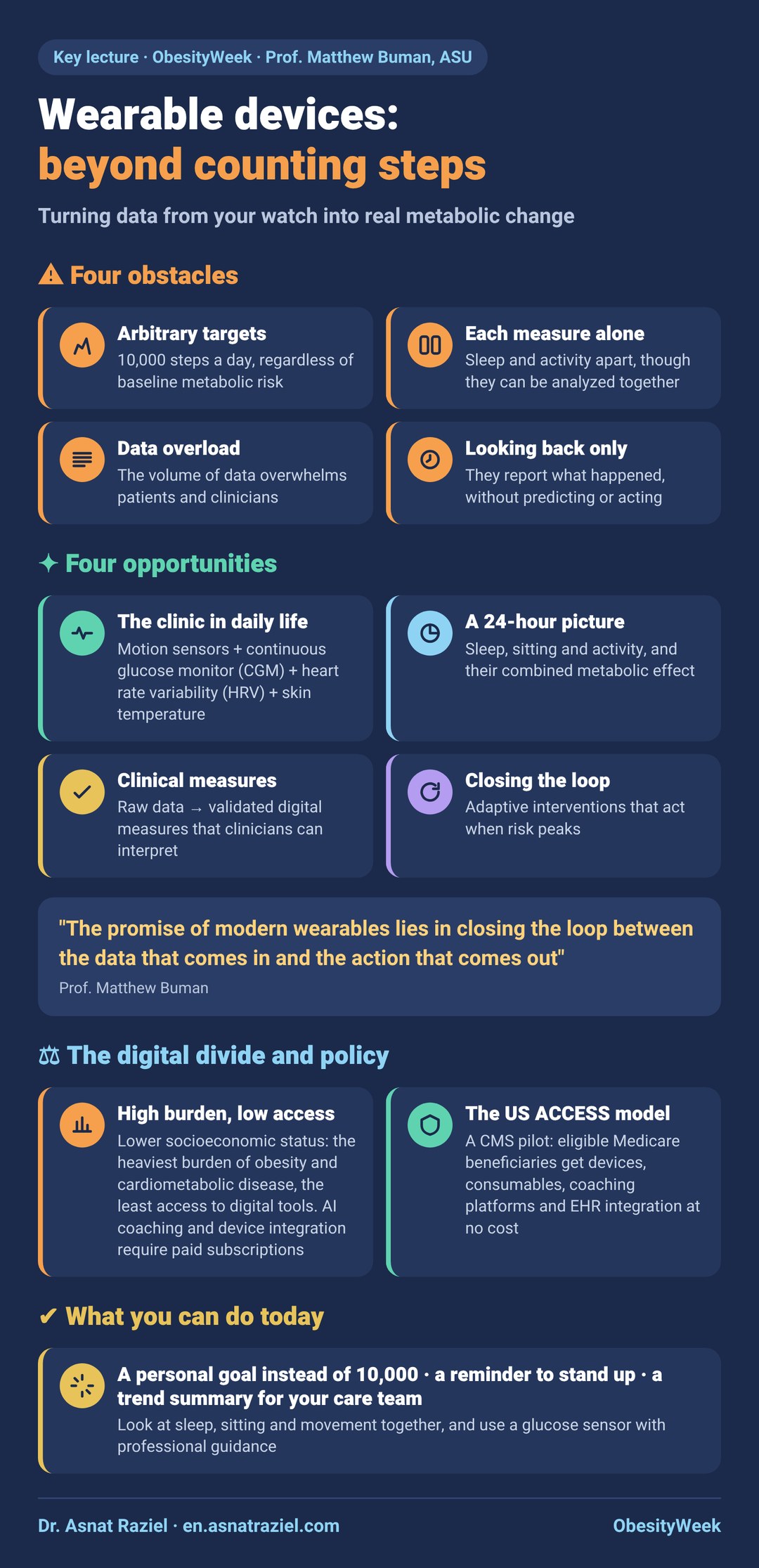
First, Buman pointed to goals that are too crude. The well-known target of 10,000 steps a day is arbitrary. Moreover, it ignores each person’s metabolic risk at the starting point. Studies on daily step counts also show that going from nothing to a little is worth the most.
Second, most devices look at each behavior on its own: sleep separately and activity separately. Yet today we can analyze several measures together. Third, the sheer amount of information floods both patients and doctors. Finally, devices mostly report on what has already happened. They still do not predict when risk is rising, so they do not step in on time.
What wearables can offer us
On the other hand, Buman described four opportunities. The first is to extend the clinic into daily life. For example, motion sensors in a phone and watch can be combined with a continuous glucose monitor (CGM). Skin temperature and HRV (heart rate variability) join them as well. HRV describes the small changes in the time between one heartbeat and the next.
A full picture of 24 hours
The second opportunity is a view of the whole day. Sleep, long sitting and physical activity affect one another. Therefore, their combined metabolic effect matters more than any single measure. According to Buman, single-purpose devices could not do this analysis in the past. Today, wearables measure all the components together. This matters, because sleep affects appetite, metabolism and the brain.
From raw numbers to measures the doctor can interpret
The third opportunity is to turn raw data into validated digital measures. Such measures fit the clinical goal, and the doctor understands them easily. In other words, instead of thousands of data points, the doctor gets a clear picture that guides a decision.
Closing the loop: help at the right moment
The fourth opportunity is to close the loop. The new measures can feed adaptive interventions, such as a just-in-time intervention. That means help that arrives exactly when it is needed. It works at the moment risk peaks, and not a week later. “The promise of wearables lies in closing the loop between the data that goes in and the action that comes out,” Buman said.
Wearables for everyone? The digital gap
However, Buman warned of a social gap. Groups with lower socioeconomic status carry the heaviest burden of obesity and of heart and metabolic disease. Yet they have the most limited access to advanced digital tools. The devices themselves are cheap today, but many of the key features need a paid subscription. Examples include personal coaching based on artificial intelligence (AI) and links between devices.
In addition, Buman called for cooperation between academia and industry. In his view, today’s research apps are not fit for wide use, because researchers build each one for a specific purpose. Academia can provide independent evaluation and check that models are fair to all populations. It can also run studies inside commercial platforms, with large groups of users. By contrast, closed systems and economic barriers that leave high-risk patients out will limit the benefit for the whole population.
The ACCESS model: free devices for Medicare members
Buman also presented one policy step. The US Centers for Medicare and Medicaid Services (CMS) run a pilot called the ACCESS model. Within it, eligible Medicare members receive devices, scales, coaching platforms and a link to the electronic medical record at no cost.
What you can do with wearables today
Research is still moving forward, but your watch or ring can already help. These are my recommendations for patients:
A personal goal instead of 10,000 steps. Check your current average and add to it gradually. Remember that even five minutes of movement changes the picture.
A view of the whole day. A smart ring or smartwatch can measure sleep, sitting and movement. So look at all three together, and not just at your step count.
A reminder to get up from your chair. Turn on an alert for long sitting. It is a simple version of help at the right moment.
Few measures, much meaning. Choose two or three measures that matter to you. Then bring your care team a summary of trends, not all the raw data.
A glucose sensor with professional support. Such a sensor shows how meals, sleep and activity affect your blood sugar. With the right support, the measurement helps you change habits, not just worry.
Before a paid subscription. Ask yourself whether you will really use the features that cost money every month.
Bottom line: wearables need to close the loop
Buman ended with cautious optimism, but stressed that the road is still long. In his view, wearables need four things to become a treatment tool for metabolic health. These are continuous monitoring of body and behavior, interventions that close the loop, fair policy and cooperation between sectors. I see this as a very promising direction. Ultimately, the future is a personal health system that connects the data to the care team, and not just another device.
Further reading on the site:
Metabolic risk in teens
Exercise energy compensation
This article is general information and does not replace personal medical advice.
References
Speaker Shares How Clinicians Can Put to Better Use All the Data From Wearables
ACCESS (Advancing Chronic Care with Effective, Scalable Solutions) Model