By Dr. Asnat Raziel, bariatric surgeon specializing in obesity treatment, metabolic health and healthy longevity; Director of the Multidisciplinary Center for Obesity Treatment, Assia Medical, Assuta Ramat HaChayal, Tel Aviv
A new GLP-1 NAION warning: what happened?
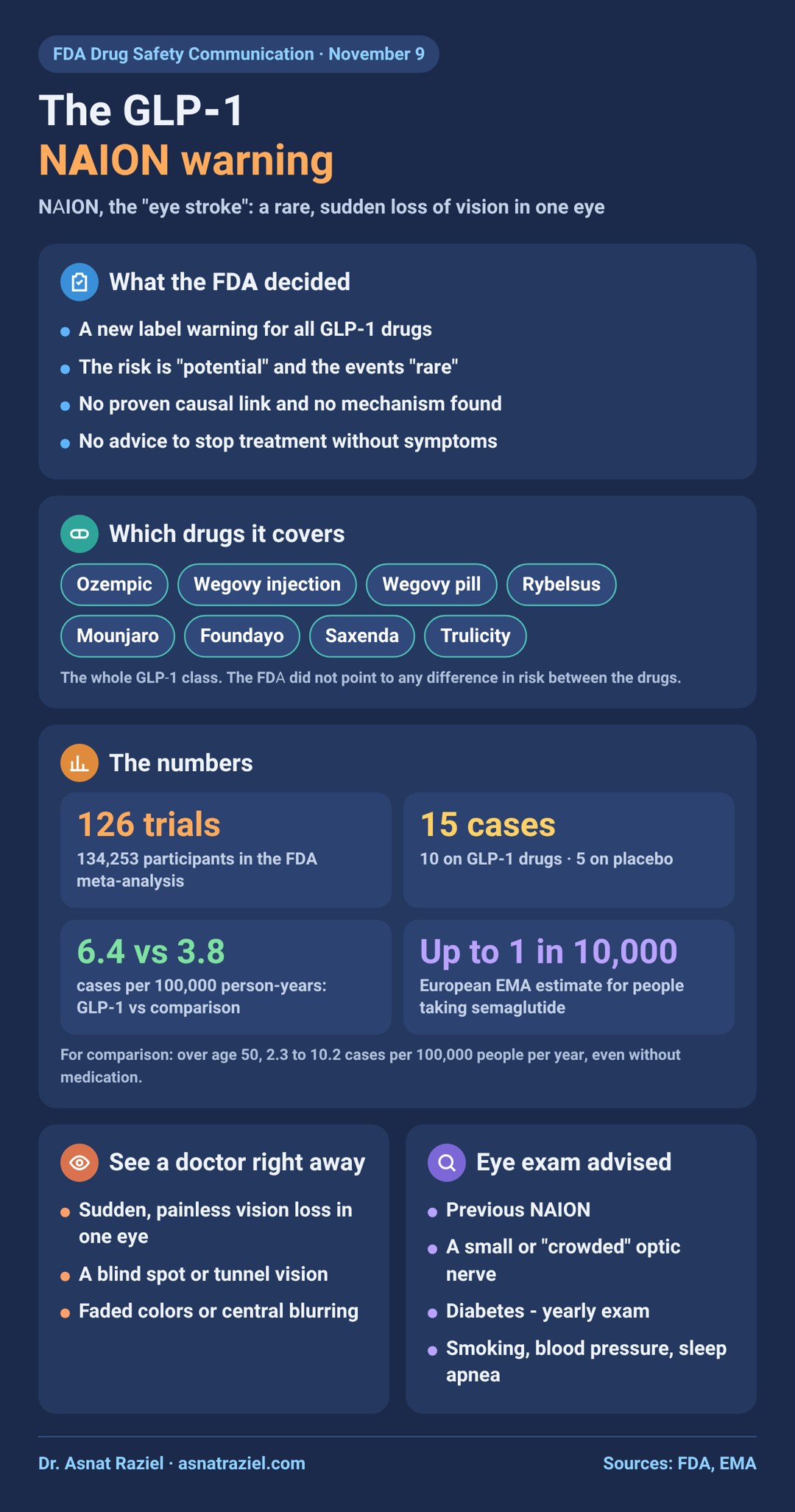
On November 9, the FDA announced a new GLP-1 NAION warning. It covers the entire class of GLP-1 medications. NAION is a rare condition that affects the optic nerve. Headlines spoke of “blindness,” and many patients understandably got worried. However, it is worth reading the decision itself. The risk is rare. The FDA did not conclude that the drugs cause it. Nor did it recommend stopping treatment.
In this article, I have gathered the exact figures. I will also explain which medications the warning covers. Then, who should see an eye doctor, and how to spot symptoms early.
What is NAION, the “eye stroke”?
NAION stands for non-arteritic anterior ischemic optic neuropathy. In other words, blood flow to the front of the optic nerve drops. As a result, the nerve is damaged. That is why it is sometimes called an “eye stroke.”
It usually affects one eye, suddenly and without pain. Many people notice it when they wake up in the morning. The loss of vision may be permanent. In addition, NAION in one eye raises the risk in the other eye.
The risk factors for NAION are well known. They include smoking, diabetes, high blood pressure, sleep apnea, anemia and kidney disease. In fact, many of them are common in exactly the patients who receive GLP-1 drugs. So it is hard to tell whether the medication itself raises the risk.
The GLP-1 NAION warning: what exactly did the FDA decide?
The FDA issued an official Drug Safety Communication with four main messages:
First, the makers of all GLP-1 drugs must add information about a potential increased risk of NAION to the “Warnings and Precautions” section of the prescribing information.
Second, the agency describes the risk as “potential” and the events as “rare.” Animal studies found no mechanism. Nothing explains how the drugs could raise the risk.
Third, a patient who notices a sudden drop in vision should contact a doctor right away. The doctor should then refer the patient promptly to an ophthalmologist.
Finally, if NAION is diagnosed, the doctor should consider stopping the drug, unless the benefits clearly outweigh the risk. This decision is made together with the patient.
What the FDA did not say matters too. It did not recommend stopping treatment in people without symptoms. It also did not require a routine eye exam before starting treatment. Contrary to some media reports, it does not tell patients to stop on their own.
Which drugs does the GLP-1 NAION warning cover?
The short answer: all of them. NAION cases have been reported with every GLP-1 drug on the market, the FDA noted. So it applied the warning to the whole class. The communication does not point to any difference in risk between the drugs.
Semaglutide: Ozempic, Wegovy injection and the Wegovy pill
The warning covers semaglutide, the active ingredient in Ozempic, Wegovy and Rybelsus. It applies to the active ingredient itself, so it also covers the Wegovy pill. In Europe, the European Medicines Agency (EMA) recognized NAION as a “very rare” side effect of semaglutide back in 2025. That decision already included the Rybelsus pill.
Tirzepatide: Mounjaro
Yes, the warning also covers tirzepatide, the active ingredient in Mounjaro and Zepbound. Even so, Lilly noted that the communication applies to the whole class. It does not cite findings specific to Lilly medicines.
Foundayo
Yes. Foundayo, Lilly’s pill whose active ingredient is orforglipron, appears by name on the FDA’s list. The list also includes Saxenda and Victoza (liraglutide), Trulicity (dulaglutide) and exenatide.
How rare is it? The numbers behind the GLP-1 NAION warning
The FDA performed a meta-analysis, a combined analysis, of 126 randomized controlled trials. These trials included 134,253 participants: 78,217 received a GLP-1 drug and 56,036 were in comparison groups.
Altogether, the reviewers identified only 15 probable cases of NAION. Ten occurred in GLP-1 patients and five in the placebo groups. The rate was 6.4 cases per 100,000 person-years, compared with 3.8 in the comparison groups. A person-year means one patient taking the drug for one year.
Put simply, the difference is about 2.6 cases per 100,000 patients per year. For comparison, people over 50 have 2.3 to 10.2 cases per 100,000 per year. In Europe, the EMA estimated a risk of up to 1 in 10,000 semaglutide users.
GLP-1 NAION warning: what the studies show, and what they don’t
The concern arose in 2024 after a study from a medical center in Boston. It reported a 4.28-fold higher risk in people with diabetes who took semaglutide, and a 7.64-fold higher risk in people with overweight or obesity. However, the FDA noted that the study had several limitations. In addition, it was conducted at a single center and included a small number of cases.
On the other hand, much larger studies showed a more moderate picture. The EMA concluded that in large population studies of people with type 2 diabetes, the risk roughly doubled. In absolute terms, that is about one additional case per 10,000 person-years of treatment.
The FDA also examined insurance data from people with diabetes who started treatment between 2019 and 2024. Compared with SGLT-2 drugs such as Jardiance, there was no significant difference. In contrast, compared with DPP-4 drugs such as Januvia, the risk was 43% higher. The rates themselves were very close: 30 to 32 cases per 100,000 person-years with GLP-1 drugs, 31 with SGLT-2 drugs and 26 with DPP-4 drugs.
This is why the FDA speaks of a “potential” risk rather than a proven causal link. The data point to a small increase in the risk of a rare condition. They do not prove that the medication is the cause.
Who should see an eye doctor?
The FDA did not require a routine exam for every patient. However, the American Optometric Association recommends an eye exam for anyone starting a GLP-1 drug. My recommendation is to see an eye doctor before or early in treatment in several situations:
First, anyone who has had NAION or another sudden episode of vision loss.
Second, anyone who has been told by an eye doctor that they have a small or “crowded” optic nerve head.
In addition, people with diabetes, who need a yearly eye exam anyway.
Finally, anyone with several risk factors together: smoking, uncontrolled blood pressure, kidney disease or untreated sleep apnea.
Moreover, these risk factors threaten the eyes even without any medication. That is why controlling blood pressure, quitting smoking and treating sleep apnea matter for every patient.
Symptoms that need immediate attention
Contact a doctor the same day, rather than waiting for a routine appointment, if you notice any of the following:
A sudden, painless drop in vision in one eye, sometimes noticed on waking.
A blurry or missing area in your field of vision, such as a blind spot or tunnel vision.
Colors that look faded or different than usual.
Blurring in the center of your vision.
Should you stop treatment because of the GLP-1 NAION warning?
No, not if you have no symptoms. The FDA decision does not change the treatment recommendation for patients without complaints. Untreated obesity and diabetes harm the eyes, the heart and the kidneys, and their risk is far greater. Stopping suddenly also tends to bring weight and metabolic markers back to where they were.
If you have a question or concern, talk to your doctor before making any change. You can also read about Wegovy side effects and how to manage them.
The bottom line
The FDA has added a GLP-1 NAION warning about a potential, very rare risk of optic nerve damage with all GLP-1 drugs. It covers Ozempic, Wegovy as an injection and as a pill, Mounjaro and Foundayo. A causal link has not been proven, and the benefits of treatment remain high. So there is no reason to stop treatment out of fear. At the same time, it is worth knowing the symptoms, seeking care right away if your vision changes suddenly, and seeing an eye doctor if you have risk factors.
This article is general information and is not a substitute for personal medical advice.
References
Risk of Nonarteritic Anterior Ischemic Optic Neuropathy in Patients Prescribed Semaglutide