By Dr. Asnat Raziel, bariatric surgeon specializing in obesity treatment, metabolic health and healthy longevity; Director of the Multidisciplinary Center for Obesity Treatment, Assia Medical, Assuta Ramat HaChayal, Tel Aviv
Eating disorders and obesity: two worlds that meet in the clinic
Eating disorders and obesity often show up together. Yet for years, medicine trained two separate groups of specialists. Each side saw only part of the picture. At ObesityWeek, a special session on November 15 tackled this gap. Its message was clear: every adult who seeks obesity treatment should receive a gentle screening for eating disorders.
The session, as summarized by The Obesity Society News, featured three speakers. Dr. Janet Lydecker is a psychologist and associate professor of psychiatry at Indiana University School of Medicine. Dr. Abby Braden is a psychologist at Bowling Green State University in Ohio. Melinda Watman, a nurse and patient advocate, shared her personal story.
Why this matters for anyone treating weight
Many patients come in with two goals. They want healthier eating patterns, and they also want to lose weight. Therefore, care that focuses only on the number on the scale can miss what lies beneath the surface. In addition, many people hide eating behaviors out of shame. Weight bias in healthcare only deepens that secrecy.
I have written before about how healthy advice can become a burden for some patients. This session took that idea a step further, into obesity clinics themselves.
Which disorders screening looks for
The DSM-5, the psychiatric diagnostic manual, lists several feeding and eating disorders. The session focused on the four most common. The first is anorexia nervosa. The second is bulimia nervosa. Next comes binge eating disorder, meaning eating a large amount of food in a short time with a sense of loss of control. Finally, ARFID (avoidant/restrictive food intake disorder) involves avoiding or restricting foods.
Screening for eating disorders and obesity: three areas to ask about
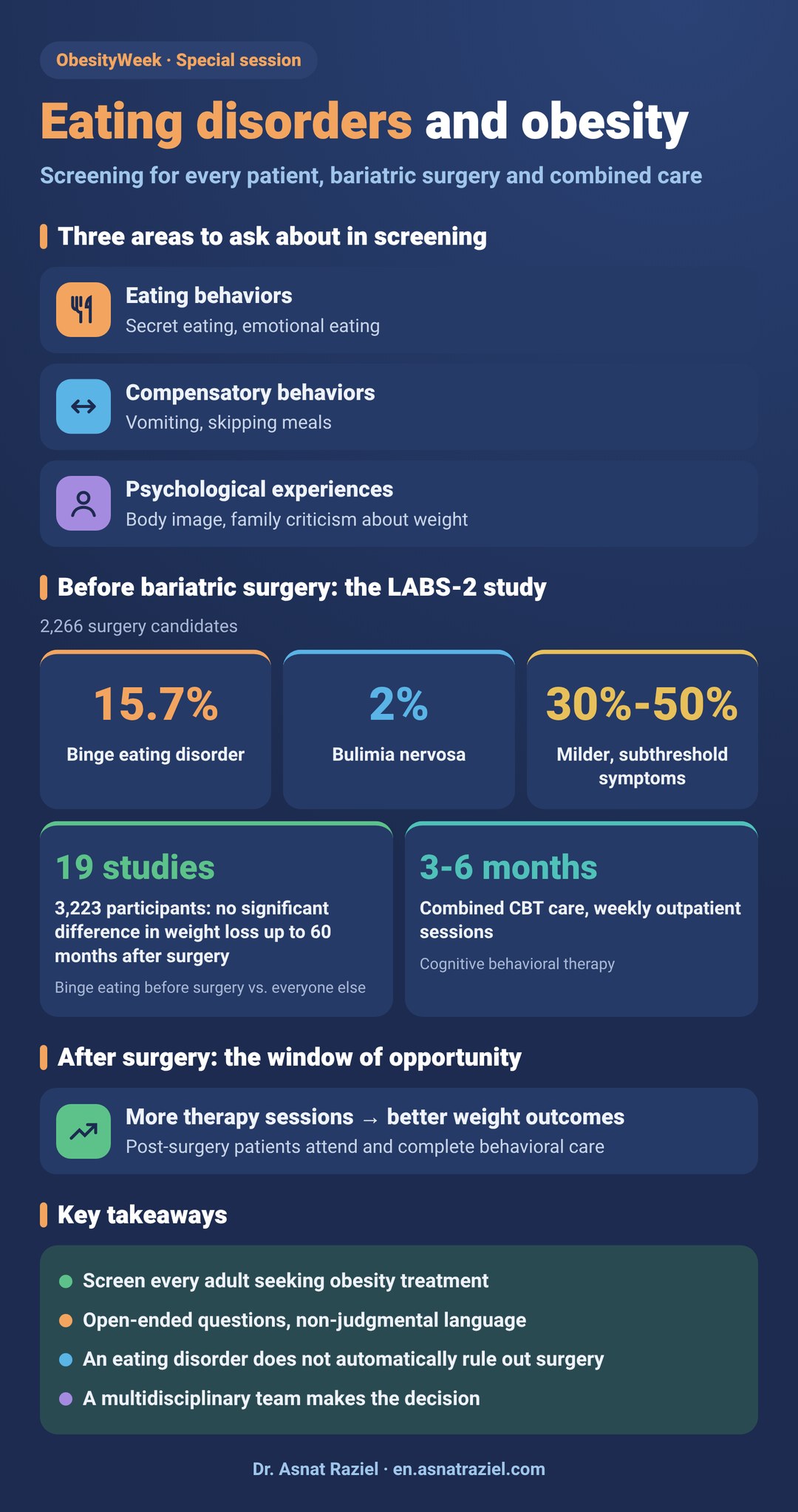
Dr. Lydecker suggested asking about three areas:
Eating behaviors: for example, secret eating or emotional eating.
Compensatory behaviors: for example, vomiting or skipping meals.
Psychological experiences: for example, distressing body image concerns, or family criticism about weight.
She compared six validated screening tools. In her view, no screener is perfect. Still, several can help clarify what is really going on. How we talk about the results matters just as much. Dr. Lydecker recommended open-ended questions and respectful, non-judgmental language.
New at ObesityWeek: binge eating, self-regulation and listening to body signals
ObesityWeek also featured a poster by researchers from Georgetown University and the VA Boston Healthcare System, led by Brett Rauch and Prof. Chandan Vaidya. The researchers studied 63 young college students, with an average age of about 19. They asked whether binge eating is linked to two brain abilities. The first is executive function, the ability to regulate thoughts, emotions and actions, to plan and to stop an impulse. The second is interoceptive accuracy, the ability to sense internal body signals such as heartbeat, hunger and fullness.
What makes the study special is how it measured body awareness. Participants exercised up to a target heart rate while wearing a heart rate monitor. Then, as their heart rate returned to rest, they matched the heartbeat they felt to an animated beating heart on a screen. This gave a biological measure, not just a questionnaire.
The findings are intriguing. First, the higher the BMI, the higher the binge eating score. Second, students with little binge eating had better executive function than the average group. One finding surprised the researchers: the groups with low or high binge eating sensed their heartbeat more accurately, while the average group sensed it less well.
Keep in mind that this is a small, preliminary study. Each of the extreme groups had only nine participants, so larger studies are needed. Still, the direction is encouraging: binge eating is not a lack of discipline. It is linked to self-regulation and to the connection with body signals, and both can be strengthened. Behavioral therapy, mindfulness and regular physical activity are tools that are already available today.
Combined care: eating disorders and obesity on one path
Sometimes it makes sense to treat both problems at the same time. In that case, several evidence-based options exist. Most rely on cognitive behavioral therapy (CBT). This approach teaches people to recognize patterns of thinking and behavior, and to change them. Usually it means weekly outpatient sessions over three to six months.
Does an eating disorder rule out bariatric surgery?
Dr. Braden focused on candidates for metabolic and bariatric surgery. In this group, eating disorders are far more common than in the general population. For example, the US LABS-2 study assessed 2,266 surgery candidates. Of these, 15.7% met criteria for binge eating disorder and 2% for bulimia nervosa. Moreover, when milder symptoms below the full diagnostic threshold are counted, the rate rises to roughly 30% to 50%.
Does that mean surgery is off the table? Not necessarily. According to Dr. Braden, an eating disorder alone is not an absolute contraindication to surgery. A meta-analysis of 19 studies, with 3,223 participants, examined this question. The researchers found no significant difference in weight loss between people with binge eating before surgery and everyone else, up to 60 months afterward.
On the other hand, a multidisciplinary team should make the decision. Alongside eating patterns, the team also weighs tobacco use, high stress and inconsistent clinic attendance. This way, surgery becomes part of one continuous treatment pathway, not a single isolated event.
After surgery: the biggest window of opportunity
Full eating disorders are uncommon after surgery. However, when they do appear, they are linked to less weight loss. A broad review of mental and behavioral factors reached a similar conclusion about binge eating after surgery.
The good news is that post-surgery patients are more likely to attend and complete add-on behavioral treatment. In addition, attending more sessions goes along with better weight outcomes. That is why Dr. Braden sees the postoperative period as the greatest opportunity to intervene. Finally, she stressed that education about eating disorders helps every patient, whether or not they have surgery.
A personal story: when surgery did not heal the pain
Melinda Watman described restricted eating in childhood and teasing about her weight. Body image struggles followed her into adulthood. In her mid-forties she had bariatric surgery. Physically, she says, it was the right decision. Even so, the surgery did not resolve the self-stigma she carried inside.
After surgery she developed restricted eating, and later binge eating and compensatory behaviors. Nearly two decades after surgery, she reached a state of severe malnutrition. Two falls, partly linked to the malnutrition, led to hospitalization. She then completed a three-month eating disorder treatment program.
Three years later she started a GLP-1 medication that she obtained online. To get it, she gave inaccurate answers about her weight and medical history. She experienced side effects, stopped the drug and told her care team. Today she describes treatment as lifesaving, and staying well as continuous work. Her team includes a therapist, a dietitian, an eating disorder physician and a primary care physician.
Her message to clinicians is simple: use whatever tools and language help you uncover what is really happening with your patient.
What this means for you: eating disorders and obesity in daily life
If you live with excess weight, watch for a few signs. For example: secret eating, a sense of losing control around food, skipping meals to “make up for” eating, or thoughts about your body that take up much of your day. Signs like these are not a personal failure, and they are not a lack of willpower.
First, talk about them openly with your doctor or dietitian. Second, do not get weight-loss medications from unauthorized sources, and do not hide information from your care team. Watman’s story shows the price. Third, know that effective, evidence-based treatment exists, and it can be combined with obesity care. Tools such as mindfulness for emotional eating and self-compassion can help along the way. They also strengthen awareness of your body’s hunger and fullness signals.
At the multidisciplinary obesity center I direct at Assia Medical, we work with a dietitian and a broad mind-body team that includes psychologists. This lets us address both eating patterns and weight, on one path.
The bottom line on eating disorders and obesity
Eating disorders and obesity are not two separate stories. Simple screening, in respectful language, helps identify who needs more support. In addition, an eating disorder does not automatically close the door to bariatric surgery. A multidisciplinary team makes the decision, and the period after surgery is an important opportunity for behavioral care.
This article is general information and does not replace personal medical advice. If you or someone close to you is struggling with an eating disorder, reach out to your family doctor or a professional who specializes in this field.
References
Session Highlights: Challenges at the Intersection of Disordered Eating and Obesity
Eating behavior and eating disorders in adults before bariatric surgery