By Dr. Asnat Raziel, bariatric surgeon specializing in obesity treatment, metabolic health and healthy longevity; Director of the Multidisciplinary Center for Obesity Treatment, Assia Medical, Assuta Ramat HaChayal, Tel Aviv
The SYNT-101 pill: a new idea from ObesityWeek
The SYNT-101 pill is an experimental once-daily tablet that tries to mimic part of what gastric bypass surgery does. Boston-based Syntis Bio presented it this week at ObesityWeek, the American obesity congress in Washington. In a first human trial, the pill raised gut satiety hormones and was tolerated about as well as a placebo. However, the weight loss over one month was small. It is an investigational drug and is not approved for use.
Why gastric bypass works so well
Roux-en-Y gastric bypass is one of the most effective treatments for obesity. Part of its power is not just a smaller stomach. Food skips the first part of the small intestine and reaches the lower gut quickly. There, gut cells release satiety hormones such as GLP-1 and PYY. As a result, appetite falls and blood sugar improves.
Yet, according to the company, fewer than 1% of eligible patients undergo this surgery each year. So the researchers asked a simple question: can we get part of the effect without an operation? I wrote about how the gut, hormones and brain talk to each other in my article on the physiology of satiety.
How the SYNT-101 pill works
The technology came out of the labs of Prof. Robert Langer and Prof. Giovanni Traverso at MIT. According to the company’s launch announcement, the pill creates a thin, temporary coating on the wall of the duodenum, the first part of the small intestine. The coating is made of polydopamine, a material inspired by mussel glue. It lasts up to 24 hours, and then the body clears it.
During that window, absorption at the start of the intestine is briefly blocked. Food moves further down and triggers several hormones: GLP-1, PYY, GIP and ghrelin. In addition, the material stays inside the digestive tract, and the company does not describe it as absorbed into the blood. This is a different approach from drugs such as Wegovy and Mounjaro, which mimic a hormone from the outside.
What the SYNTIETY-1 trial tested
SYNTIETY-1 is a randomized, double-blind, placebo-controlled Phase 1/1b trial. Its primary goal was safety. The trial had two parts:
- Single dose: 32 healthy adults with a BMI of 18.5 to 29.9 received one dose of 857 to 3,428 mg (one to four tablets) or placebo.
- Repeated doses: 23 adults with obesity, with a BMI of 30 to under 40, received 857, 1,714 or 2,571 mg or placebo, once daily for 28 days.
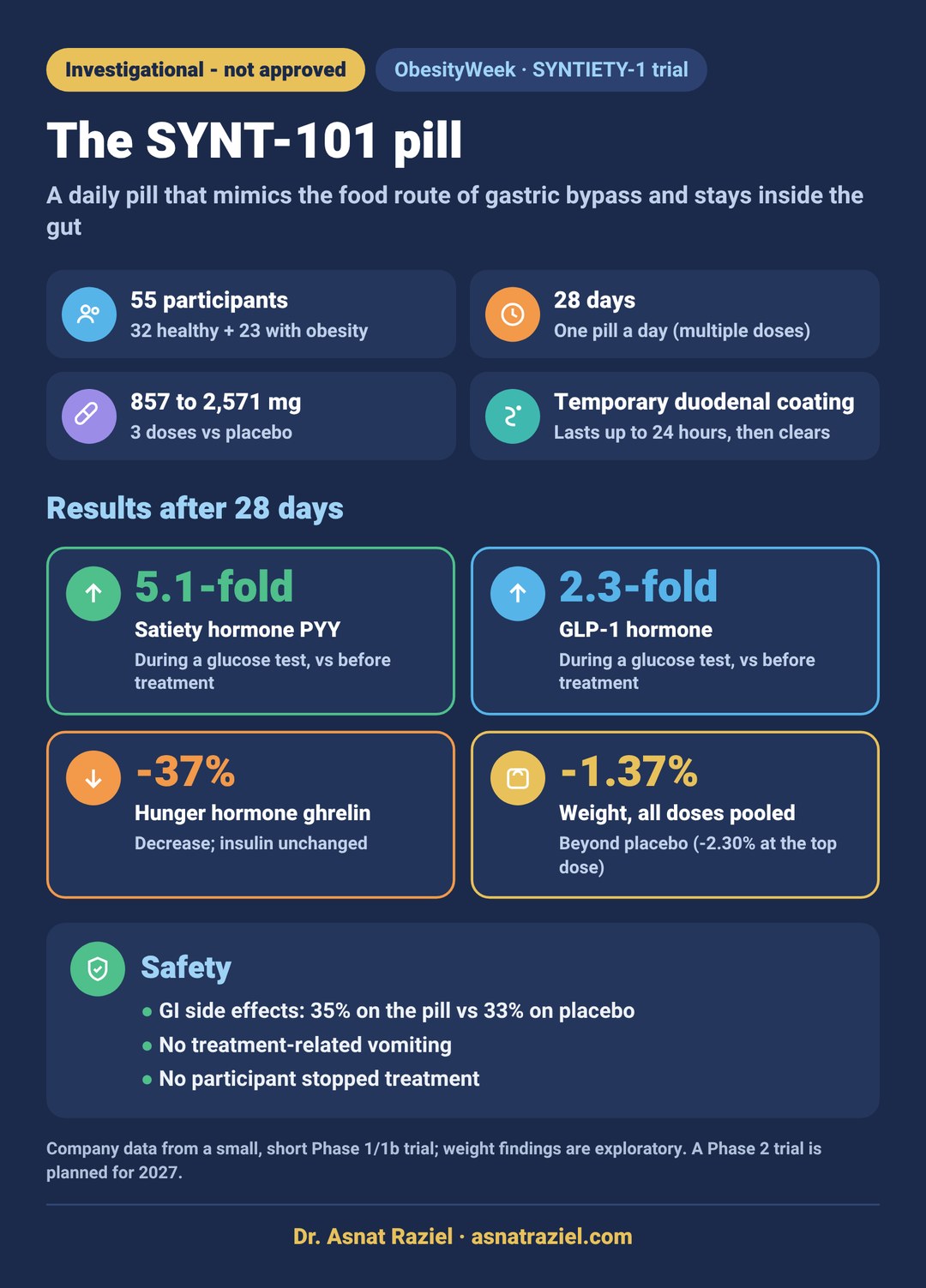
In total, 55 people received the pill. On the other hand, this is a very small and short trial, so body weight was only an exploratory measure.
The SYNT-101 pill: the results
Satiety hormones
After 28 days, the researchers ran a glucose tolerance test and measured gut hormones. PYY rose 5.1-fold and GLP-1 rose 2.3-fold. At the same time, the hunger hormone ghrelin fell by 37%. In contrast, insulin levels did not change. In the highest-dose group, PYY rose as much as 8.7-fold. According to the company, this hormone response resembles the one seen after gastric bypass.
Body weight
Weight loss after 28 days, compared with placebo, was modest:
- 857 mg: 1.26% loss.
- 1,714 mg: 0.46% loss.
- 2,571 mg: 2.30% loss.
- All doses pooled: 1.37% loss.
Note that the middle dose led to less weight loss than the lowest dose. So there is no clear dose-response pattern yet. Also, the groups were tiny, and the company itself calls these findings exploratory.
Safety and side effects
This may be the most interesting finding. Digestive side effects occurred in 35% of people on the pill, compared with 33% on placebo. There was no treatment-related vomiting. Finally, none of the 55 participants stopped treatment. For comparison, nausea and vomiting are common side effects of GLP-1 drugs.
What the SYNT-101 pill could mean for patients
First, this is a truly new idea: not another hormone, but a temporary change in the route food takes through the gut. Second, the good tolerability is encouraging. Still, a loss of about 1% in a month is far from what current medications achieve. The company plans a Phase 2 trial in 2027 to test doses and longer treatment.
Meanwhile, effective approved pills for obesity are already available, such as Foundayo and the Wegovy pill. Other experimental pills are also moving forward, such as the CX11 pill and aleniglipron. And for people who need a stronger treatment, surgery itself remains an excellent option. I wrote about combining drugs and surgery in my article on obesity care as a continuum.
What you can do today
If you are weighing treatment, do not wait for the next drug. Start with a conversation with a doctor who specializes in obesity, and build a plan that combines nutrition, movement and sleep. My guide on how to start weight-loss medication can help you prepare for that visit.
Bottom line
The SYNT-101 pill offers an original direction: mimicking the food route of a bypass with a pill that stays in the gut. In its first trial, it raised satiety hormones and was well tolerated. However, weight loss was small, and the data come from a small company trial. In the end, only larger and longer trials will show whether it becomes a treatment.
This article is general information and does not replace personal medical advice.
References
The data were released by Syntis Bio, the company developing the pill, and have not yet been published in a scientific journal.