By Dr. Asnat Raziel, bariatric surgeon specializing in obesity treatment, metabolic health and healthy longevity; Director of the Multidisciplinary Center for Obesity Treatment, Assia Medical, Assuta Ramat HaChayal, Tel Aviv
Wegovy and metabolic health: the difference after one year
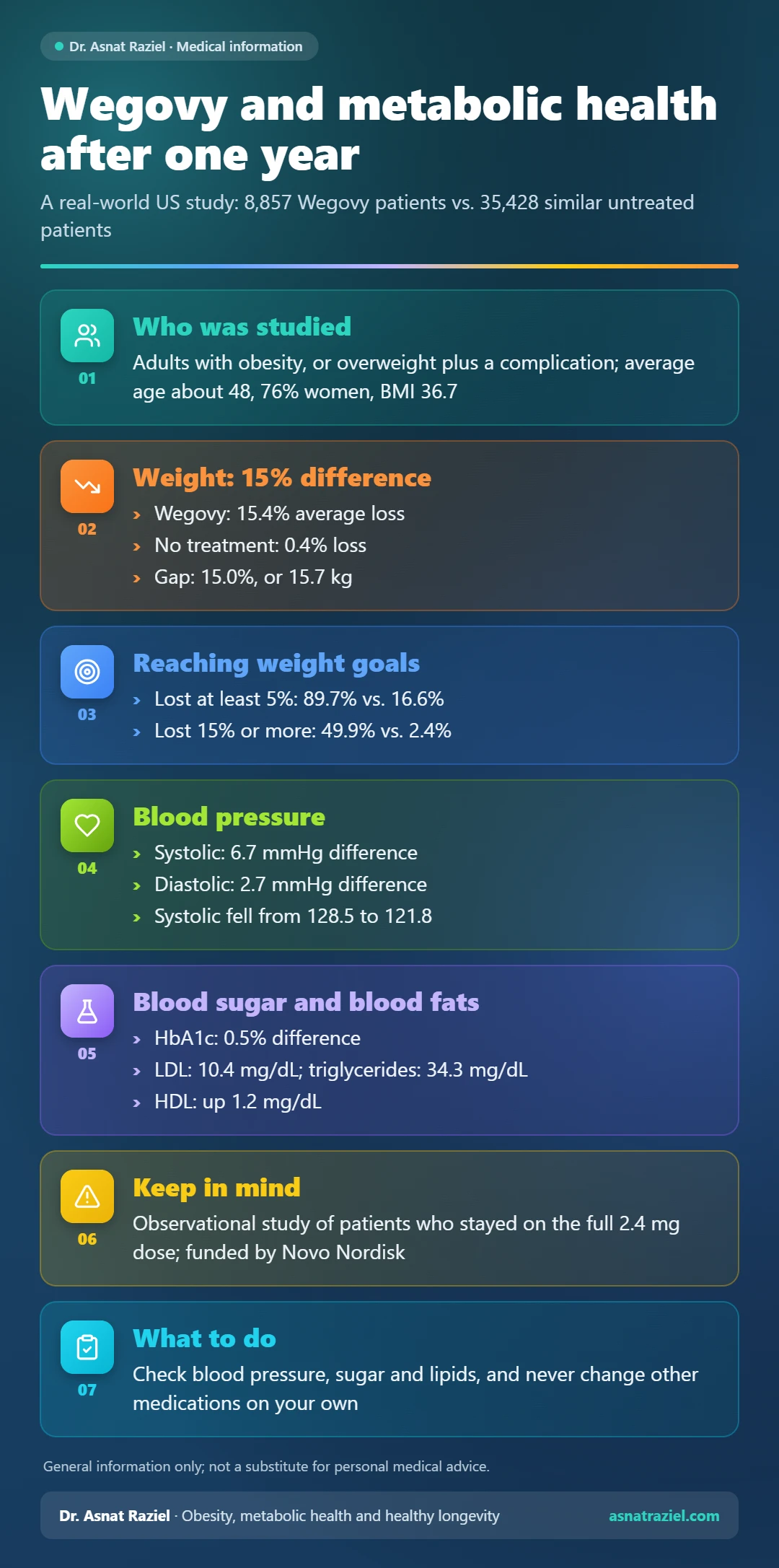
Wegovy and metabolic health is a topic on the mind of anyone considering medication for obesity. A large American study compared 8,857 Wegovy patients with 35,428 similar patients who received no obesity medication. After one year, the gap between the groups was 15.0% of body weight, or 15.7 kg. In addition, blood pressure, blood sugar and blood fats all improved in the Wegovy group.
Why a comparison group matters
Wegovy contains semaglutide, which mimics the satiety hormone GLP-1. In the STEP 1 trial, for example, it led to an average weight loss of 14.9%, compared with 2.4% on placebo. However, without a comparison group, it is hard to know what would have happened without treatment. This study answers that question, because it looks at similar patients who did not take an obesity medication.
What the study examined
The researchers used Komodo, a US database that brings together insurance claims and medical records. They included adults with obesity, or with overweight plus at least one related complication. All Wegovy patients reached the 2.4 mg dose and stayed on it, refilling their prescriptions regularly. Next, the researchers matched each Wegovy patient with four similar patients who were not on any obesity medication.
The average age was about 48, and about 76% were women. Likewise, the average BMI was 36.7 in both groups. People with diabetes were not excluded, but they made up only about 5% of participants.
Wegovy and metabolic health: the weight results
Weight measurements at baseline and after one year were available for 1,186 Wegovy patients and 4,038 untreated patients. These are the estimated differences between the groups:
- Percentage weight loss: a difference of 15.0%.
- Absolute weight loss: a difference of 15.7 kg.
- BMI: a difference of 4.2 kg/m².
In practice, Wegovy patients lost an average of 15.4% of their body weight. By contrast, the weight of untreated patients barely changed, with a loss of only 0.4%. Moreover, 89.7% of Wegovy patients lost at least 5%, compared with 16.6% in the control group. A loss of 15% or more was reached by 49.9% of Wegovy patients, compared with just 2.4% in the other group.
Results by degree of obesity
Notably, weight loss appeared at every BMI level. For instance, in class 1 obesity the loss was 16.5%, and in severe obesity (a BMI of 40 or higher) it was 14.1%. People with diabetes also lost weight, though slightly less: 13.2%, compared with 15.6% in those without diabetes.
Wegovy and metabolic health: blood pressure, blood sugar and blood fats
Now comes the especially interesting part. The researchers also looked at risk factors for heart and blood vessel disease. These were the differences between the groups after one year:
- Systolic (upper) blood pressure: a difference of 6.7 mmHg.
- Diastolic (lower) blood pressure: a difference of 2.7 mmHg.
- HbA1c, the average blood sugar over the past three months: a difference of 0.5%.
- LDL, the “bad” cholesterol: a difference of 10.4 mg/dL.
- Triglycerides: a difference of 34.3 mg/dL.
- HDL, the “good” cholesterol: an increase of 1.2 mg/dL.
In other words, Wegovy patients improved on almost every metabolic measure tested. For example, their systolic blood pressure fell from 128.5 to 121.8 mmHg. It is important to note that these tests were available for only some of the participants. I wrote about the link between weight loss and blood pressure in my article on treating high blood pressure through weight loss.
What the study cannot prove
First, this is an observational study, so it shows an association, not necessarily cause and effect. Even after matching, lifestyle differences between the groups may remain. Second, the study included only people who reached the full dose and stuck with it for a year. That kind of selection may inflate the result, because it leaves out those who stopped.
Third, weight data were available for only a small share of the participants. Also, most participants were white women with private insurance. Finally, the study was funded by Novo Nordisk, the maker of Wegovy, and most of the researchers are company employees.
What this means for you
This study reinforces a message I repeat in my clinic: treating obesity means treating your whole health, not just your weight. Here are a few practical principles:
- Check your blood pressure, blood sugar and blood fats before and during treatment.
- Don’t change your blood pressure or diabetes medications on your own. Sometimes they need to be reduced as your weight drops.
- Stay with the treatment. Read more in my article on sticking with obesity treatment.
- Combine a balanced diet with physical activity. See my guide to improving metabolic markers.
You can find more about the medication itself on the Wegovy page on this site.
Bottom line: Wegovy and metabolic health
In this study, Wegovy patients who stayed on the full dose for a year lost about 15% of their body weight, compared with a negligible change in the control group. In addition, blood pressure, blood sugar and blood fats improved. So the connection between Wegovy and metabolic health shows up not only on the scale but also in heart risk factors. Still, these were persistent patients, and results in broader everyday practice may be more modest.
The information in this article is general information only and is not a substitute for personal medical advice. Before starting or changing any treatment, consult your doctor.
References
Once-Weekly Semaglutide in Adults with Overweight or Obesity
The study was funded by Novo Nordisk. Five of the six researchers are company employees, and the sixth is a consultant to the company.




