By Dr. Asnat Raziel, specialist in obesity treatment, metabolic health and healthy longevity; Director of the Multidisciplinary Center for Obesity Treatment, Assia Medical, Assuta Ramat HaChayal, Tel Aviv
Preserving muscle on GLP-1 drugs: why it matters during weight loss
Preserving muscle during weight loss is one of the most common questions I hear from patients in my clinic. The number on the scale goes down, but the scale doesn’t tell you exactly what was lost. Along with fat, the body also loses lean tissue, including muscle. So the goal isn’t just a lower number on the scale. The goal is to lose fat while keeping strength, function and independence.
The good news is that we have clear tools. Regular strength training, the right amount of protein and tracking strength and function make a real difference. In this article, I’ve gathered what the research shows and what to do in practice. You may also want to read my earlier guide on muscle and weight loss.
What happens to muscle when you lose weight
When you eat fewer calories, the body breaks down both fat and lean tissue. It helps to understand one term: lean mass, which is everything that isn’t fat. It includes muscle, but also organs, bone and fluids. In other words, a drop in lean mass is not the same as a drop in muscle.
For example, in the STEP 1 trial of semaglutide, the drug in Wegovy injections, researchers checked body composition in some participants with a DXA scan, a low-dose X-ray that separates fat, lean tissue and bone. Out of an average loss of 13.6 kg, about 8.3 kg (62%) was fat and about 5.3 kg (38%) was lean mass. According to the joint advisory of four US professional organizations, muscle makes up roughly half of lean mass. So roughly 20% of the weight lost is muscle.
Still, the research picture isn’t uniform. A review in Diabetes, Obesity and Metabolism found a wide range: in some studies lean mass made up 40% to 60% of the weight lost, and in others about 15% or less. The researchers also note that MRI scans show an adaptive change in muscle, and sometimes better muscle quality. I’ve written more about this in my article on lean body mass on GLP-1 drugs.
Preserving muscle on GLP-1 drugs during treatment
Drugs such as Wegovy and Mounjaro, whose active ingredient is tirzepatide, reduce appetite significantly. That’s their strength, but it’s also their weak spot. Many patients eat very little and sometimes skip whole meals. As a result, protein intake drops too, just when the body needs it.
Moreover, fast and large weight loss raises the risk of muscle loss. The risk is especially high in older age and in people who already have sarcopenia, meaning muscle wasting. So before starting treatment, I check strength, function and eating habits. You’ll find information on the types of obesity medications on a separate page of my site.
What a training study teaches us
One of the clearest studies in the field followed 249 older adults with obesity, average age about 67, for a year and a half. The researchers split participants into three groups: diet alone, diet with aerobic training, and diet with strength training. They measured body composition with DXA scans.
The results were published in the journal Obesity. In the diet-only group, people lost an average of about 1.0 kg of lean mass. In the aerobic group, they lost about 1.6 kg, and in the strength training group only about 0.8 kg. At the same time, the strength group lost about 7.8 kg of fat, compared with about 4.8 kg on diet alone. In other words, strength training helped burn fat and preserve lean tissue.
Strength training for preserving muscle during weight loss
The Israeli Ministry of Health recommends, on its information page on sarcopenia and muscle wasting (in Hebrew), doing resistance training at least twice a week. The joint advisory for patients on GLP-1 drugs goes one step further. It recommends strength training at least three times a week, plus at least 150 minutes a week of moderate-intensity aerobic activity.
In practice, focus on the large muscle groups: legs, glutes, back and chest. Exercises such as squats, chest presses and rows suit most people. Over time, increase the load gradually and keep a rest day between workouts for the same muscle. I’ve written in detail about compound exercises in my article on strength training and the deadlift.
If you’re starting from zero, or you have pain and limitations, it’s better to begin with professional guidance. A physiotherapist or certified trainer can build a plan that fits you.
Protein: how much do you really need?
The recommended daily allowance of protein for a healthy adult is 0.8 grams per kilogram of body weight. However, during active weight loss, slightly higher targets have been suggested, such as 1.2 to 1.6 grams per kilogram a day. The recommendations also warn against long-term intake of 2 grams per kilogram a day or more.
It’s important to know that in people with obesity, calculating by actual weight can inflate the need. So the dietitian calculates the target using an adjusted weight or lean mass. In kidney disease, the target is completely different and must be personalized. Spread protein through the day, and start each meal with a protein source. You’ll find more in my guide to protein intake.
How to track: strength and function, not just weight
Weight alone doesn’t tell the story. So at follow-up, I also look at body composition, for example with bioelectrical impedance (BIA) or a DXA scan. I also ask about daily function: getting up from a chair, climbing stairs and carrying bags.
Another simple and important measure is grip strength. If strength drops or function suffers, we adjust the plan. For example, we add protein, change the training or slow the pace of weight loss. Don’t change a medication dose without consulting your doctor.
Preserving muscle on Mounjaro: what the T-REx trial found
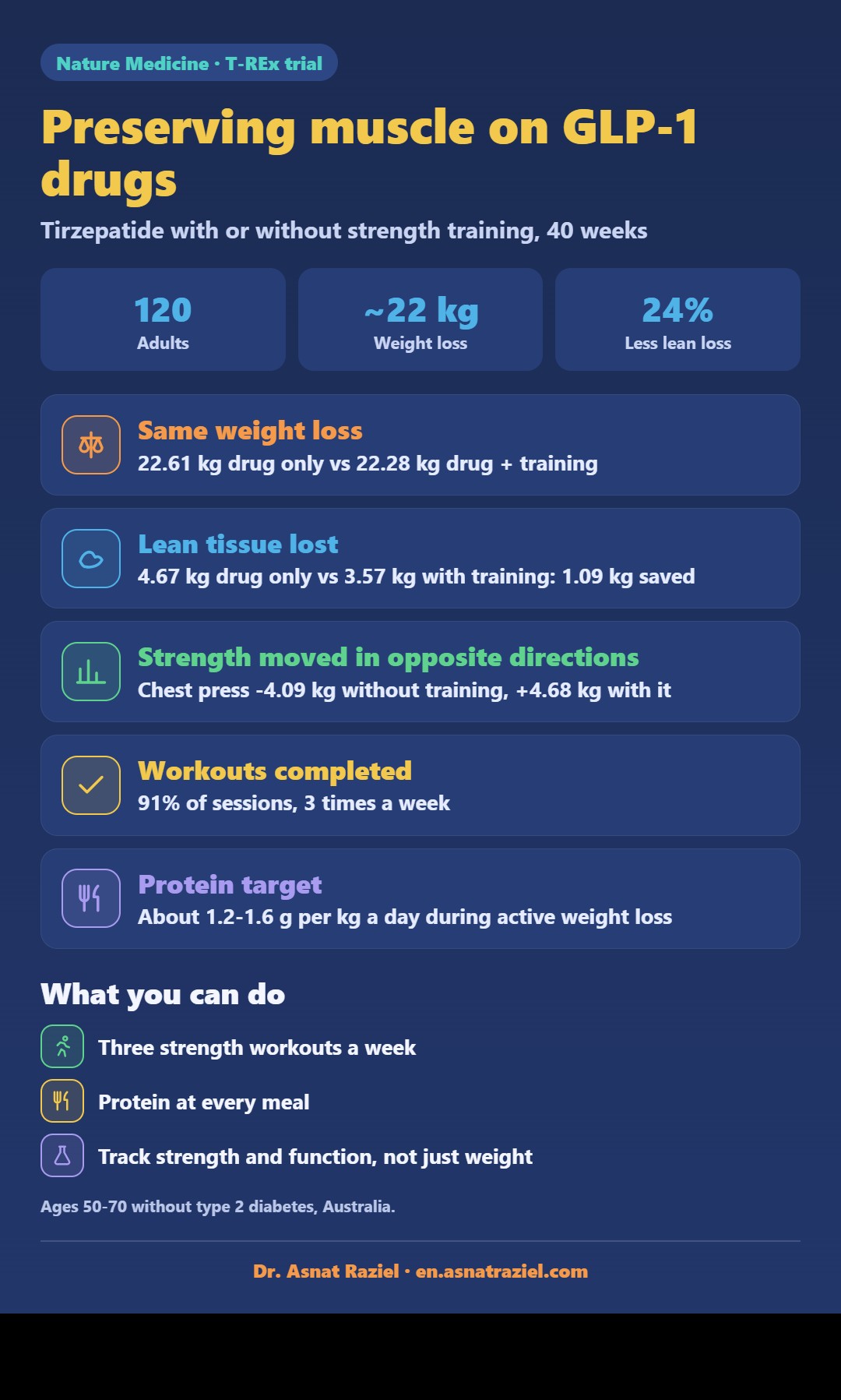
This week, Nature Medicine published a controlled clinical trial that tested exactly this question. The researchers, from the University of Western Australia in Perth, enrolled 120 adults with obesity or overweight. All participants received tirzepatide, and most went up to a dose of 15 mg a week. By random assignment, half did strength training three times a week. The rest continued their usual routine. The trial lasted 40 weeks.
Weight loss was almost identical in the two groups: 22.61 kg in the drug-only group and 22.28 kg in the drug-plus-training group. Fat loss was also similar, 17.19 kg versus 17.98 kg. The big difference appeared in lean tissue. The drug-only group lost 4.67 kg of lean tissue, while the training group lost only 3.57 kg. In other words, strength training saved 1.09 kg of lean tissue, about 24% less loss.
What’s more, strength itself moved in opposite directions. In the drug-only group, strength fell: by 4.09 kg in the chest press, 4.42 kg in the lat pulldown and 4.42 kg in knee extension. By contrast, in the training group, strength rose by 4.68 kg, 8.58 kg and 5.88 kg, respectively. Participants completed 91% of the workouts, and the drug was safe.
It’s also important to remember the limitations. The trial included people aged 50 to 70 without type 2 diabetes, in Australia only. The manufacturer supplied the drug free of charge, but according to the university’s announcement, it played no part in designing the study. Still, this is evidence from a randomized clinical trial in humans, not another observational study. In one line: training didn’t slow weight loss, and it preserved muscle and strength.
What you can do today
- Starting Mounjaro or Wegovy? Schedule three strength workouts a week right now, as in the trial.
- Focus on the large muscle groups and increase the load gradually. At first, guidance from a trainer or physiotherapist is a good idea.
- Make sure you have protein at every meal and drink enough, as all trial participants were instructed.
- Check your body composition and signs of sarcopenia at the start of treatment and along the way.
Tirzepatide is approved for obesity treatment in Israel as Mounjaro, and in the US as Zepbound. In my clinic, I combine drug treatment with a dietitian and a tailored training plan. In older age this matters even more, and I wrote about it in my article on building muscle after 60.
Preserving muscle after bariatric surgery: the BARI-OPTIMISE trial
As a bariatric surgeon, I also hear a different question. What happens to muscle when we add a medication after surgery? A new analysis of the BARI-OPTIMISE trial, published in the Journal of Cachexia, Sarcopenia and Muscle, looked at exactly this. Researchers at University College London (UCL) included 43 patients at least a year after a sleeve gastrectomy or gastric bypass. All of them had lost less weight than expected.
Their average age was 46.4 years, and their average BMI was 42.9. By random assignment, 22 patients received liraglutide 3.0 mg, the active ingredient in Saxenda. The other 21 received a placebo. In addition, everyone received lifestyle support with a 500-calorie daily deficit for 24 weeks. The trial’s main result, published in JAMA Surgery, was a weight loss of 8.82% with the drug versus 0.54% with placebo.
What happened to muscle and strength
First, the starting point is worrying. Using measures that adjust muscle mass and strength for body size, up to 100% of the patients were at risk of sarcopenia at baseline. By the European EWGSOP2 definition, the rate ranged from 0% to 36.4%, depending on the measure.
After 24 weeks, limb muscle mass fell in both groups: by 2.06% with placebo and by 7.31% with liraglutide. Fat mass, however, fell only in the drug group, by 9.51%. In the placebo group it even rose by 1.64%. Moreover, grip strength held steady in the drug group. The five-times sit-to-stand test also improved only in that group, from 13.2 to 11.3 seconds. The 6-minute walk test improved in both groups.
In other words, the drug did reduce muscle, but strength and function relative to body size held up. Still, this is a small study and a secondary analysis of the trial. So it is not final proof.
New from genetics: myostatin
A large genetic study in Nature Communications found 63 regions of the genome linked to lean mass. One of them is a rare change in the MSTN gene. This gene makes myostatin, a protein that limits muscle growth. Carriers of the change had somewhat higher leg lean mass (β = 0.28 SD). The finding supports drugs that block the myostatin pathway, which are now being tested alongside GLP-1 drugs. It is still a genetic, observational study, not a treatment.
What you can do today after surgery
- Did your weight loss stall early after surgery? Add-on medication is available today. I wrote about the options in my article on weight regain after bariatric surgery.
- Check body composition, grip strength and chair rises before and during treatment. That way a drop in function is caught early.
- Build in regular strength training. I covered the best types in my article on exercise after bariatric surgery.
- Start every meal with protein. After surgery the stomach holds less, so the order matters even more.
Liraglutide (Saxenda), semaglutide (Wegovy) and tirzepatide (Mounjaro; Zepbound in the US) are approved for obesity treatment in Israel and the US. In my clinic, I tailor the choice to each patient, together with a dietitian and an exercise plan.
Preserving muscle during weight loss: practical steps
- Start strength training before starting the drug, or right when you start.
- Aim for three strength workouts a week, plus walking or other aerobic activity.
- Eat a protein source at every meal, even when your appetite is low.
- Track strength and function, not just the number on the scale.
- Consult a dietitian about your personal protein target.
In the future, new muscle-preserving drugs may also arrive, but they are still in development. For now, the foundation remains training and nutrition.
My clinic has a dietitian. In addition, I refer patients as needed to a multidisciplinary body-and-mind team: dietitians, psychologists, holistic coaches, naturopaths and complementary medicine practitioners, as well as Pilates and yoga instructors and experts in stress-reduction techniques.
Alongside strength training, nutrition also changes over the course of treatment. The recommendations for each stage are in my article on what to eat on GLP-1 drugs.
The bottom line on preserving muscle
Preserving muscle during weight loss is possible, even on GLP-1 drugs. Part of the loss will always be lean tissue, but you can reduce it. Strength training at least two to three times a week, enough protein and tracking strength and function are the foundation. That way, weight loss serves your health for years to come.
This article provides general information and is not a substitute for personal medical advice.
Frequently asked questions
Does all weight loss include muscle loss?
Almost always, part of the weight lost is lean tissue. However, strength training and enough protein reduce the loss considerably.
How many strength workouts a week do I need?
The Israeli Ministry of Health recommends at least twice a week. The recommendations for patients on GLP-1 drugs suggest at least three times a week, alongside aerobic activity.
Does preserving muscle during weight loss depend only on protein?
No. Protein alone isn’t enough. It’s the combination of protein and strength training that makes the difference.
Is aerobic training enough?
Aerobic training is good for the heart and for burning fat. However, in the study I described, strength training preserved lean mass much better.
Further reading on the site:
Enobosarm for muscle preservation
“Shame” and “shortcut”
Muscle mass on weight loss medication
Sources
Resistance training key to maintaining muscle function during GLP-1 weight loss
Changes in lean body mass with glucagon-like peptide-1-based therapies and mitigation strategies
Sarcopenia (muscle wasting) – Israel Ministry of Health (Hebrew)