By Dr. Asnat Raziel, bariatric surgeon specializing in obesity treatment, metabolic health and healthy longevity; Director of the Multidisciplinary Center for Obesity Treatment, Assia Medical, Assuta Ramat HaChayal, Tel Aviv
Exercise after bariatric surgery: why it matters
Exercise after bariatric surgery is part of the treatment itself, not an add-on. These operations are among the most effective tools we have for treating severe obesity. They lead to major weight loss, improve diabetes and lower heart risk. However, they come with a cost that gets less attention: loss of muscle mass and a drop in bone density during rapid weight loss.
A new Israeli study is the first randomized trial to test which type of exercise best protects muscle and bone. The study was published in June 2026 in the Journal of Cachexia, Sarcopenia and Muscle. The answer is surprising: each type of exercise has its own advantage.
Who conducted the study?
The study was part of the POWER BARIATRIC project. It was led by a large Israeli and international team of physicians, dietitians and exercise physiologists. Notably, the researchers came from Tel Aviv University, Assuta Medical Center and UCLA, among other institutions. The team included Ariela Goldenshluger, Lior Friedman, Tamir Turjeman, Roi Yavetz, Asnat Raziel, David Goitein, Irit Markus, Hassan Kais, Ron Sternfeld, Estherina Trachtenberg, Gal Dubnov-Raz, Ilanit Mhaler, Ilan Youngster, David Peled, Roee Amedi, Andrei Keidar, Edward Livingston, Nasser Sakran, Dror Dicker and Yftach Gepner.
The challenge after surgery: it’s not just about losing weight
A large part of the weight lost after surgery is not fat alone. The body also loses lean mass, muscle strength and bone density. As a result, the consequences are wide-ranging. Losing muscle lowers the number of calories you burn at rest, impairs physical function and increases frailty. In addition, it raises the risk of regaining weight.
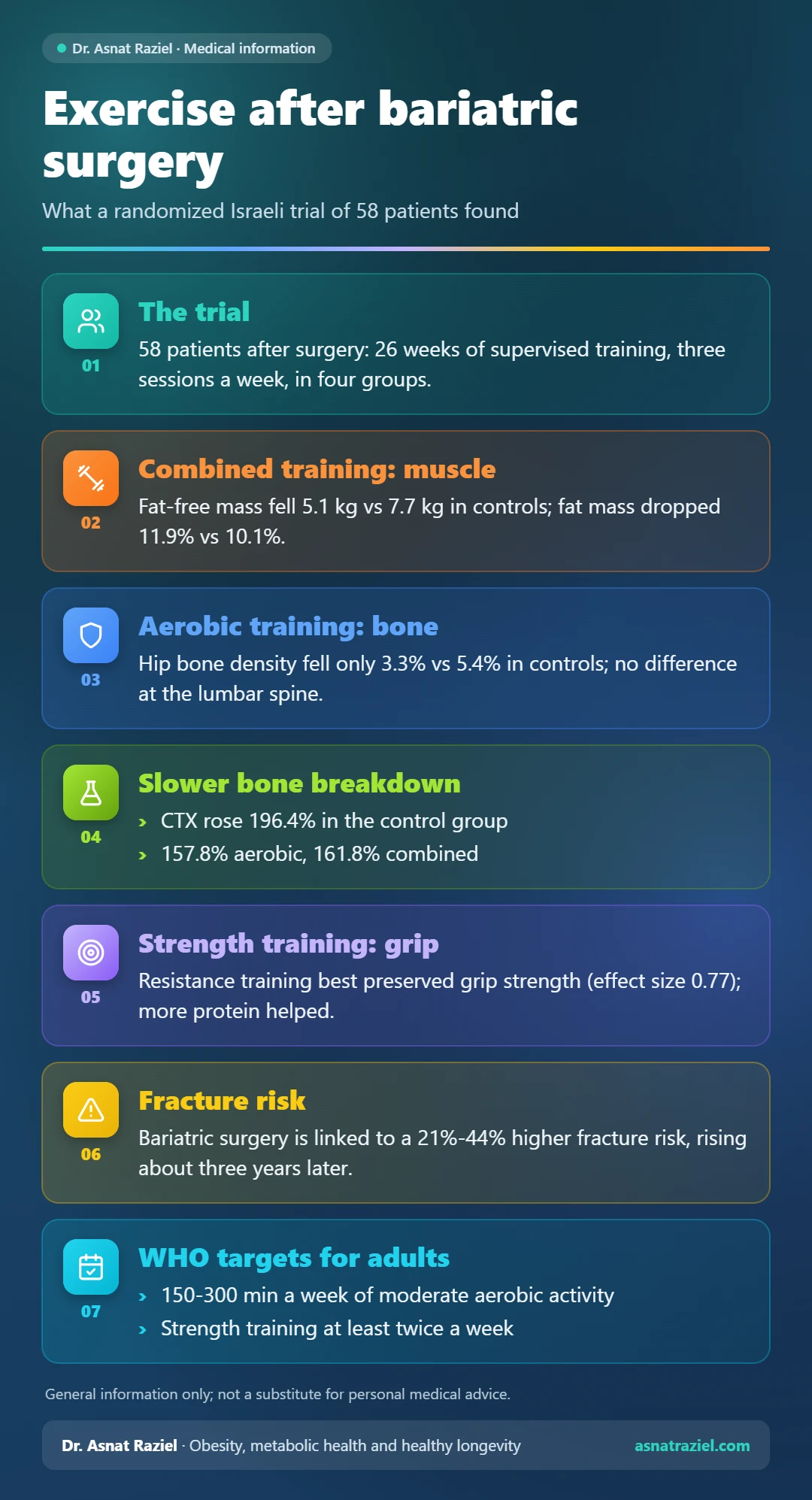
Bone also suffers. According to a position statement by the European Calcified Tissue Society, bariatric surgery is linked to a 21%-44% higher risk of fractures. The risk rises about three years after the operation. For this reason, the society recommends adequate vitamin D, calcium and protein for every patient, as well as physical activity before and after surgery.
How the study was designed
The researchers screened 443 candidates and selected 58 patients aged 18 to 65. About 70% of them were women. At the start of the study, their average BMI (body mass index, the ratio of weight to height) was 41.7. After surgery, participants were randomly assigned to four groups:
- Aerobic training, 15 participants.
- Resistance (strength) training, 13 participants.
- Combined aerobic and strength training, 14 participants.
- A control group with no training program, 16 participants.
Overall, the training program lasted 26 weeks. It included three supervised sessions a week, with intensity increasing gradually. In the end, 91.3% of participants were included in the analysis. The main outcome was the change in fat-free mass, meaning everything that isn’t fat, mostly muscle. Specifically, it was measured with a DXA scan, a low-dose X-ray scan that maps fat, muscle and bone.
Exercise after bariatric surgery: combined training preserved muscle
In the combined training group, fat-free mass dropped by an average of 5.1 kg. By contrast, the control group lost 7.7 kg. In other words, combined training clearly reduced the loss of lean tissue. This group also lost plenty of fat: an 11.9% drop in fat mass, compared with 10.1% in the control group.
This finding refutes a common fear that strength training “slows down” weight loss. In practice, the combination preserved muscle and also improved body composition. You can read more about this in my article on preserving muscle mass during weight loss.
Aerobic training protected bone
When it came to bone health, aerobic training took the lead. In the aerobic group, hip bone density fell by only 3.3%. In the control group, on the other hand, the drop reached 5.4%. There was also a moderate protective effect at the femoral neck. At the lower (lumbar) spine, however, there was no difference between the groups.
The researchers also measured CTX, a blood marker of bone breakdown. In the control group, its level rose by 196.4% after surgery. The increase was 157.8% in the aerobic group and 161.8% in the combined group. Put simply, exercise slows the accelerated bone breakdown that follows surgery. In addition, aerobic training improved the six-minute walking distance: 80.0 meters, compared with 65.6 meters in the control group.
Strength training preserved grip strength
Grip strength is a simple, important measure of muscle strength and overall function. Here the resistance training group came out ahead, with an effect size of 0.77. In fact, this was the strongest finding on muscle function in the study. Moreover, higher protein intake was linked to better preservation of grip strength. That is why close nutritional support matters just as much as the training itself. You’ll find a practical guide in my article on protein intake during weight loss.
Exercise after bariatric surgery: what does it mean for you?
These findings are consistent with a systematic review and meta-analysis of 22 training programs. The review found that exercise after surgery improves fitness and muscle strength and adds a little extra fat loss. However, its effect on lean mass was not significant. The new study shows that the type of exercise changes the picture.
Therefore, a good program combines both types. The World Health Organization guidelines recommend 150-300 minutes a week of moderate aerobic activity for adults. They also recommend strength training at least twice a week. After surgery, you should set your pace of progress together with your care team. For a comparison of the two approaches, see my article on aerobic vs. strength training.
A clinical exercise physiologist at Mayo Clinic Health System also explains why exercise is essential after bariatric surgery. She recommends a mix of cardio and strength training.
Practical steps after surgery
- Start with light walking in the first few days, as your doctor advises.
- Add strength training gradually, ideally with professional guidance.
- Make sure every meal includes protein, as your dietitian advises.
- Have your vitamin D and calcium checked regularly.
The bottom line on exercise after bariatric surgery
The success of surgery isn’t measured in kilograms alone. The real challenge is to preserve muscle, protect the skeleton and improve function over time. Exercise after bariatric surgery that combines aerobic and strength training offers the best protection for body composition. Aerobic training adds important protection for bone. Ultimately, structured physical activity should be part of every bariatric treatment plan, together with nutritional support. You’ll find more information on body composition and health throughout this site.
The information in this article is general information only and is not a substitute for personal medical advice.
References
Exercise Modalities to Preserve Muscle Mass and Bone Health After Metabolic Bariatric Surgery