By Dr. Asnat Raziel, bariatric surgeon specializing in obesity treatment, metabolic health and healthy longevity; Director of the Multidisciplinary Center for Obesity Treatment, Assia Medical, Assuta Ramat HaChayal, Tel Aviv
Sleeve vs gastric bypass: the question every candidate asks
Sleeve vs gastric bypass? It is one of the questions I hear most often in my clinic. This week, three studies added real numbers to the answer. The largest compared 132,040 patients in the United States. In addition, a Dutch study followed patients for more than ten years, and a meta-analysis looked at people with a BMI of 50 or more.
The main message is simple. Roux-en-Y gastric bypass leads to slightly more weight loss and more improvement in related diseases. On the other hand, it carries a few more complications in the first month. So there is no single “best” operation for everyone, only the right operation for a specific person.
The two operations in brief
In a sleeve gastrectomy, the surgeon removes most of the stomach and leaves a narrow tube. As a result, less food fits in, and hunger and fullness hormones change. It is the most common weight-loss operation worldwide.
In a Roux-en-Y gastric bypass, by contrast, the surgeon creates a small stomach pouch and connects it directly to the small intestine. Food then bypasses most of the stomach and the first part of the intestine. There is also a one anastomosis gastric bypass (OAGB), often called a mini bypass, with a single connection.
Sleeve vs gastric bypass at six months: 132,000 patients
Researchers at the University of Minnesota analyzed the 2023 US quality registry MBSAQIP. Out of 182,148 records, they included 132,040 patients: 92,838 had a sleeve and 39,202 had a bypass. They used a method called target trial emulation. In other words, they balanced 15 background factors between the groups so the comparison would resemble a trial as closely as possible.
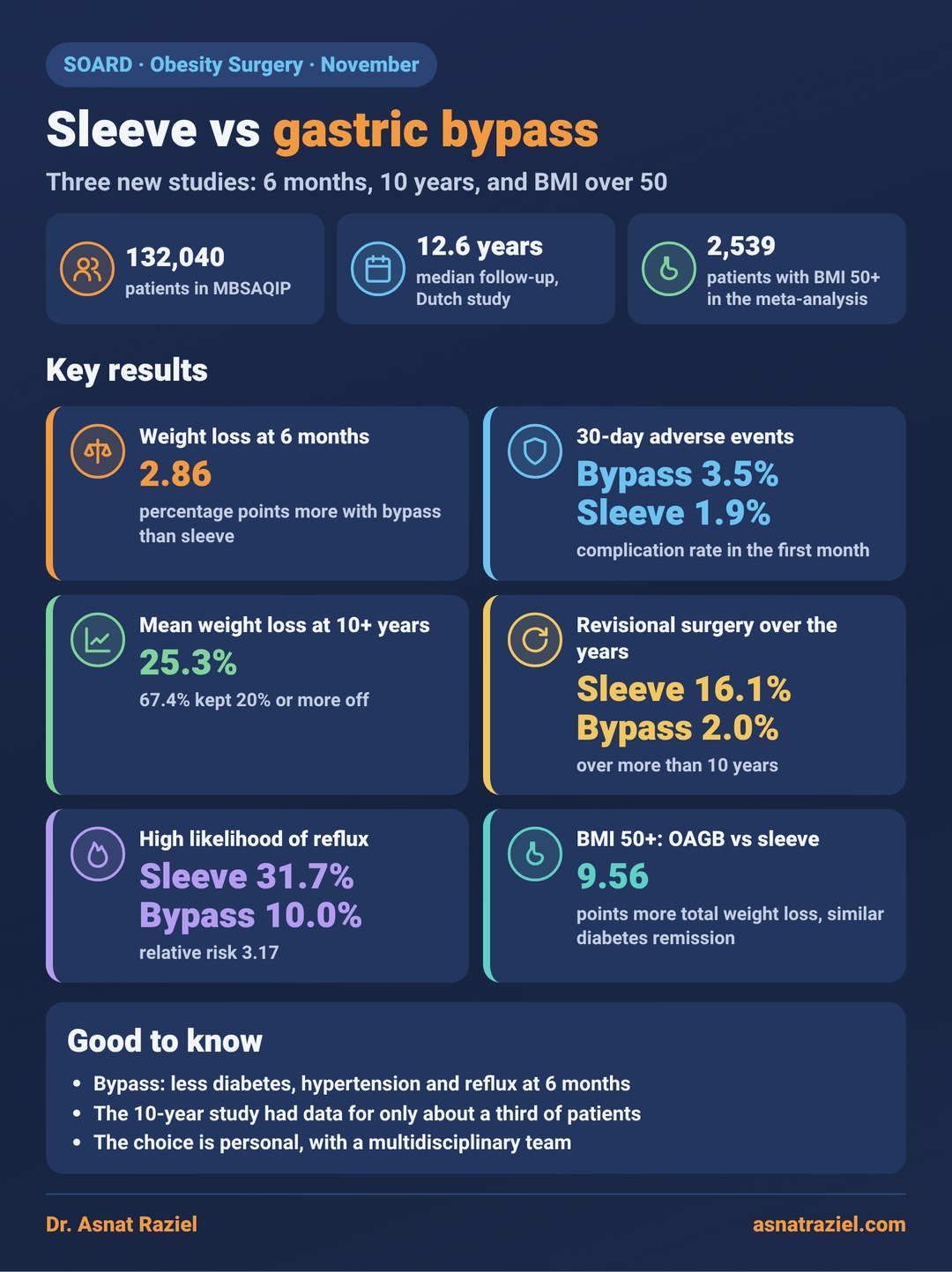
The result: at six months, sleeve patients lost 2.86 percentage points less weight than bypass patients. Bypass patients also had less diabetes, high blood pressure, reflux and high blood lipids. However, 30-day adverse events were 3.5% after bypass versus 1.9% after sleeve. You can read the full data in the study published in SOARD.
There is an important limitation. This covers only six months, and the authors themselves write that the findings do not settle long-term comparative effectiveness.
Ten years after surgery: what lasts
For the long view, a Dutch study followed sleeve and bypass patients for a median of 12.6 years. Of 2,734 patients, long-term data were available for only 879 (32.2%).
- Mean weight loss was 25.3% at ten years or more.
- Overall, 67.4% kept off 20% or more of their weight.
- After adjustment, bypass led to 2.9 percentage points more weight loss than sleeve.
- Substantial weight regain occurred in 40.6%.
- Revisional surgery: 16.1% after sleeve versus 2.0% after bypass.
- High likelihood of reflux: 31.7% after sleeve versus 10.0% after bypass.
Put simply, both operations maintain meaningful weight loss a decade later. However, the sleeve is linked to much more reflux and more revisional surgery.
Sleeve vs gastric bypass when BMI is over 50
With very severe obesity, the decision is especially complex. A meta-analysis of 11 studies with 2,539 patients compared OAGB with sleeve in people with a BMI of 50 or more. OAGB led to 9.56 more points of total weight loss. Still, there was no significant difference in diabetes remission, high blood pressure remission or reoperation rates.
How to choose between sleeve and bypass
We make this choice together, in an open conversation, based on personal factors. These are the main points I review with every patient:
- Reflux: existing heartburn or a hiatal hernia usually tips the balance toward bypass.
- Type 2 diabetes: in long-standing diabetes, bypass often improves control strongly. See also my article on obesity and type 2 diabetes.
- Very high BMI: here a mini bypass is also worth considering, as the meta-analysis shows.
- Regular medications and absorption: after bypass, absorption of drugs and vitamins changes, so close follow-up is needed.
- Age, planned pregnancy and overall health: for example, pregnancy after bariatric surgery needs special planning.
What you can do today
First, if you are considering surgery, check whether you meet the criteria. According to the international bariatric surgery societies’ indications, surgery is recommended at a BMI of 35 or more and can be considered from a BMI of 30 with metabolic disease. In Israel, these operations are provided through the health funds after a multidisciplinary assessment.
Second, get a full workup before deciding. That means blood tests, a reflux evaluation when needed, and nutritional and psychological assessments. Today there are also effective medications, and sometimes we combine them with surgery. I wrote about this in my article on surgery after GLP-1 drugs.
Finally, long-term success depends on habits. Protein-rich eating, strength and aerobic training, good sleep, and support from a dietitian and a psychologist protect against weight regain. If your weight is already creeping up, there are solutions, as I described in my article on weight regain after bariatric surgery.
It is also worth knowing how to protect your skeleton after surgery.
The bottom line on sleeve vs gastric bypass
The new data confirm that both operations work very well, even after ten years. Bypass offers a little more weight loss and less reflux, but with more early complications. So the sleeve vs gastric bypass decision should be personal, made after a conversation with an experienced team. That is how you choose the path that will serve you for years to come.
This article is general information and does not replace personal medical advice.