By Dr. Asnat Raziel, bariatric surgeon specializing in obesity treatment, metabolic health and healthy longevity; Director of the Multidisciplinary Center for Obesity Treatment, Assia Medical, Assuta Ramat HaChayal, Tel Aviv
Health habits for leaders: the LM2026 closing keynote
Health habits for leaders were the theme of the closing keynote. It wrapped up the LM2026 Lifestyle Medicine Conference in Orlando. Dr. John Findley, CEO of the American College of Lifestyle Medicine (ACLM), took the stage with a simple message. In his view, anyone who leads others has to take care of themselves first. The talk was not about drugs or technology. Instead, it focused on seven everyday habits that shape the brain, our energy and our ability to lead.
Our time, and now your time
Dr. Findley opened the conference on its first day with a talk on designing a better health care system. I wrote about that opening in Lifestyle medicine: from a movement to the standard of care. At the close, however, he turned the focus inward. “At the opening I said it’s our time,” he said. “Now it’s your time.”
He asked the audience to take the conference energy home. He also reminded them that the real work starts the next day, with colleagues who are not yet convinced. To make the point, he borrowed an image from Harry Potter. The Dementors drain joy and hope. The Patronus, on the other hand, is a protective force. That force, he said, lives inside each of us. It is built from the six pillars of lifestyle medicine. These are nutrition, physical activity, sleep, stress management, social connection and avoiding risky substances.
Why health habits for leaders are not a luxury
Findley admitted that in medicine, self-care is sometimes seen as weakness. He thinks that is a mistake. Self-care is not a detour from leadership; it is the best investment you can make in it. He put a direct question to the room: what grade would you give yourself? Do you practice the pillars regularly? Or is your grade low because other people always come first?
Here he cited Parkinson’s Law, the idea that work expands to fill all the time available. So time for self-care will never simply free up. You have to block it out in advance, just like an important meeting.
Cortisol: why leaders need health habits
Over many years as a leader, one thing surprised Findley most. It was the effect of the stress hormone cortisol on the ability to lead. In his words, chronic stress dulls your sense of humor and stifles creativity. It also makes it harder to see the big picture and to find solutions.
We know a lot about how stress affects body weight, blood pressure and loneliness. Even so, Findley argued that we talk too little about its effect on the brain. The prefrontal cortex, the region in charge of planning, judgment and decision making, responds to every one of the lifestyle pillars.
Seven health habits for leaders
The list was inspired by the well-known management book “The 7 Habits of Highly Effective People.” Early in his career, Findley said, he devoured that literature. But then he asked himself: why is nobody talking about the health habits of highly effective leaders? That question became the following list of health habits for leaders.
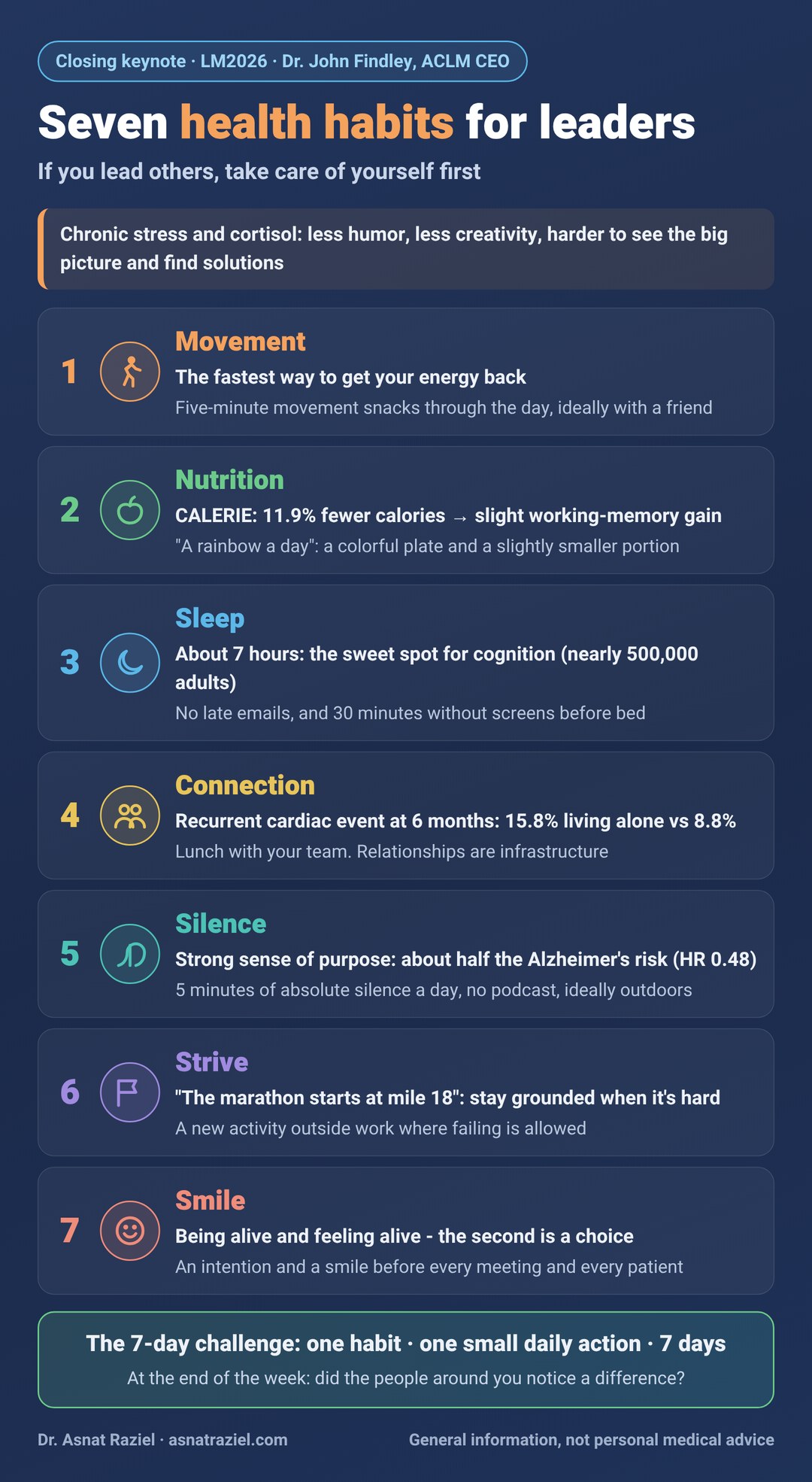
1. Movement: five-minute movement snacks
“Movement is medicine,” said Findley, a longtime marathon runner. He called movement the fastest way to get your energy back. It also sharpens your ability to communicate, persuade and bring others along. In addition, it supports better sleep and a sense of purpose.
His advice is practical: five-minute movement snacks spread through the day, ideally with a friend or colleague. He used to tell patients to commit to just five minutes. Once the endorphins and serotonin kick in, many decide to keep going for ten. Ultimately, the hardest part, he joked, is tying your shoes. If you want more on walking, see my article on walking and Alzheimer’s prevention.
2. Nutrition: fuel for the brain, not just the body
The second message: food is fuel for the brain. Findley presented a study comparing total brain volume, white and gray matter, on a whole-food, plant-based, anti-inflammatory diet versus the standard American diet. According to him, brain volumes improved consistently, in people with and without metabolic disease. He also mentioned a new JAMA review on a brain-healthy plate, in the spirit of the MIND diet. That diet combines the Mediterranean diet with the DASH diet for lowering blood pressure.
However, the research picture is mixed. A randomized trial of the MIND diet enrolled 604 older adults, and both groups also followed mild calorie restriction. After three years, cognition improved in both groups, with no significant difference between them.
His second point was quantity. In the CALERIE study, healthy adults without obesity were asked to cut calories by 25% for two years. In practice, participants reached an average reduction of 11.9%. An analysis of working memory in the study found a significant improvement in the restriction group compared with controls. The researchers described the effect as slightly positive. Findley put it simply: that is about one bagel a day. He also suggested swapping “an apple a day” for “a rainbow a day,” meaning a colorful plate of vegetables and fruit.
3. Sleep: the performance tool we all neglect
According to Findley, sleep is not just recovery; it is a performance tool. During sleep the glymphatic system, a network that clears metabolic waste from the brain, goes to work. In a mouse study published in Science, researchers found that the space between brain cells grew by 60% during sleep. As a result, clearance of amyloid beta from the brain sped up. Findley compared the system to a wide push broom moving slowly down a hallway. He said it needs about seven hours to clear the day’s waste.
In people, too, seven hours looks like the sweet spot. A study of nearly 500,000 adults in the UK Biobank found a U-shaped pattern. In other words, both short and long sleep went along with weaker cognitive performance. Findley’s advice: no emails at 10 p.m. or 5 a.m., less screen time, and 30 minutes to wind down before bed. I covered the night-time link to the brain in Sleep and brain health. The conference sleep lecture is covered in Healthy sleep: four dimensions to check.
4. Connection: relationships are infrastructure
Findley pointed to the Harvard Study of Adult Development, which has been running since 1938. He said it shows a link between relationships and happiness, health and meaning. He also thanked Dr. Dean Ornish for bringing a rare word into medicine: love. Research on heart patients supports the idea. One example is a study published in JAMA. There, the rate of recurrent cardiac events at six months was 15.8% among people who lived alone. Among those who did not live alone, it was 8.8%.
At work, according to the surveys he showed, meaningful connections boost psychological safety. They also lead to better ideas and problem solving, along with higher satisfaction and engagement. “Relationships are not soft skills,” he said. “They are the infrastructure for greatness.” Therefore, his advice: schedule a lunch and get to know the people on your team. I wrote about love and longevity in Social connections and longevity.
5. Silence: step away to see the way
A sense of purpose and meaning, Findley said, goes along with slower cognitive decline and a lower risk of dementia. In a study of 951 older adults, for example, a strong sense of purpose came with roughly half the risk of Alzheimer’s disease (HR 0.48). After all, we all know someone who retired and declined quickly. That is why a reason to get up in the morning matters.
Findley also described meditation as a well-studied practice that activates the prefrontal cortex. In his words, studies of meditators found better executive function, accuracy and working memory. His challenge: five minutes of absolute silence a day, with no podcast and no music. Nature also helps. Time outdoors, he said, lowers blood pressure, anxiety and stress, and restores focus. I covered the research in Meditation research, and meaning in medicine in Spirituality in medicine.
6. Strive: get comfortable being uncomfortable
“The marathon starts at mile 18,” Findley said. That is where negative self-talk shows up and the urge to stop grows stronger. Endurance running, he explained, did not make him tough. Instead, it taught him to stay grounded when things get hard. The leadership lesson: face reality, listen to your cues, respond rather than react, and move through the discomfort.
He quoted a line often attributed to Winston Churchill. “Success is not final, failure is not fatal: it is the courage to continue that counts.” For the record, quote researchers found no evidence that Churchill ever said it. His challenge to the audience: try something outside work with a real chance of failure. For example, ballroom dancing, pickleball or a race.
7. Smile: energy is a choice
The last habit is attitude. “Being alive and feeling alive are two different things,” Findley quoted, “and the second one is a choice.” According to him, workplace research found that leaders who smile build connection and trust. It also found a link between a leader’s smile and better business performance. On the other hand, he reminded the room that everyone has bad days. Sometimes, without noticing, we are the Dementor who leaves a meeting after draining its energy.
The washer on a string: an exercise in energy
Near the end, Findley asked the audience to hold a metal washer dangling from a string. With eyes closed, each person recalled the energy of the conference and thought of one colleague they could influence. Then the audience silently “told” the washer to swing back and forth, side to side and in a circle, without moving it.
Findley openly admitted that he is an evidence-minded skeptic and does not know whether the exercise works. In fact, science knows this as the ideomotor effect: tiny, unconscious muscle movements that move the string. But the point was not scientific. It was meant to show that the energy we project affects the people around us.
A seven-day challenge to start health habits for leaders
In his final minutes, Findley gave the audience a simple assignment. First, pick one of the seven habits. Do one small action each day for seven days. That is the easiest way to start health habits for leaders. Then see whether friends, family and colleagues notice a difference. As an example, he described how between patients he used to set an intention and walk into the room with a smile.
“Don’t work too hard on yourselves,” he added. “Being a perfectionist is hard.” Small improvements, he said, add up over time, and self-love is something we rarely talk about. I wrote more about the power of small steps in Small lifestyle changes.
Health habits for leaders: what this means for you
Findley aimed his words at physicians and health system leaders. Still, the message fits anyone who leads others: a team manager, a business owner, a parent. In my obesity and metabolic health clinic, these habits are the foundation of every treatment, including when we use medication. I wrote about that in Lifestyle medicine in obesity. Here is how you can start this week:
Movement: a five-minute walking break, two or three times a day.
Nutrition: a colorful plate, and a slightly smaller portion than usual.
Sleep: no late-night emails, and half an hour without screens before bed.
Connection: one lunch a week with someone from your team.
Silence: five minutes without your phone, ideally outdoors.
Strive: a new activity where failing is allowed.
Smile: a moment to pause and set an intention before every meeting.
The bottom line on health habits for leaders
The LM2026 closing keynote brought lifestyle medicine back to the people who deliver it. Findley’s message was clear: you cannot lead change in other people’s health without investing in your own. Health habits for leaders are not a big project. They are one small action a day, seven days in a row, and then another week.
This article is general information and does not replace personal medical advice.
References
Sleep drives metabolite clearance from the adult brain
The effect of caloric restriction on working memory in healthy non-obese adults
Trial of the MIND Diet for Prevention of Cognitive Decline in Older Persons
Living alone after myocardial infarction. Impact on prognosis
Harvard Study of Adult Development
Success Is Never Final and Failure Never Fatal. It’s Courage That Counts