By Dr. Asnat Raziel, bariatric surgeon specializing in obesity treatment, metabolic health and healthy longevity; Director of the Multidisciplinary Center for Obesity Treatment, Assia Medical, Assuta Ramat HaChayal, Tel Aviv
Small lifestyle changes: the new message of longevity medicine
Small lifestyle changes can have a surprising effect on health and lifespan. Modern medicine is used to thinking big: new drugs, advanced surgery and breakthrough technologies. However, recent research offers a simple message. Even a small improvement in sleep, movement and diet may extend life and improve its quality.
The gain does not come from one big change. In fact, it comes from a combination of small steps that add up over time. This approach changes the way we understand preventive medicine. Instead of dramatic and sometimes impossible goals, it offers gradual, lasting improvement.
The study: a few minutes a day change the picture
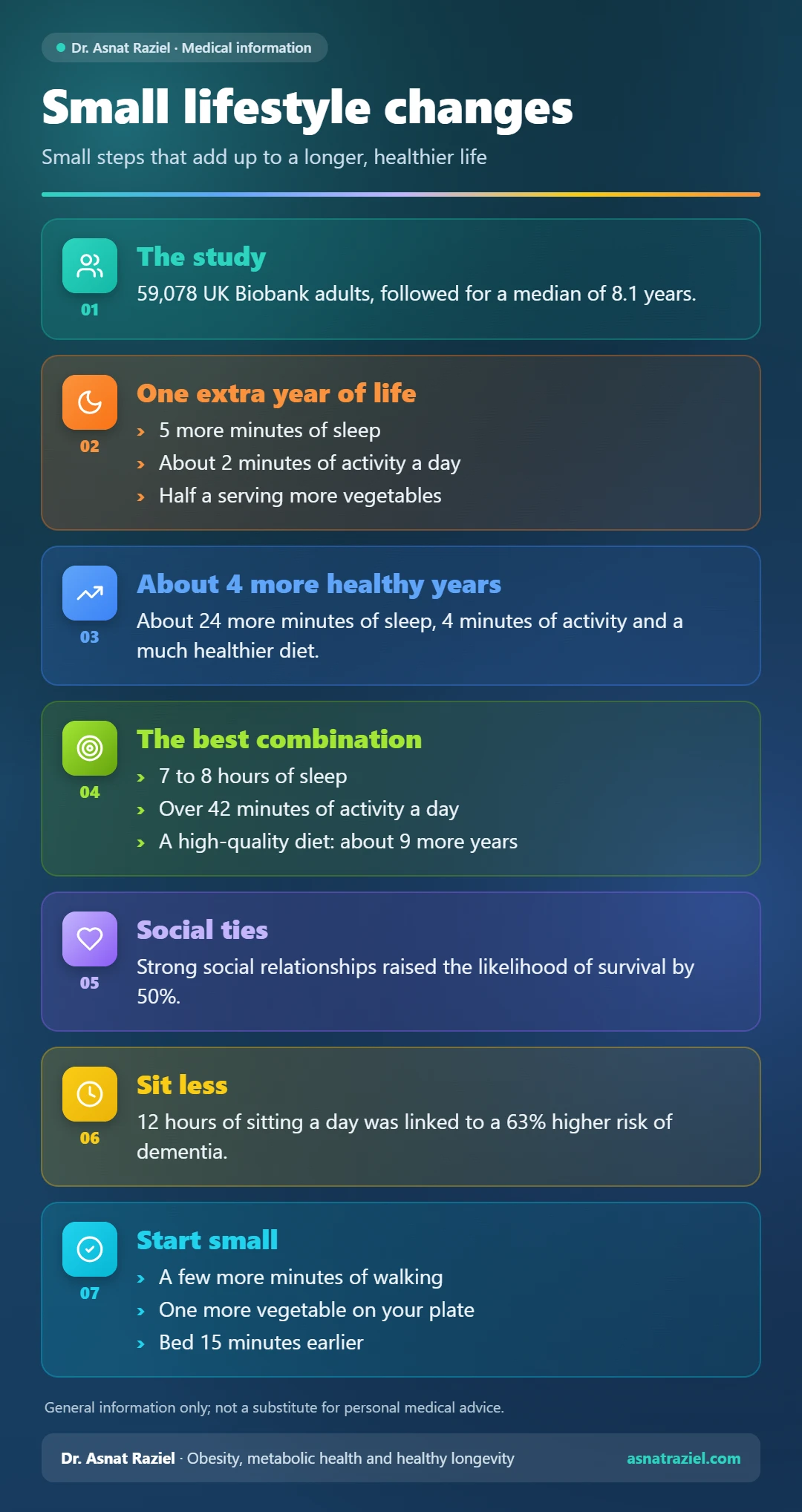
In early 2026, researchers from Australia and the UK published a study in the journal eClinicalMedicine. They used data on 59,078 adults from the UK Biobank database. Participants wore a wrist activity tracker for a week, which measured their sleep and activity. The researchers then followed them for a median of 8.1 years.
The main finding is surprising in its simplicity. Among people with the least healthy habits, three tiny changes together were linked to one extra year of life:
- About five more minutes of sleep a night.
- About two minutes (1.9) of moderate to vigorous physical activity a day.
- A small improvement in diet, such as an extra half serving of vegetables a day.
When the improvement is a little larger, the gain grows too. About 24 more minutes of sleep, about 4 minutes of activity a day and a much healthier diet were linked to about 4 more years of healthy life. The best combination included 7 to 8 hours of sleep, more than 42 minutes of activity a day and a high-quality diet. Compared with the least healthy habits, it was linked to about 9 more years of life.
It is important to remember that this is an observational study. It shows an association and does not prove cause and effect. Still, the direction is clear: even small steps add up to a big impact.
Why combining habits is the key
One of the most important messages of the study is the power of combination. The big effect does not come from a single change, but from several healthy habits at once. For example, a little more movement, a little less sitting, good sleep and a slightly healthier diet. When each factor improves even slightly, the effect on the body’s systems builds up. As a result, the risk of diabetes, heart disease and obesity may fall.
This approach fits with long-term research. For instance, a large American study followed about 123,000 health professionals for up to 34 years. The researchers looked at five habits: not smoking, keeping a healthy weight, at least 30 minutes of activity a day, moderate alcohol and a high-quality diet. At age 50, women who adopted all five could expect to live 14 more years on average. For men, the gap was 12.2 years, compared with those who adopted none of the habits.
Simple everyday movement also pays off. You can read about the link between daily steps and keeping weight off in my article on 8,500 steps a day. Similarly, the importance of sleep is covered in my article on the effects of sleep deprivation.
Small lifestyle changes and healthspan
Today’s science looks not only at how many years we live, but also at their quality. The term healthspan describes the number of years a person lives in good health and good function. In the new study, small lifestyle changes were also linked to more years free of major chronic disease. That means less illness, less dependence on medical care and a good quality of life, even in older age. I compare different approaches to extending these healthy years in my article on wellness, longevity and lifestyle medicine.
Stress, social connection and meaning in life
A healthy lifestyle is not only about diet and exercise. Mental and social factors matter too. Managing stress, easing anxiety and having strong social ties are all linked to good health and a long life. For example, a meta-analysis of 148 studies with 308,849 participants examined this question. The researchers found that strong social relationships raised the likelihood of survival over the follow-up period by 50%.
The same features also appear in research on the Blue Zones. These are regions of the world where researchers documented unusual longevity. Their shared features include moderate daily movement, a plant-based diet and meaningful social ties. That said, some researchers question part of the data on these regions. So it is best to see them as inspiration rather than proof. You can watch this video on the link between social isolation and dementia. In addition, you will find tools for relaxation in my article on meditation and stress relief.
No revolution needed: how to start small lifestyle changes
Many people struggle to keep up a healthy lifestyle because they think it requires a dramatic change. A strict diet, intense workouts or a completely new routine seem like a must. The new research suggests a different view. You do not need to run five kilometers a day. Nor do you need to change your entire menu at once. And you certainly do not have to reach eight hours of sleep right away. Sometimes, steps like these are enough:
- A few more minutes of walking each day.
- One more vegetable on your plate.
- Going to bed a quarter of an hour earlier than usual.
- Getting up from your chair for a few minutes every hour.
Kept up over the years, these steps may have a meaningful effect on health. Precisely because they are small, they are much easier to stick with. At the same time, it is also important not to overdo it, even with healthy habits.
Prolonged sitting is a good example of the power of small habits. A study in JAMA followed 49,841 adults aged 60 and over. Compared with 9.27 hours of sitting a day, 12 hours of sitting was linked to a 63% higher risk of dementia. You can also watch a video on sitting and dementia.
Preventive medicine: small lifestyle changes as the foundation
The broader meaning of these findings is a shift in medical thinking. Instead of waiting for disease, modern medicine focuses on prevention. This approach is especially important for metabolic diseases: obesity, type 2 diabetes, high blood pressure and heart disease. Treatment often starts with very small steps. Yet when they are consistent, they create deep change. Even when medication is needed, lifestyle remains the foundation. I cover this in my article on lifestyle medicine in obesity treatment.
The bottom line: small steps, big impact
The message is simple but meaningful. Longevity does not depend only on advanced medical technology or dramatic interventions. Sometimes it is small lifestyle changes that shape our health over the years. A few more minutes of movement. A little more sleep. And, on top of that, more vegetables on the plate.
This article provides general information and is not a substitute for personal medical advice.
References
Impact of Healthy Lifestyle Factors on Life Expectancies in the US Population
Social relationships and mortality risk: a meta-analytic review




