By Dr. Asnat Raziel, bariatric surgeon specializing in obesity treatment, metabolic health and healthy longevity; Director of the Multidisciplinary Center for Obesity Treatment, Assia Medical, Assuta Ramat HaChayal, Tel Aviv
Meditation research: what was tested and why it matters
New meditation research appears almost every week, but not all of it is equally reliable. In this article, I focus on what clinical trials actually measured: anxiety, cortisol, blood pressure and markers of inflammation. Ongoing stress affects appetite, sleep, blood pressure and blood sugar control. That is why, at our clinic, we ask every patient about their stress levels. I cover the direct link between meditation and body weight in a separate article on meditation, emotional eating and weight.
What chronic stress does to the body
Under stress, the body releases hormones such as cortisol and adrenaline. In the short term, this is a useful response that prepares us for action. However, when stress lasts for weeks and months, the same response starts working against us. Cortisol raises blood sugar and encourages fat to build up around the belly.
In addition, stress changes our behavior. People under stress sleep less, move less and reach for comfort food that is sweet and fatty. This creates a cycle: stress leads to eating, and eating leads to guilt and even more stress. I have written more about this in my article on the link between stress and obesity. Good sleep is also an important part of the solution.
Meditation research on anxiety, cortisol and inflammation
Meditation is training for your attention. For example, mindfulness, which means paying deliberate attention to the present moment, teaches you to notice thoughts and sensations without reacting to them right away. There are also other methods, such as mantra-based meditation. A broad overview of the effects of meditation shows that meditation research has grown enormously, but its quality varies.
47 trials: anxiety, depression and perceived stress
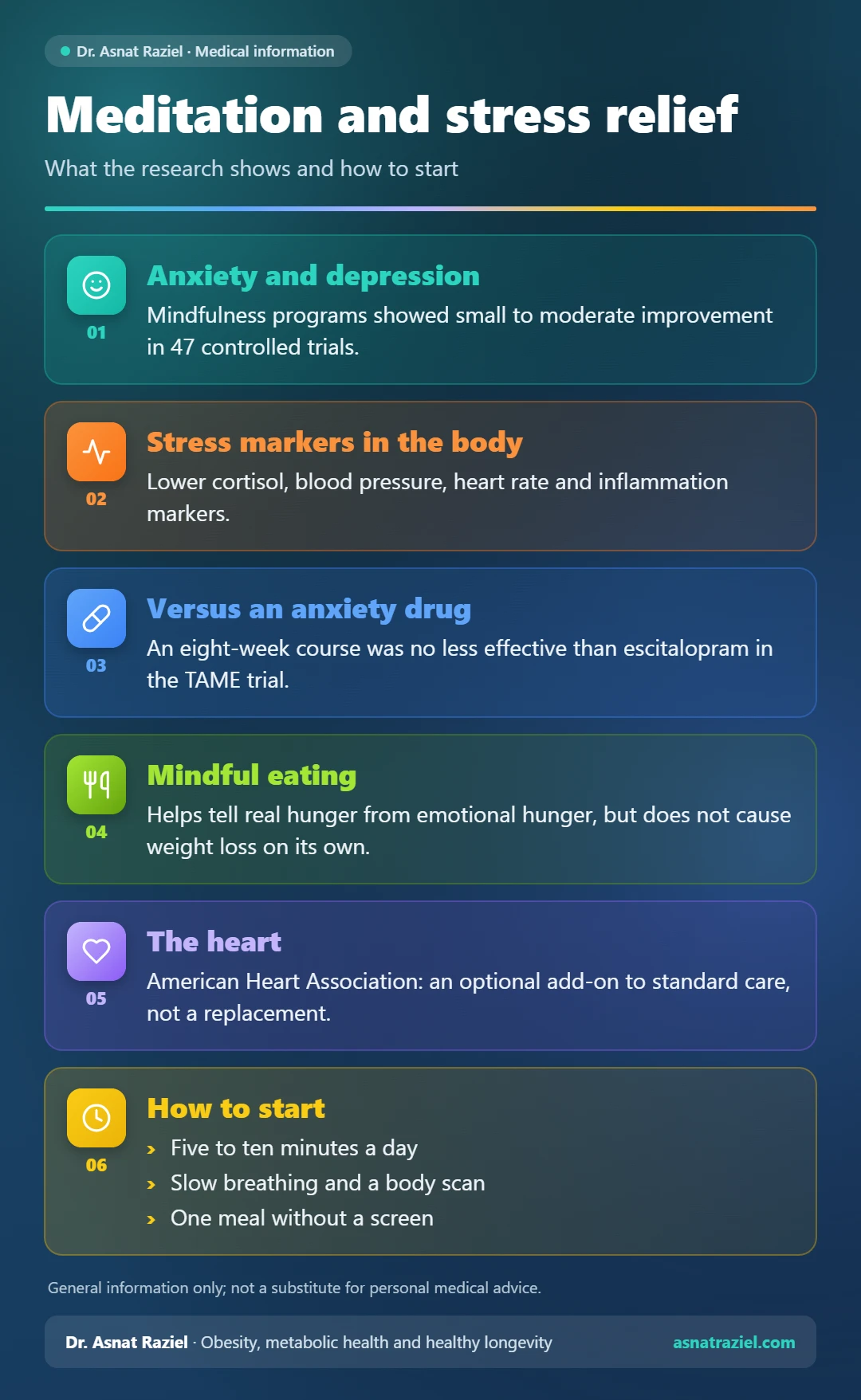
In a meta-analysis from Johns Hopkins University, researchers included 47 controlled trials with 3,515 participants. Mindfulness programs improved anxiety, depression and pain to a small to moderate degree. By contrast, the evidence for an effect on perceived stress itself was of lower quality. Moreover, the researchers did not find meditation to be better than other active treatments, such as medication or exercise.
45 studies: physical markers of stress
Another meta-analysis examined 45 studies that compared meditation with a control activity. In the pooled analysis, meditation lowered cortisol, blood pressure, heart rate and triglyceride levels. It also lowered two markers of inflammation: CRP (a protein that reflects inflammation in the body) and TNF-alpha. In other words, the effect shows up not only in how people feel, but also in lab tests.
The TAME trial: meditation compared with an anxiety drug
In the TAME trial, 276 adults with an anxiety disorder were split into two groups. One group took an eight-week mindfulness course (MBSR), and the other received the drug escitalopram. At the end of the study, the course was no less effective than the drug at reducing anxiety. What is more, side effects were reported by 15.4% of the meditation group, compared with 78.6% of the medication group. Still, this does not mean anyone should stop their medication without medical advice.
How to read the numbers in meditation research
Not every study carries the same weight. A meta-analysis pools dozens of controlled trials, so it is more reliable than a single study. For example, the Johns Hopkins review included 47 trials and 3,515 participants, and the review of stress markers included 45 studies. In contrast, TAME is a single randomized trial with 276 participants, but it compared meditation directly with a drug. Finally, the retreat study with 632 participants, described below, is observational, so it cannot prove cause and effect. So when you see a headline about meditation, ask three questions. How many people took part? Was there a control group? And what was meditation compared with?
What the studies say about meditation and weight
Here, it is important to be precise. According to meditation research so far, meditation alone is not a weight-loss treatment, and the Johns Hopkins meta-analysis found insufficient evidence of an effect on weight. On the other hand, it can improve your relationship with food. A broader approach appears in my four-step stress management plan for weight loss. In the SHINE study, for example, 194 adults with obesity took part in a diet and exercise program lasting about five and a half months. Half of them also received mindfulness training. In an analysis of the study results, the mindfulness group improved mindful eating and kept fasting blood sugar stable after one year.
In practical terms, meditation helps you tell real hunger from emotional hunger. It also quiets what is known as food noise, the constant thoughts about food. When obesity comes with complications, meditation works well alongside medication, not instead of it.
Meditation research on the heart and longevity
The American Heart Association published a scientific statement on meditation and cardiovascular risk. According to the statement, meditation may help lower that risk, but the quality of the studies is modest. Therefore, the association recommends considering it as an add-on to standard care for those who are interested. It complements a healthy lifestyle and heart medications, but it does not replace them.
What about longevity? Low-grade chronic inflammation speeds up aging. It is also linked to the buildup of so-called zombie cells, aging cells that release inflammatory substances. A Psychology Today article on meditation and longevity describes an observational study of 632 adults. After an eight-day meditation retreat, participants lost about 3% of their body weight, and their CRP levels dropped. However, this is an observational study by a single team, and it does not prove that meditation extends life.
How to start, based on what the studies tested
- Start small: five to ten minutes a day, at the same time, is better than half an hour once a week.
- Slow breathing: breathe in through your nose, breathe out slowly through your mouth, and pay attention to the sensation.
- Body scan: move your attention from your feet up to your head and release tension as you go.
- Mindful eating: one meal a day without a screen, eaten slowly, with attention to taste and fullness.
- A structured course: an eight-week program such as MBSR has been tested in the best studies.
Keep in mind that meditation is only one tool. Some people connect better with art therapy, while others use brainspotting therapy to work through trauma. For more practical options, see my guide to everyday stress relief techniques. In the end, the best method is the one you stick with.
Who should be careful
For most people, meditation is safe. However, in people with severe trauma, deep depression or active psychiatric conditions, it can stir up difficult feelings. In such cases, it is best to practice with the guidance of a professional. In addition, meditation does not replace medication or mental health treatment prescribed by a doctor.
Bottom line
Meditation is a simple, inexpensive tool that is safe for most people. Meditation research shows a small to moderate improvement in anxiety and depression, along with lower cortisol, blood pressure and inflammation markers. On the other hand, meditation alone does not cause weight loss, but it can support mindful eating and help you stay with your treatment. If stress affects your eating or your health, it is worth building meditation into a comprehensive plan.
The information in this article is general and does not replace personal medical advice.
Questions and answers
Does meditation help with weight loss?
Not directly. However, meditation helps reduce emotional eating and improve mindful eating, so it supports a treatment plan.
How long do I need to practice before I notice a change?
In most of the high-quality meditation research, programs lasted about eight weeks, with short practice sessions almost every day.
Can meditation replace anxiety medication?
In the TAME trial, a mindfulness course was no less effective than the drug. However, any decision to stop a medication should be made only together with your doctor.
Does meditation lower blood pressure?
Yes, to a moderate degree. Meta-analyses have shown a drop in systolic blood pressure, but meditation complements treatment rather than replacing it.
Sources
Meditation programs for psychological stress and well-being: a systematic review and meta-analysis
Mindfulness mediates the physiological markers of stress: Systematic review and meta-analysis