By Dr. Asnat Raziel, bariatric surgeon specializing in obesity treatment, metabolic health and healthy longevity; Director of the Multidisciplinary Center for Obesity Treatment, Assia Medical, Assuta Ramat HaChayal, Tel Aviv
Stress management for weight loss: what really helps
Stress management for weight loss is not a luxury; it is part of treatment. Ongoing stress disrupts sleep, increases appetite and pushes us toward comfort food. In this article, I offer a practical plan with a clear order of priorities: sleep first, then breathing, movement and spotting emotional eating. Research shows that these tools do not replace obesity treatment, but they certainly support it.
I have written in detail about the biology behind this link in my article on stress and obesity. Here, I focus on the practical side: what to do day to day, and what the data show. For general calming methods that are not specifically about weight, see my guide to stress relief techniques. I also review what clinical trials show about meditation in a separate review of the evidence on meditation.
In brief: why stress makes weight loss harder
Under stress, the body releases cortisol, the stress hormone. Over time, high cortisol fuels cravings for sweet and fatty food, and especially the buildup of belly fat. You can read more about the hormonal mechanism of stress and other causes of weight gain.
In addition, stress harms sleep and saps the energy to exercise. In other words, it works through several channels at once. That is why the solution also needs several tools, not a single trick.
What studies show about stress management for weight loss
In Greece, researchers tested a stress management program in 45 adults with obesity. Over 8 weeks, participants learned diaphragmatic breathing, muscle relaxation and guided imagery. By the end of the program, their BMI had dropped by 3.1 units, compared with 1.74 in the control group. Their anxiety and depression scores also improved.
However, not all studies are clear-cut. A pilot study in the United States included 44 women with moderate to high stress levels. Those who also received stress management tools lost 2.7% of their body weight, compared with 1.4% in the standard program, but the difference did not reach statistical significance. In the end, the picture is consistent: stress management adds value, but mainly as part of a broader program.
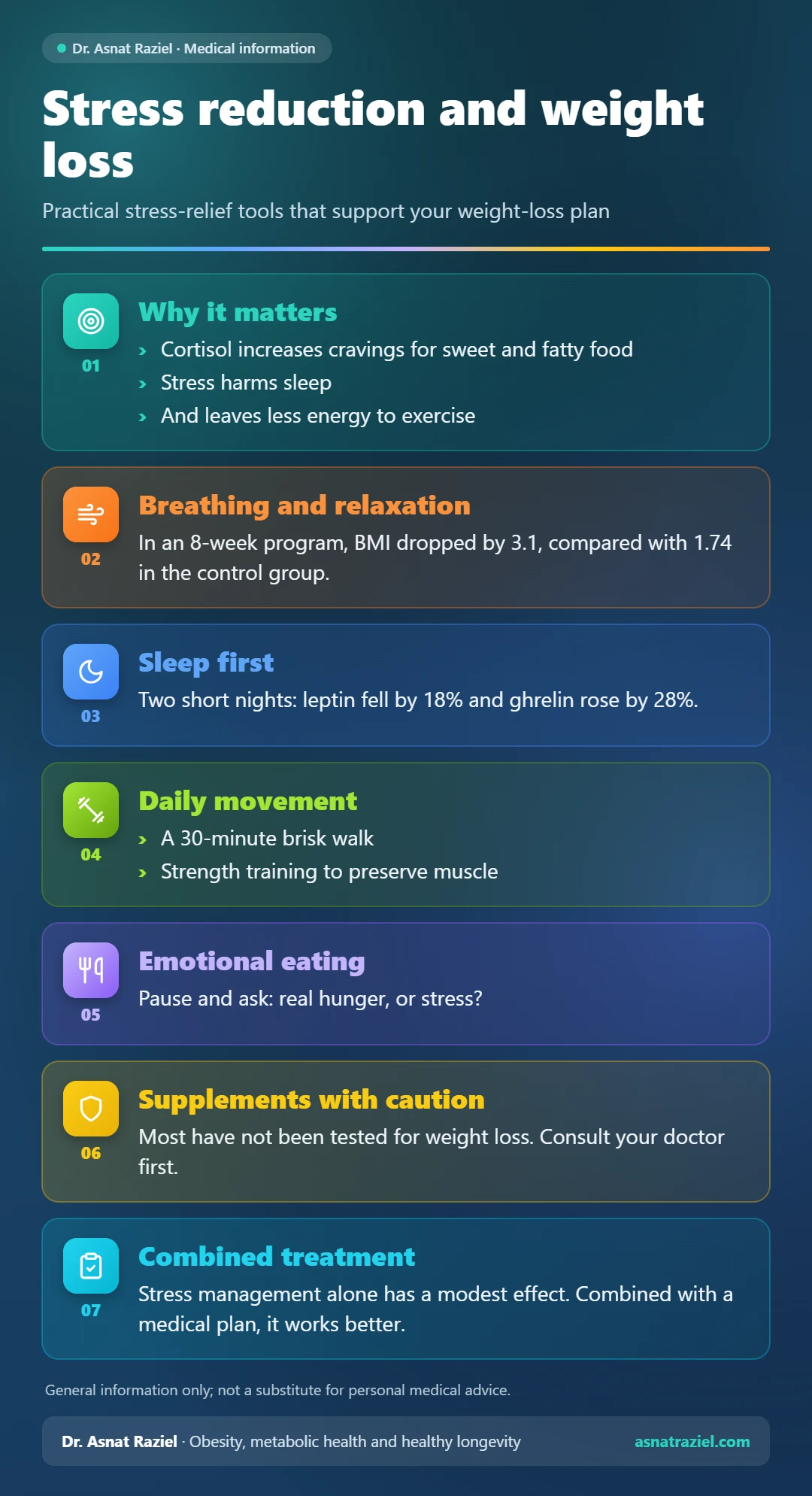
A four-step stress management plan for weight loss
From the studies above, I build a simple stress management plan for weight loss in a fixed order. Step one is sleep, because two nights of short sleep raised the hunger hormone ghrelin by 28%. Next comes five minutes of breathing a day, for example breathing in for four seconds and out for six. The third step is movement, such as a 30-minute brisk walk. Finally, learn to spot emotional eating before you eat. Supplements call for caution, and medication is added when these steps are not enough.
Step one: sleep
Short sleep increases stress, and stress shortens sleep. In a classic study, two nights of restricted sleep in 12 young men lowered the satiety hormone leptin by 18%. At the same time, the hunger hormone ghrelin rose by 28%, and hunger increased by 24%.
That is why I almost always start stress management for weight loss with sleep. A fixed bedtime, screens off an hour before bed and a dark, cool bedroom are a good foundation. I have written separately about the link between sleep and brain health.
Step two: five-minute breathing and relaxation
The tools tested in the Greek study are very simple. Slow diaphragmatic breathing calms the nervous system within minutes. For example, breathe in through your nose for four seconds and breathe out slowly for six seconds. Progressive muscle relaxation, which means tensing and releasing muscle groups one after another, helps you fall asleep.
Some people feel that stress is “stuck” in the body. In such cases, body-based approaches such as somatic experiencing can complement the work.
Step three: movement, the double-duty tool
Physical activity is one of the most effective tools against stress. A 30-minute brisk walk, swimming or cycling improves mood and sleep. What is more, strength training preserves muscle mass during weight loss. A daily walk with the dog is a simple way to start.
Step four: spot emotional eating before you eat
A lot of eating under stress is not real hunger. So it is worth pausing for a moment to ask: am I hungry, or am I tired, angry and tense? A study of mindfulness for emotional eating included 47 women with overweight. On average, weight did not change, but participants with obesity lowered their morning cortisol response and kept their weight stable. By contrast, women with obesity in the waitlist group gained weight.
In a trial from Brazil with 138 women, mindful eating reduced emotional eating. However, it did not add weight loss beyond a reduced-calorie diet. My conclusion: mindfulness helps you control eating, but it is less of a direct engine for weight loss.
Anti-stress supplements: be careful
Anti-stress supplements are very popular, but most have not been well tested for weight loss. Some people choose turmeric, and others choose ashwagandha. Before you start, read about ashwagandha safety and talk to your doctor, especially if you take regular medications.
Stress management for weight loss in hard times
There are periods when stress is beyond our control, such as war, illness in the family or a crisis at work. In such situations, the goal is to maintain a baseline, not to reach a peak. I have gathered practical tips in my article on staying healthy during wartime.
On the other hand, when stress lasts for months and comes with depression or anxiety, it is important to seek professional help. Mental health care is not a luxury; it is part of weight treatment.
When stress management for weight loss is not enough
Sometimes reducing stress on its own is not enough. Modern obesity medications reduce hunger and “food noise,” and in doing so they also ease some of the pressure around food. I have written separately about the link between medication and mental health, and about Wegovy at the high dose.
In any case, it is the combination that works: a healthy lifestyle, good sleep, stress-reduction tools and, when needed, medication. If you would like a personalized plan, you can turn to us for a personal consultation and a tailored treatment plan.
Bottom line
Reducing stress and losing weight go hand in hand. Still, stress management for weight loss usually has only a modest effect on weight when used on its own. The most effective tools are regular sleep, daily movement, breathing and relaxation, and recognizing emotional eating. When you combine them within a comprehensive medical program, your chances of succeeding and keeping the results go up.
The information in this article is general and does not replace personal medical advice.
Questions and answers
Can stress management alone lead to weight loss without a diet?
Reducing stress on its own usually leads to only a small change in weight. Still, it makes it much easier to stick to your eating plan and to sleep well, so it is an important partner in any program.
How much time a day do I need to practice?
You can start with five to ten minutes of breathing or relaxation a day. Consistency matters more than the length of each session.
Do obesity medications also help with emotional eating?
For many people, they reduce hunger and thoughts about food. However, they do not replace emotional support, so it is worth combining the two.
Sources
Mindful eating for weight loss in women with obesity: a randomised controlled trial