By Dr. Asnat Raziel, bariatric surgeon specializing in obesity treatment, metabolic health and healthy longevity; Director of the Multidisciplinary Center for Obesity Treatment, Assia Medical, Assuta Ramat HaChayal, Tel Aviv
Spirituality in medicine: back to the big questions
Spirituality in medicine is returning to center stage. A new paper calls for bringing meaning in life, a sense of purpose and spirituality back to the heart of healthcare. According to the authors, this is not just a philosophical idea. It is a factor that affects health, coping with illness and the success of treatment.
Modern medicine is advancing at a tremendous pace. Biologic therapies, artificial intelligence and advanced surgery are changing its face. Yet alongside the technology, many doctors and researchers point to a deeply human element that is sometimes forgotten: meaning, purpose and spirituality. In the world of lifestyle medicine, experts are now calling for them to return to patient care.
Medicine for the whole person
In recent decades, an approach called lifestyle medicine has developed. It emphasizes that health does not depend only on drugs or surgery. It also depends on habits: nutrition, physical activity, sleep, stress management and social connections.
The new paper adds another layer to this approach. The authors propose treating meaning, purpose and spirituality as a basic part of care, not a marginal add-on. In their view, a person who feels they have a reason to get up in the morning finds it much easier to:
- Adopt a healthy lifestyle.
- Cope with illness.
- Stick with treatment over time.
The authors remind us that health is not merely the absence of disease. It is a broad state of physical, mental and existential well-being. A similar approach also guides combined obesity treatment at our clinic.
An expert summit: nearly 100 researchers and clinicians
The paper is based on the work of a large expert group. The group met in March 2025 in San Diego, at a professional summit on the topic. The meeting was initiated by the American College of Lifestyle Medicine (ACLM), together with the Global Positive Health Institute. The Ardmore Institute of Health funded the summit.
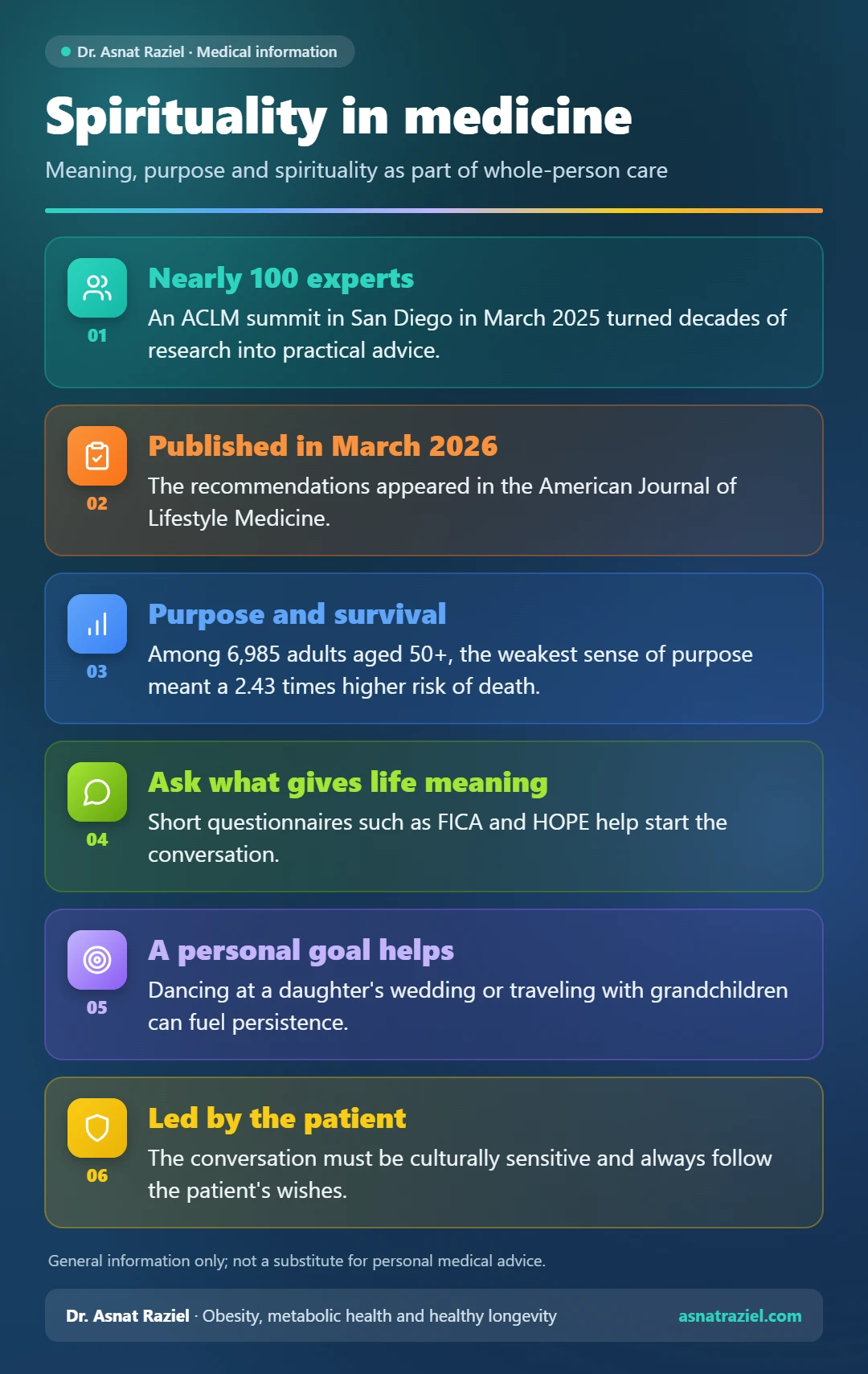
Nearly 100 experts from different fields took part in the discussions. Their goal was to translate decades of research into practical recommendations for doctors and health systems. The result was published in March 2026 in the American Journal of Lifestyle Medicine, as part of a special issue on the topic.
Spirituality in medicine and meaning in life: the link to health
Many studies show a link between a sense of meaning and good health. According to the paper, people with a sense of purpose tend to adopt healthy habits. In addition, they develop mental resilience and enjoy greater emotional well-being. What’s more, their risk of death over the years is lower.
The data are impressive. A US study followed 6,985 adults aged 50 and older. Among those with the weakest sense of purpose, the risk of death was 2.43 times higher than among those with the strongest sense of purpose. Likewise, a systematic review in JAMA recommended incorporating spiritual care into the treatment of patients with serious illness. Meaning also shapes how people cope with chronic illness, with pain and with difficult life situations. This connection also comes up in my article on healthy aging.
How to bring spirituality into medicine
One of the central questions at the summit was a practical one. How do you bring spirituality into modern medicine, which is based on science and data? The authors suggest a few simple tools.
1. A brief check-in on values and meaning
During the intake visit, the doctor asks a few short questions. For example: What gives your life meaning? What matters to you right now? For this purpose, the paper suggests short, well-known questionnaires such as FICA and HOPE.
2. Documentation in the medical record
Information about values, beliefs and life goals can be included in the patient’s file. That way, the whole team knows the patient in depth, and not just their disease.
3. Working in a multidisciplinary team
Psychologists, chaplains and social workers support patients who are facing existential questions. The doctor can refer patients to them in a personal and caring way.
4. Group sessions
Some clinics run group sessions. In these meetings, participants talk about meaning, coping with illness and changing their lifestyle.
The approach stresses that any conversation about spirituality in medicine must be culturally sensitive. In addition, it always follows the patient’s wishes and lead. You can find more tools for reducing stress and building inner connection in my article on meditation and weight.
Spirituality in medicine requires change in the system
The authors note that broad adoption also requires changes at the system level. Among their recommendations:
- Payment models that reward holistic care.
- Training doctors and staff in whole-person medicine.
- New measures of well-being and meaning.
- Including the topic in medical school curricula.
Until now, the six pillars of lifestyle medicine did not include spirituality. However, a recent update makes it possible to start including it. According to the authors, many doctors want to see their patients not just survive, but thrive. Long-term persistence also relies on this inner motivation, as I wrote in my article on persistence in obesity treatment.
From treating the disease to treating the person
Modern medicine is more advanced than ever. Yet alongside the technology, there is a renewed understanding that a person is a system of body, mind and spirit. When patients feel that their lives have meaning, they manage to change habits, stick with treatment and protect their health. That is why personalized obesity treatment also begins with the question of what matters to the patient.
In obesity treatment, this connection is especially clear. People who try to lose weight only “because they have to” sometimes struggle to keep going. By contrast, a personal goal gives them the strength to continue. For example, dancing at a daughter’s wedding or traveling with the grandchildren. The goal turns medical advice into a personal choice. So it is worth asking not only about weight and test results, but also about what the patient wants their health to make possible.
The bottom line on spirituality in medicine
Spirituality in medicine is not a substitute for drugs or surgery. Instead, it adds depth to them. In the end, perhaps in the near future the question “How are you feeling?” will be joined by a much deeper one: “What gives your life meaning?”
In this video from the Global Positive Health Institute, an interview explores positive psychology, meaning in life and spirituality.
The information in this article is general and does not replace personal medical advice.
References
Meaning, Purpose, and Spirituality in the Clinical Practice of Lifestyle Medicine
Meaning, Purpose, and Spirituality in Lifestyle Medicine Summit: A resounding success
Association Between Life Purpose and Mortality Among US Adults Older Than 50 Years
Spirituality in Serious Illness and Health
The summit was funded by the Ardmore Institute of Health.




