By Dr. Asnat Raziel, bariatric surgeon specializing in obesity treatment, metabolic health and healthy longevity; Director of the Multidisciplinary Center for Obesity Treatment, Assia Medical, Assuta Ramat HaChayal, Tel Aviv
Nutritional deficiencies on GLP-1 drugs: the short version
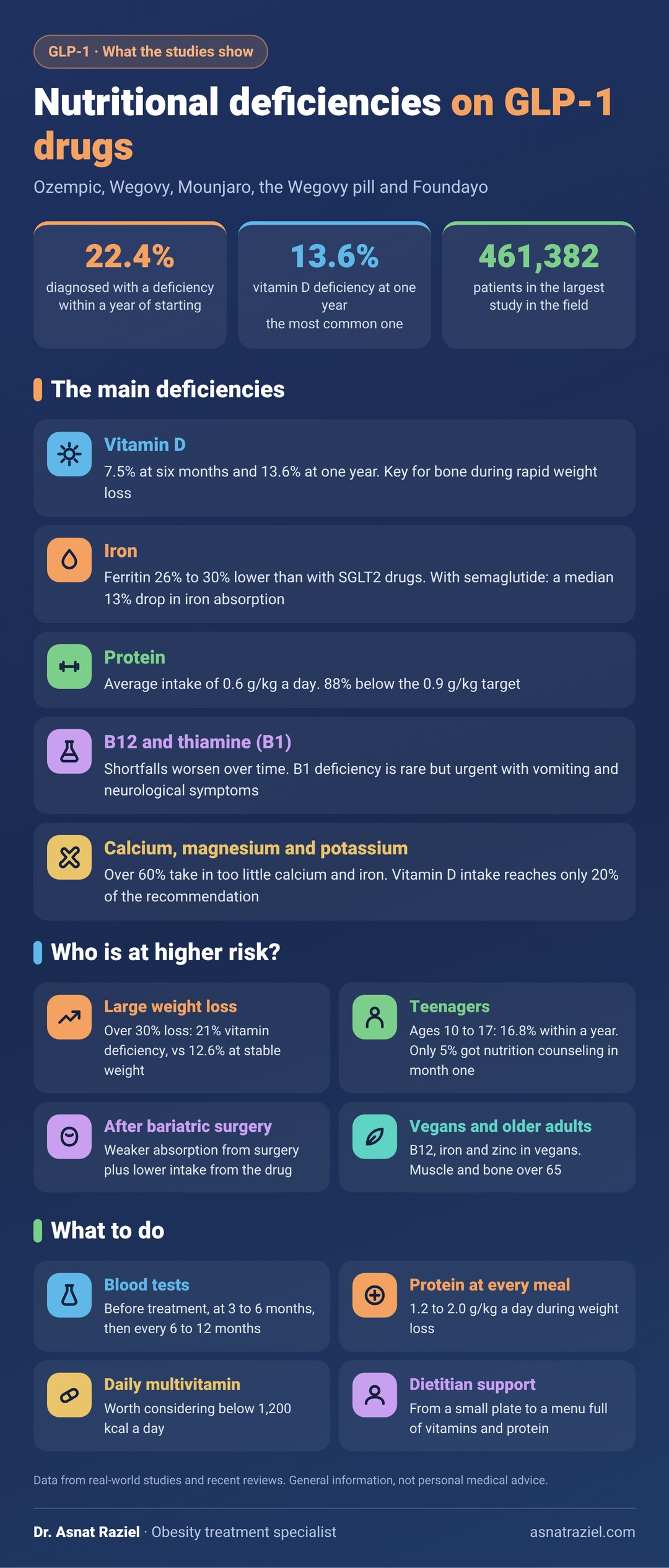
Nutritional deficiencies on GLP-1 drugs are real, but most of them are easy to prevent. GLP-1 medications reduce appetite, and with it the amount of vitamins and minerals you take in. In the largest study so far, about one in five patients was diagnosed with a nutritional deficiency during the first year. That is why it helps to know who is at risk, which warning signs to watch for, which tests to order and how to replenish.
This article covers the whole GLP-1 family: Ozempic and Wegovy (semaglutide), Mounjaro (tirzepatide), the Wegovy pill and Foundayo (orforglipron). They all work through the same fullness mechanism, so the same principles apply.
Why do nutritional deficiencies on GLP-1 drugs develop?
The main reason is simple: people eat less. In an Italian study that tracked food logging in an app, semaglutide and tirzepatide users ate an average of 1,102 kcal a day, compared with 1,281 kcal in people not taking a medication. When the plate gets smaller, so does the vitamin supply.
In addition, these drugs slow stomach emptying. A pilot study from Croatia tested 51 people with diabetes before starting semaglutide and after 10 weeks of treatment. The researchers found lower iron absorption from the gut, with a median drop of 13%. Almost 18% of participants showed a drop of 30% or more.
Moreover, people with obesity often start treatment with low stores. Low vitamin D levels are common in obesity, and chronic inflammation makes iron harder to absorb. I covered this link in detail in iron deficiency and obesity.
How common is it? The numbers
The largest study in the field analyzed insurance data on 461,382 adults who started a GLP-1 medication. None had a prior diagnosis of a nutritional deficiency. Within six months, 12.7% were diagnosed with a nutritional deficiency. Within a year, the rate rose to 22.4%. Vitamin D deficiency was the most common: 7.5% at six months and 13.6% at one year.
Another study looked at what people actually eat. Sixty-nine GLP-1 users kept a detailed three-day food record. Their intake fell short of recommendations for fiber, calcium, iron, magnesium, potassium, choline and vitamins A, C, D, E and K. By contrast, B vitamins, zinc, selenium and copper were adequate. Only 43% of participants reached the protein intake recommended during weight loss.
Furthermore, a review in the journal Clinical Obesity pooled studies on about 480,000 patients. More than 60% of patients took in less calcium and iron than they needed. Vitamin D intake averaged only 20% of the recommendation. Shortfalls in thiamine (vitamin B1) and vitamin B12 grew worse over time.
Which nutritional deficiencies on GLP-1 drugs are most common, and how deep do they go?
It is important to separate low intake from a true deficiency. Low intake is a warning sign. A true deficiency shows up on a blood test, and it is usually mild to moderate. Still, in rare cases a deficiency can be deep and dangerous.
Vitamins: D, iron, B12 and thiamine
Vitamin D: This is the most common deficiency in every study. Vitamin D is needed to absorb calcium and protect bone. Rapid weight loss already puts bone under strain, so a vitamin D shortfall adds to the load.
Iron and anemia: According to the review, GLP-1 users with diabetes had ferritin (iron store) levels 26% to 30% lower than patients on SGLT2 inhibitors. In an analysis of 18,746 people with diabetes, the risk of low ferritin was 54% higher in GLP-1 users. The deficiency is especially common in women of childbearing age. For the tests themselves, see iron and B12 testing.
Vitamin B12 and folate: B12 deficiency develops slowly because the liver keeps a large reserve. It usually appears after many months of eating little, mainly in people who eat little meat, fish and eggs or who take metformin.
Thiamine (vitamin B1): rare but urgent: The body’s thiamine stores are small and run out within weeks. A pharmacovigilance study published in 2026 found reports of Wernicke encephalopathy (acute brain injury caused by B1 deficiency) in GLP-1 users. Most cases also involved vomiting, very low food intake or rapid weight loss. In one published case, a patient lost 70 pounds in just three months. This complication is rare, and there is no reason to panic. I explain it in thiamine deficiency on obesity medication.
Protein and minerals
Protein: In the Italian study, medication users ate an average of 0.6 grams of protein per kilogram of body weight a day. Of them, 88% were below the target of 0.9 grams per kilogram. Too little protein leads to muscle loss, which makes this one of the most important gaps. More on this in muscle mass on weight-loss medication.
Calcium, magnesium, potassium and zinc: These minerals come mainly from dairy, vegetables, legumes and whole grains. When portions shrink, they are the first to drop. Low magnesium and potassium also contribute to constipation and muscle cramps.
Who is at higher risk of nutritional deficiencies on GLP-1 drugs?
Risk varies from one patient to the next. The differences between groups are meaningful, so follow-up should be tailored to each person.
People who lose a lot of weight quickly
An Epic Research analysis looked at more than two million adults in the United States. Among GLP-1 users whose weight stayed stable, 12.6% were diagnosed with a vitamin deficiency. By contrast, among those who lost more than 30% of their weight, the rate rose to 21%. The anemia rate nearly doubled as well, from 3.9% to 7.6%. In other words, the bigger the loss, the higher the risk.
Severe obesity
People with severe obesity often start with low vitamin D, iron and zinc. At the same time, they are likely to lose a large number of kilograms. That makes testing before treatment especially important.
People who have had bariatric surgery
Many patients now take a medication after a sleeve gastrectomy or a Roux-en-Y gastric bypass to treat weight regain. Here two factors add up: weaker absorption because of the surgery and lower intake because of the drug. In the Epic data, the anemia rate after bariatric surgery was 12.5%, compared with 4.6% in GLP-1 users. I wrote about combining surgery and medication in bariatric surgery in the drug era.
Teenagers
A study from September 2026 followed 2,031 young people aged 10 to 17 who started a GLP-1 medication. Within a year, 16.8% were diagnosed with a nutritional deficiency, mostly vitamin D deficiency (12.4%). Only 5% received nutrition counseling in the first month of treatment. In teenagers, iron, calcium and vitamin D are essential for growth and bone building. You can read about treating teenagers in the STEP TEENS trial.
Other groups
Adults over 65 lose muscle and bone easily. Vegetarians and vegans need to watch B12, iron and zinc, and the guide to plant protein sources can help. In addition, people with prolonged nausea and vomiting, or with a history of eating disorders, need close follow-up.
Is there a difference between the medications?
So far, no study has directly compared deficiency rates between Ozempic, Mounjaro and Foundayo. Even so, the data point in a clear direction. Stronger medications cause more weight loss and cut food intake more. So Mounjaro, for example, calls for at least as much nutritional attention as Wegovy.
The finding on reduced iron absorption was tested specifically with semaglutide. On the other hand, cases of thiamine deficiency were reported with both semaglutide and tirzepatide. For the pills, the Wegovy pill and Foundayo, there are no dedicated data yet. Because the mechanism is the same, the same caution makes sense. I compared the two pills in Wegovy pill vs Foundayo.
Compared with other diabetes drugs, the picture is much clearer. In the analysis of 18,746 people with diabetes, the risk of vitamin D deficiency was 49% higher in GLP-1 users than in SGLT2 inhibitor users, and 32% higher than in DPP-4 inhibitor users.
Symptoms that warn of nutritional deficiencies on GLP-1 drugs
Many symptoms are general and resemble ordinary side effects of treatment. So it is wise not to blame every bout of fatigue on the drug alone. Here are the main signs:
- Fatigue, weakness, shortness of breath on exertion and pallor: possible iron, B12 or folate deficiency.
- Hair shedding and brittle nails: low protein, iron, zinc or biotin. See also hair loss during weight loss.
- Numbness and tingling in the hands and feet, memory problems: possible B12 deficiency.
- Bone pain, muscle weakness and falls: low vitamin D and calcium.
- Muscle cramps and palpitations: low magnesium or potassium.
- Slow wound healing and repeated infections: low protein, zinc or vitamin C.
- Double vision, unsteady walking and confusion, especially after vomiting: possible thiamine deficiency. This is an emergency that needs an immediate visit to the ER.
To tell side effects from warning signs, read GLP-1 side effects.
Blood tests to detect nutritional deficiencies on GLP-1 drugs
The new European consensus from obesity and dietetic associations, published in July 2026 in The Lancet Diabetes & Endocrinology, recommends monitoring diet quality and deficiency risk throughout treatment. The position paper of Atid, the Israeli Dietitians and Nutritionists Association, also stresses a nutrition assessment before the first injection.
In practice, these tests are recommended before starting treatment:
- Complete blood count.
- Iron, ferritin and transferrin saturation.
- Vitamin D (25-OH-D).
- Vitamin B12 and folate.
- Calcium, magnesium, phosphorus and albumin.
- Kidney function and electrolytes (sodium and potassium).
- As needed: zinc, copper, PTH and vitamin A.
After that, it is worth repeating the tests after three to six months, and then every six to twelve months. People who lose weight very quickly, teenagers and people who have had bariatric surgery need closer follow-up. Any new symptom is also a reason to test sooner. A blood thiamine level is not reliable in an acute situation, so when deficiency is suspected, treatment starts right away without waiting for the result.
How to replenish nutritional deficiencies on GLP-1 drugs
First, the plate
No pill replaces good nutrition. The joint recommendations of US obesity and nutrition organizations emphasize adequate protein and strength training. In practice, the target during weight loss is 1.2 to 2.0 grams of protein per kilogram of body weight a day, starting every meal with protein. Choose nutrient-rich foods: fish, eggs, dairy, legumes, tahini, vegetables and fruit. The Mediterranean diet fits this especially well. Practical tips are in eating well from a small plate, and a full guide in protein intake.
A multivitamin for anyone eating little
The European consensus advises considering a multivitamin and mineral supplement when intake falls below 1,200 kcal a day. In practice, that describes most patients during the months of weight loss. So a daily multivitamin suits most patients from the start of treatment. In Israel there are several suitable options today:
- Barimil: developed for bariatric patients and also intended for people on weight-loss medication. One tablet a day provides 24 vitamins and minerals, including 800 IU of vitamin D, iron and calcium. There is also a chewable version for people who find it hard to swallow pills.
- BariMax: a multivitamin in one small tablet a day, with 1,000 mcg of B12 and 1,000 IU of vitamin D. The formula contains no iron or calcium, so these are added separately as needed.
- Altman: the company has a dedicated range to support weight-loss medication. It includes a multivitamin with thiamine, B12, vitamin D and iron, along with a digestive enzyme and probiotic capsule.
- Solgar: a wide range of multivitamins, plus separate vitamin D, B12, calcium and iron products for targeted replenishment.
Good to know: no controlled trial has yet shown an advantage for any specific product in GLP-1 users. So the choice depends on the formula, convenience and your test results. I wrote about the wider benefits in multivitamins and aging.
Targeted replenishment based on test results
When a test shows a true deficiency, a multivitamin alone is not always enough. Vitamin D is replaced at a dose your doctor sets according to your blood level. Significant iron deficiency calls for a dedicated iron product, and sometimes an IV infusion, because absorption from the gut weakens. B12 deficiency is treated with high-dose tablets or injections. Prolonged vomiting with neurological symptoms requires IV thiamine in hospital.
Tips for taking supplements
- Take the multivitamin with a meal to reduce nausea.
- Separate iron and calcium by about two hours, because they compete for absorption.
- Prefer chewable tablets or small capsules during periods of nausea.
- Do not take high doses on your own. Too much vitamin A, iron or vitamin D is harmful too.
- Work with a dietitian. Nutrition support lowers risks and improves results, as I explain in a dietitian on GLP-1 treatment.
Bottom line: nutritional deficiencies on GLP-1 drugs are preventable
GLP-1 medications are a true breakthrough in obesity treatment. However, they do not remove the need for vitamins and minerals. About one in five patients develops a deficiency in the first year, mainly vitamin D, iron and B12. The risk rises with rapid and large weight loss, after bariatric surgery and in adolescence. The good news is that most deficiencies are easy to detect and prevent: blood tests before and during treatment, a plate rich in protein and vegetables, a daily multivitamin and follow-up with a dietitian. That way you enjoy the weight loss and protect your health for years to come.
This article is general information and does not replace personal medical advice. Before taking supplements or changing your treatment, talk to your doctor or dietitian.
References
Wernicke Encephalopathy Associated With Semaglutide Use