By Dr. Asnat Raziel, bariatric surgeon specializing in obesity treatment, metabolic health and healthy longevity; Director of the Multidisciplinary Center for Obesity Treatment, Assia Medical, Assuta Ramat HaChayal, Tel Aviv
Iron and B12 testing: why it matters
Iron and B12 testing helps find out whether fatigue, weakness or trouble concentrating are linked to a nutritional deficiency. However, a single result does not tell the whole story. That is why it helps to understand what each marker measures and how the markers fit together into one picture.
In my clinic, I see these deficiencies often. They appear in people who eat very little, in people who have had weight loss surgery and in people who take certain medications for a long time. In this guide, you will find a simple explanation: what the vitamin does, how much you need each day, which tests exist and when it is worth looking deeper.
What vitamin B12 does in the body
Vitamin B12 takes part in making the genetic material in cells. Thanks to it, the bone marrow produces healthy red blood cells. In addition, the vitamin is essential for the nervous system to work properly. When B12 is lacking, red blood cells grow too large and do not mature properly. Doctors call this megaloblastic anemia.
The body gets B12 mainly from animal foods: meat, fish, eggs and dairy products. To absorb it, the stomach needs acid and a special protein called “intrinsic factor.” For this reason, stomach diseases, digestive surgery and acid-reducing medications all impair absorption.
The body stores about 1 to 5 milligrams of B12, according to the fact sheet from the US National Institutes of Health (NIH). Because of this reserve, a deficiency develops slowly. Sometimes symptoms appear only after years of poor absorption.
How much B12 and iron the body needs each day
The recommended daily allowance of B12 for adults is 2.4 micrograms. During pregnancy it rises to 2.6 micrograms, and during breastfeeding to 2.8 micrograms. Keep in mind that this is an intake amount, not a target value for a blood test.
For iron, too, the recommendation depends on age and stage of life. According to the NIH fact sheet on iron, men need 8 milligrams a day. By contrast, women aged 19 to 50 need 18 milligrams a day, because of blood loss during menstruation. After age 51, the recommendation for women drops to 8 milligrams, while during pregnancy it rises to 27 milligrams.
The body easily absorbs iron from meat, poultry and fish. On the other hand, it absorbs iron from plants less well. Vitamin C, for example from bell peppers or citrus fruit, improves the absorption of plant iron.
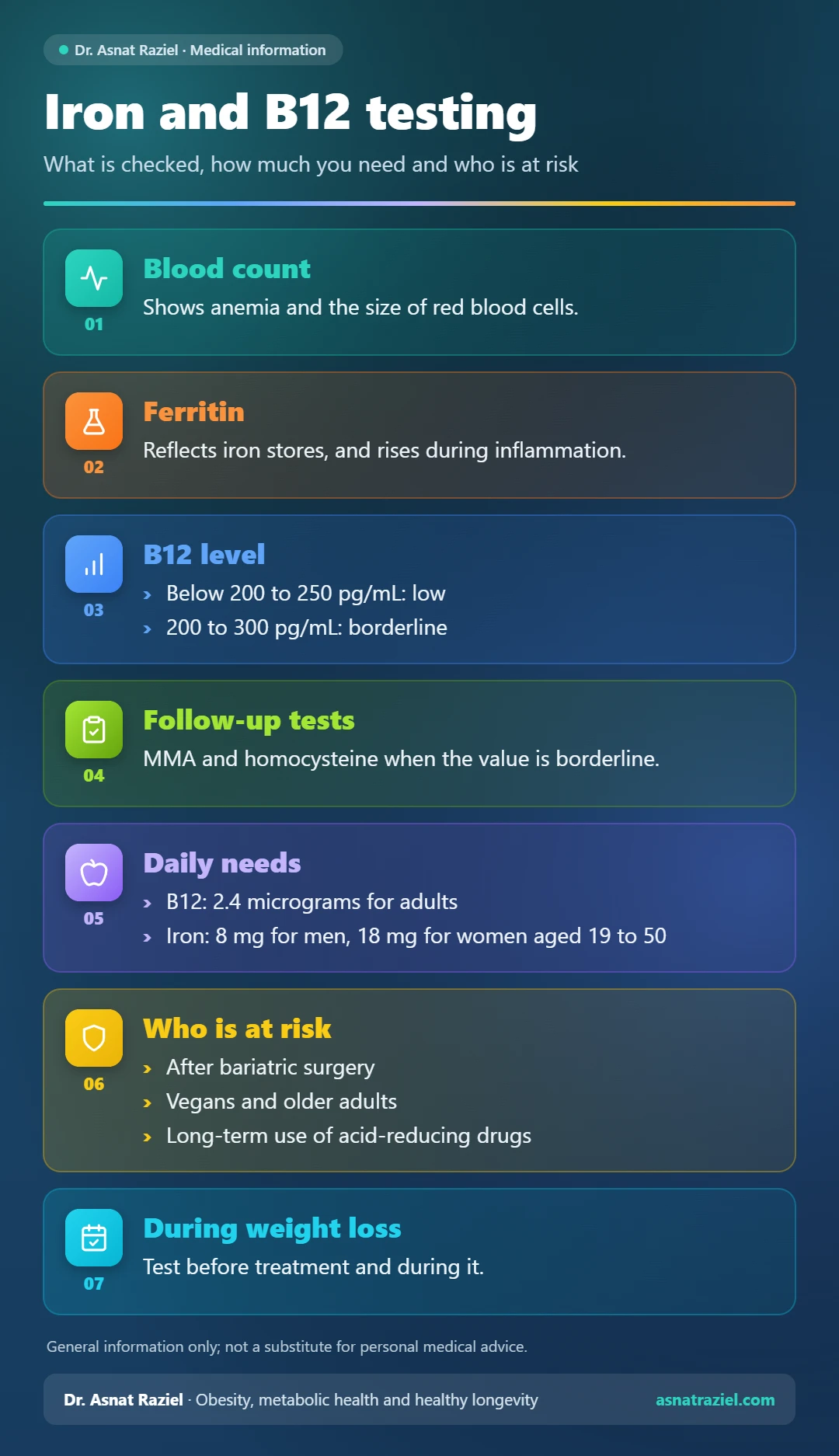
Iron and B12 testing: which markers we check
Iron and B12 testing usually includes several markers, not a single test. Each marker answers a different question, so doctors read them together.
Complete blood count
A complete blood count shows whether there is anemia, meaning a low hemoglobin level. In addition, it shows the size of the red blood cells (MCV, the mean corpuscular volume of a red blood cell). With iron deficiency, the cells are usually small. With B12 deficiency, by contrast, they are large. Even so, a normal blood count does not rule out an early deficiency.
Ferritin and iron stores
Ferritin is a protein that stores iron, and its level in the blood reflects the body’s stores. According to the NIH, ferritin detects depleted iron stores at an early stage, even before anemia appears. However, ferritin also rises during inflammation or infection. That is why the World Health Organization (WHO) states that in adults with inflammation, a ferritin level below 70 micrograms per liter may indicate iron deficiency.
Blood B12 level
Most laboratories define a B12 level below 200 to 250 pg/mL as low. Values of 200 to 300 pg/mL are a borderline range. In this range, a normal-looking value does not guarantee that the cells are getting enough of the vitamin.
When iron and B12 testing calls for follow-up tests
When the B12 level is borderline, the doctor may add tests that measure the vitamin’s activity in the cells. According to the NIH, experts recommend testing methylmalonic acid (MMA) when the B12 level is between 150 and 399 pg/mL. An MMA level above 0.271 micromoles per liter suggests B12 deficiency.
Another possible test is homocysteine. A level above 15 micromoles per liter may point to B12 deficiency. However, folate deficiency and reduced kidney function also raise it. Similarly, kidney failure also raises the MMA level, and age affects it as well. Therefore, we always interpret these tests together with the other findings.
Who needs regular iron and B12 testing
Some people need testing even without obvious symptoms. The main groups are:
- People who have had digestive surgery, including bariatric surgery for weight loss.
- Older adults, because of atrophic gastritis, which impairs absorption.
- Vegans who do not take a B12 supplement.
- Pregnant women and women with heavy menstrual bleeding.
- People with bowel diseases, such as celiac disease.
Medications also affect absorption. A large study in the journal JAMA found that taking acid-reducing drugs (proton pump inhibitors) for two years or more was linked to a higher risk of B12 deficiency. In addition, the NIH notes that metformin, a common diabetes drug, may lower blood B12 levels.
Iron and B12 testing during weight loss
Weight loss changes your diet, so it can uncover deficiencies. When you eat less, for example during treatment with weight loss injections, it is easy to take in less iron and B12. That is why I recommend iron and B12 testing before starting treatment and during it. This way, we can catch a deficiency early and correct it in time.
There is also a link between excess weight and iron balance. I wrote about this in more detail in my article on iron deficiency and obesity. In addition, iron deficiency may contribute to hair loss during treatment with GLP-1 drugs. So it is worth checking when hair loss appears.
At the same time, a tailored diet helps prevent deficiencies in the first place. It is also worth reading about nutritional support during medication treatment. A dietitian works in our clinic. In addition, when needed, I refer patients to a multidisciplinary body-and-mind team: dietitians, psychologists, holistic coaches, naturopaths and complementary medicine practitioners, as well as Pilates and yoga instructors and experts in stress-reduction techniques.
Symptoms to watch for
B12 deficiency may cause fatigue, pale skin, heart palpitations and an inflamed tongue. It may also cause numbness and tingling in the hands and feet, and in severe cases, memory problems. Iron deficiency mainly causes fatigue, weakness, shortness of breath on exertion and pale skin.
That said, fatigue is a very general symptom. Sometimes the cause is sleep, stress or another illness. I wrote about this at length in my article on physical and mental fatigue. So do not start a supplement on your own. It is better to get tested first and then treat according to the result.
The bottom line
Iron and B12 testing is a simple and important tool, especially during weight loss, after bariatric surgery and with long-term use of certain medications. The testing includes a blood count, ferritin and a B12 level, and sometimes follow-up tests. It is best to interpret the results together with your doctor rather than by a single number. Also, general supplements are no substitute for a proper workup, as I explain in my article on multivitamins and longevity.
The information in this article is general and does not replace personal medical advice.
Questions and answers
Do I need to fast before iron and B12 testing?
In most cases, a B12 test does not require fasting. However, instructions vary depending on the tests on your referral and on the laboratory. So it is best to follow the lab’s instructions.
What is the difference between blood iron and ferritin?
Blood iron changes over the course of the day and with meals. Ferritin, on the other hand, reflects the body’s iron stores. Therefore, ferritin gives a stable picture of your stores, although inflammation may raise it.
How often should you repeat iron and B12 testing?
It depends on the situation. After bariatric surgery and during medication treatment for obesity, follow-up is regular. In other cases, the doctor sets the frequency based on the results and symptoms.
Do vegans have to take a B12 supplement?
Plant foods contain almost no B12 unless they are fortified. That is why vegans need a steady source of the vitamin, usually a supplement or fortified foods. It is a good idea to check the level from time to time.
References
Vitamin B12 – Fact Sheet for Health Professionals
Iron – Fact Sheet for Health Professionals
WHO guideline on use of ferritin concentrations to assess iron status in individuals and populations
Proton pump inhibitor and histamine 2 receptor antagonist use and vitamin B12 deficiency




