By Dr. Asnat Raziel, bariatric surgeon specializing in obesity treatment, metabolic health and healthy longevity; Director of the Multidisciplinary Center for Obesity Treatment, Assia Medical, Assuta Ramat HaChayal, Tel Aviv
Why we feel tired even after a full night’s sleep
Almost all of us know the feeling. You went to bed early, put your phone aside and slept through the night, yet you still feel tired when you wake up. Sometimes your body feels heavy. At other times, your thoughts simply won’t stop. Even a short conversation or a simple decision can feel like a huge effort. This kind of physical and mental exhaustion usually comes from a mix of factors: overload, too little or poor-quality sleep, emotional distress and medical conditions. Therefore, the first step in dealing with it is understanding what lies behind it.
Sleepiness and fatigue are not the same thing
Sleepiness and fatigue are not quite the same. The first is the tendency to fall asleep. Fatigue, on the other hand, is a sense of low energy or difficulty mustering effort, even when you don’t want to sleep. The two can appear together. That is why the question “How many hours did you sleep?” is important but not enough. It is also worth asking whether your sleep is continuous, whether you snore, what has changed recently and what weighs on you during the day.
How much sleep do you really need?
Many people who feel tired ask how much sleep is enough. Most adults are advised to get seven to nine hours of sleep a night. However, time in bed is not necessarily time asleep. Likewise, a normal number of hours does not rule out a sleep disorder. Rest during the day can complement sleep, but it cannot replace it. I have written in a separate article about the effects of accumulated sleep loss on the brain, body weight and the immune system.
When you feel tired because the tension never ends
The day is over, but the alertness goes on. Under stress, the body changes its heart rate and breathing and activates systems that help it face a challenge. When stress is prolonged, it may contribute to sleep problems, headaches and digestive symptoms. The result is a familiar state: we feel exhausted, and yet we find it hard to calm down. In this situation, feeling tired in body and mind is not a sign of weakness. Rather, it is the response of a system that has not had a chance to rest.
“Rebooting the nervous system” is an image, not a diagnosis
The phrase “your nervous system needs a reboot” is a metaphor, not a medical diagnosis. Relaxation may help reduce stress. Even so, it is no guarantee that inflammation will disappear, digestion will normalize or persistent fatigue will resolve. In addition, we should not assume that everyone who feels tired has a “stuck” nervous system.
Seven types of rest: a framework for reflection
Dr. Saundra Dalton-Smith proposes a framework of seven types of rest. It is a way of looking at our needs. It is not an agreed medical classification, nor a test that identifies seven biological deficits. Still, when you feel tired, you can use it as a personal questionnaire:
First, physical rest: sleep and recovery from exertion, and sometimes gentle stretching as well.
Second, mental rest: a break from planning, decision-making and problem-solving.
Third, sensory rest: less noise, fewer screens and fewer notifications.
Fourth, emotional rest: the chance to express difficulty without hiding it or trying to please others.
Fifth, social rest: a balance between time alone and supportive relationships.
Sixth, creative rest: enjoying nature, music and art, with no obligation to produce anything.
Finally, spiritual rest: a connection to meaning and belonging, through faith, community or personal values.
There is no need to turn this list into seven more tasks. Instead, choose one need that feels relevant right now and try a small change that fits it.
Short breaks help when you feel tired
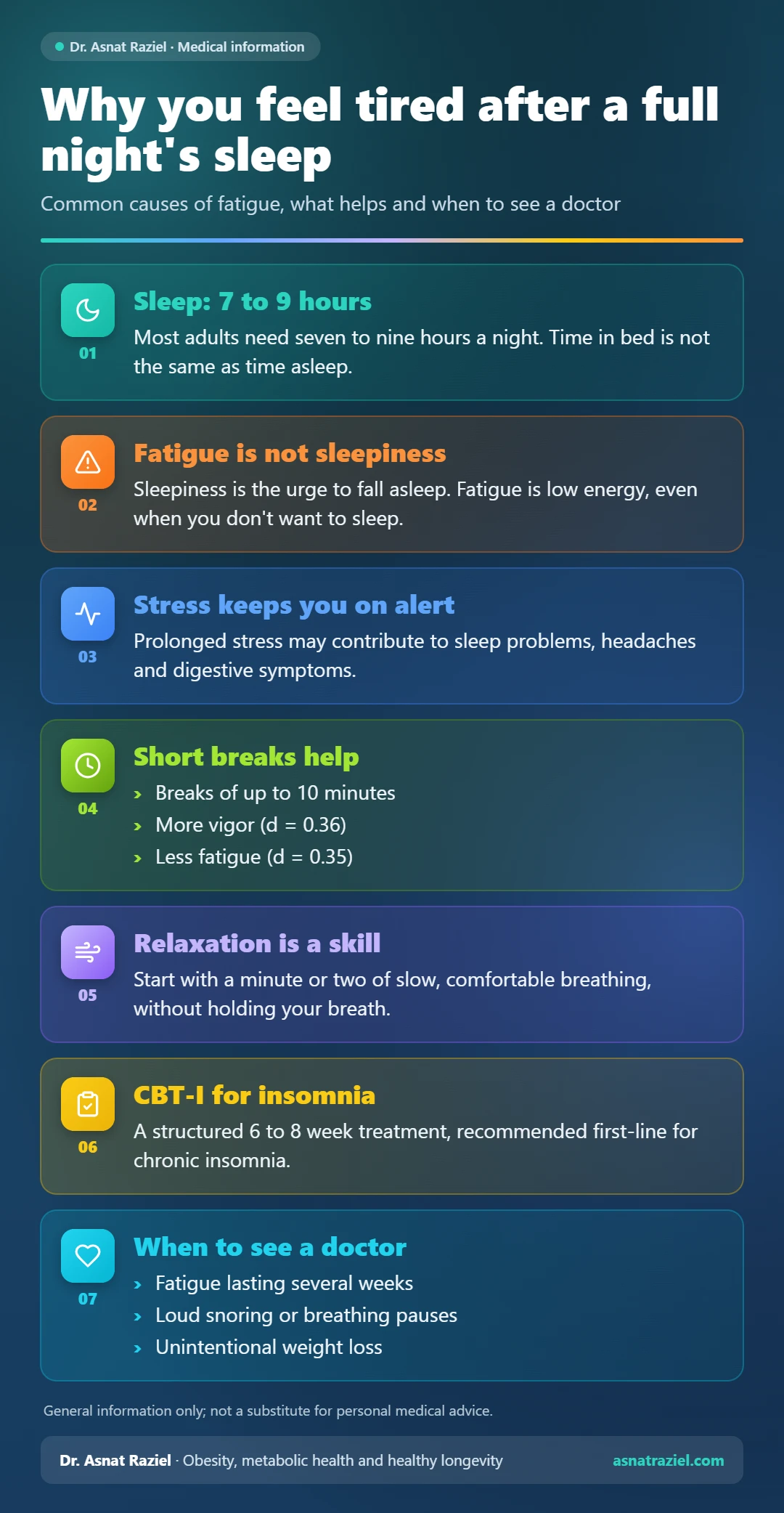
Short breaks can help. A meta-analysis published in PLOS ONE in 2022 looked at breaks of up to ten minutes. The researchers found a small but significant improvement in vigor (d = 0.36) and a reduction in fatigue (d = 0.35). By contrast, the overall improvement in task performance was not significant. The studies mainly involved healthy people in work or study settings. In other words, breaks are a useful tool, not a proven treatment for every type of fatigue.
In practice, when you feel tired at work, you can get up for a few minutes between tasks, step outside for some fresh air or sit quietly without opening your inbox. Choose an activity that reduces the specific load you are trying to recover from.
Relaxation is a skill you can practice
Slow, comfortable breathing, muscle relaxation and guided imagery may help you cope with stress. You can start with a minute or two of calm breathing, without forcing the inhale and without holding your breath. If you feel dizzy or uncomfortable, return to normal breathing. This practice can complement treatment, but it is not a substitute for a medical evaluation. If you would like to go deeper, the site also offers a practical guide to stress-relief techniques and an article on meditation and metabolic balance.
Reducing your load takes real action
Reducing your load also requires concrete steps. For example, you might ask for responsibilities to be shared at home, limit how available you are for messages or say, “I can’t take on another task right now.” Moreover, when fatigue comes with anxiety, sadness or loss of interest, it is worth seeking mental health support as well.
Treating insomnia: CBT-I
If you feel tired every morning, sleep itself needs to be checked. If it is hard to fall asleep or stay asleep, there is a treatment option beyond general advice: cognitive behavioral therapy for insomnia (CBT-I). It is a structured treatment that usually lasts six to eight weeks, and it is recommended as the first-line treatment for chronic insomnia. At the same time, it helps to know the ways to improve your sleep naturally.
When should you see a doctor if you always feel tired?
Fatigue that lasts several weeks without explanation, gets worse or affects your daily functioning needs to be checked. Loud snoring and pauses in breathing, palpitations, mood changes or unintentional weight loss are all important details to report. Depending on your history and examination, your doctor may look for anemia, a thyroid disorder, diabetes, medication side effects or a sleep disorder. However, not every test is needed for every person. For example, in people with obesity it is important to rule out sleep apnea, a common cause of feeling tired that sometimes goes undiagnosed.
When even small efforts make you feel worse
If even a small effort causes a marked and prolonged worsening, especially after an infection, tell your doctor about it explicitly. In conditions such as ME/CFS (myalgic encephalomyelitis/chronic fatigue syndrome), the accepted approach is matching activity and rest to your individual capacity, without pushing into activity that makes symptoms worse.
The bottom line if you often feel tired
You can start this week with two short breaks a day. In addition, keep a simple log of your sleep hours, your energy level and the things that make you feel better or worse. This information can help you spot the need for a change in your daily routine. It also gives your doctor a much clearer picture if the fatigue persists. Finally, please remember that the information in this article is general and does not constitute personal medical advice.
References
5 Things To Know About Relaxation Techniques for Stress




