By Dr. Asnat Raziel, bariatric surgeon specializing in obesity treatment, metabolic health and healthy longevity; Director of the Multidisciplinary Center for Obesity Treatment, Assia Medical, Assuta Ramat HaChayal, Tel Aviv
Iron deficiency and obesity: a link we often overlook
Iron deficiency and obesity may sound like an unlikely pair, since we tend to assume that people who eat plenty can’t be missing anything. In reality, research shows that people with excess weight are at especially high risk of iron deficiency. The main reason is a quiet, chronic inflammation that disrupts how the body absorbs iron from food. So persistent fatigue in someone with obesity sometimes calls for a simple blood test.
In this article, I explain how the link works, how to diagnose the problem correctly and what you can do to fix it.
What studies say about iron deficiency and obesity
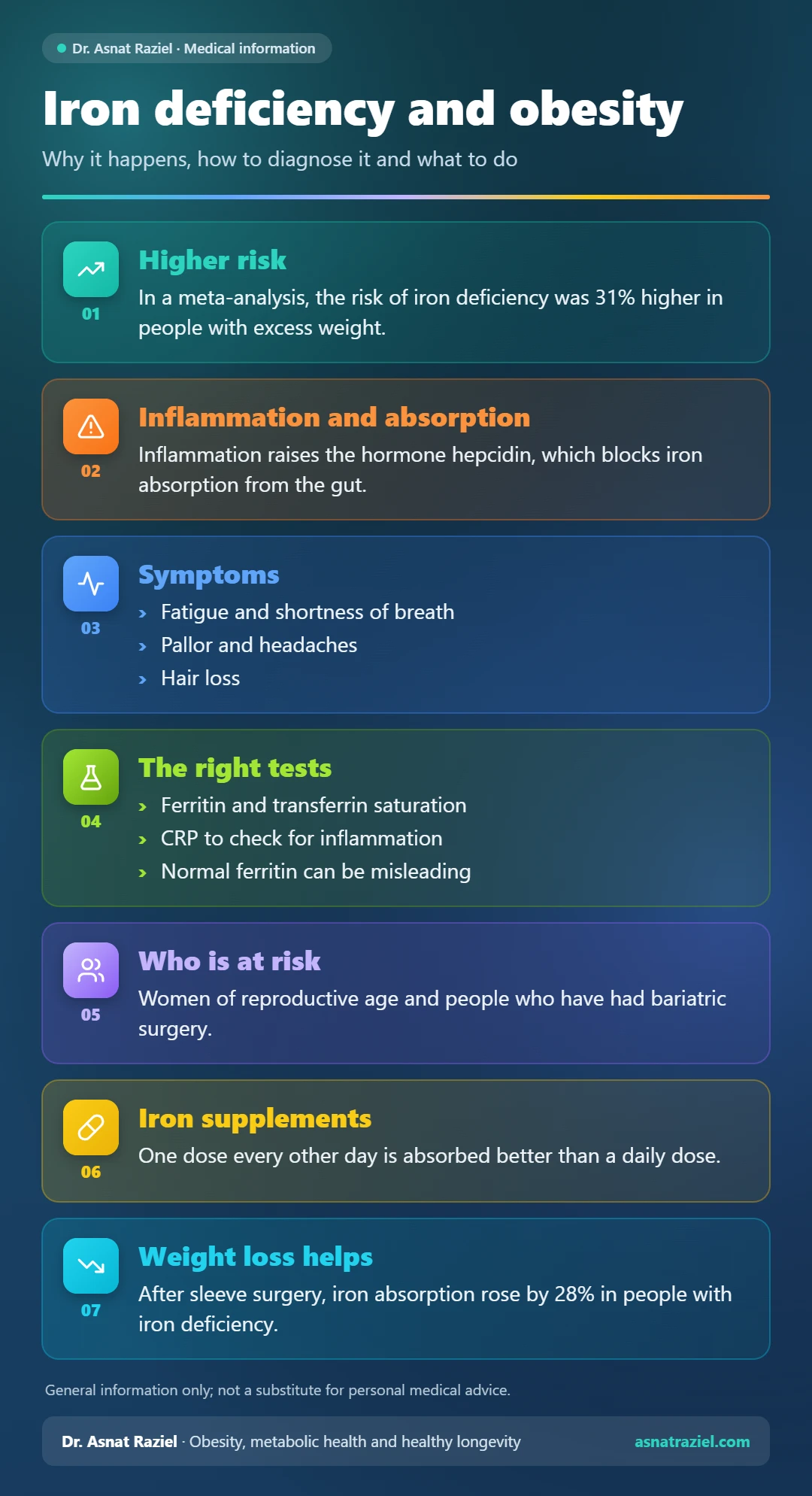
A meta-analysis of 26 studies compared 13,393 people with overweight or obesity with 26,621 people of normal weight. Blood iron levels were much lower in the group with excess weight. In addition, their risk of iron deficiency was 31% higher.
However, there is an important twist. The link showed up clearly in studies that did not rely on ferritin, but not in studies that diagnosed iron deficiency by ferritin. In other words, in obesity, a ferritin test on its own can be misleading. I’ll come back to this below.
Why the body doesn’t absorb iron: hepcidin and inflammation
Excess fat tissue is more than an energy store. It releases inflammatory substances, including interleukin 6 (IL-6). This molecule signals the liver to make a hormone called hepcidin, which regulates the body’s iron balance. Hepcidin blocks a transport protein called ferroportin, so the gut passes less iron into the bloodstream.
As a result, even an iron-rich diet is not always enough. As the overview of iron deficiency also notes, ongoing inflammation reduces the iron available to the body and can lead to anemia of chronic disease. I wrote about the broader mechanism in my article on obesity and inflammation.
Symptoms: more than just fatigue
Iron deficiency develops slowly, so it is easy to miss. First, the body’s iron stores run down. Only later does hemoglobin drop and anemia appear. This means you can be iron deficient even when your blood count is still normal. Common symptoms include fatigue, dizziness, pallor, headaches and shortness of breath on exertion. Some people also notice hair loss, brittle nails or restless legs.
For patients with obesity, this fatigue also makes it harder to exercise and change habits. As a result, a vicious cycle can form: less energy, less movement and more difficulty losing weight.
Diagnosing iron deficiency in people with obesity
The key test is ferritin, which reflects the body’s iron stores. The catch is that ferritin also rises during inflammation. That is why, in someone with obesity, a “normal” ferritin level may hide a true deficiency.
The new guidelines from the American Society of Hematology raised the diagnostic thresholds. According to these guidelines, a ferritin level of 30 or below in adults indicates iron deficiency. When inflammation is present, doctors can consider iron deficiency even with ferritin below 100, or with transferrin saturation below 20%. It is also worth checking CRP, a marker of inflammation, to interpret ferritin correctly. For a full rundown of these blood tests, see my guide to iron and B12 testing.
- Complete blood count and hemoglobin.
- Ferritin and transferrin saturation.
- CRP, to assess inflammation.
- If needed, vitamin B12 and folic acid as well.
Iron deficiency and obesity: who is at highest risk
Women of reproductive age face a higher risk because of monthly blood loss. People who have had bariatric surgery are also at risk, because the operation changes the path food takes and reduces absorption. According to a review of complications after sleeve gastrectomy and gastric bypass, iron deficiency anemia affects 16% to 24% of patients after surgery.
Good sources of iron include red meat, chicken, fish, legumes and leafy greens. Your body absorbs plant iron better when you eat it with vitamin C, for example with bell peppers or citrus fruit. On the other hand, tea and coffee with meals reduce absorption.
Medication for obesity also reduces how much you eat, so it is important to keep your diet varied. This applies to other vitamins too, such as thiamine.
Treating iron deficiency in obesity
Treatment starts with oral iron supplements. Two controlled trials in women with low iron stores showed that the body absorbs a single dose every other day better than a daily dose. The reason is that each dose raises hepcidin for the following day. When pills don’t help or cause side effects, however, your doctor may recommend intravenous iron.
What’s more, weight loss itself improves iron absorption. A study that followed sleeve gastrectomy patients found that after six months, levels of body fat, IL-6 and hepcidin had all fallen. Among participants with iron deficiency, iron absorption rose by 28%. Treating obesity, in other words, is also part of treating iron deficiency and obesity.
At our clinic, we check iron stores as part of the workup before and during treatment. A healthy lifestyle, a diet rich in protein and iron sources and, when needed, anti-obesity medication also help improve metabolic markers. Still, keep in mind that there is no quick “metabolic reset.” It is an ongoing process.
The bottom line
The link between iron deficiency and obesity is real and common, and it stems mainly from inflammation that disrupts iron absorption. Persistent fatigue therefore warrants testing ferritin, transferrin saturation and CRP. Treatment combines the right iron supplementation, weight loss and medical follow-up. If you have questions, you can read more about Dr. Asnat Raziel and reach out for a consultation.
This article provides general information and is not a substitute for personal medical advice.
Questions and answers
Does iron deficiency cause obesity?
There is no proof that iron deficiency causes obesity. Most studies show only an association, not cause and effect. Even so, the fatigue it brings makes it harder to exercise and change habits.
My ferritin is normal. Could I still be iron deficient?
Yes, especially when there is inflammation. In that situation, ferritin rises artificially. For this reason, your doctor may also check transferrin saturation and CRP.
Should I take an iron supplement on my own?
That’s not recommended. Too much iron can be harmful, and some people have iron overload conditions. It is best to start with a blood test and tailor treatment with a doctor.
References
Obesity and iron deficiency: a quantitative meta-analysis
American Society of Hematology 2026 guidelines for diagnosis of iron deficiency




