By Dr. Asnat Raziel, bariatric surgeon specializing in obesity treatment, metabolic health and healthy longevity; Director of the Multidisciplinary Center for Obesity Treatment, Assia Medical, Assuta Ramat HaChayal, Tel Aviv
The STEP TEENS trial is the study behind the approval of Wegovy for adolescents. In this article, I walk through its numbers one by one: weight loss, metabolic effects, side effects and what happened after treatment stopped. I also explain what those numbers mean for parents. For the practical side, including eligibility and the process with Israel’s health funds, see my article on weight loss injections for teens in the national health basket.
The STEP TEENS trial: why it matters so much
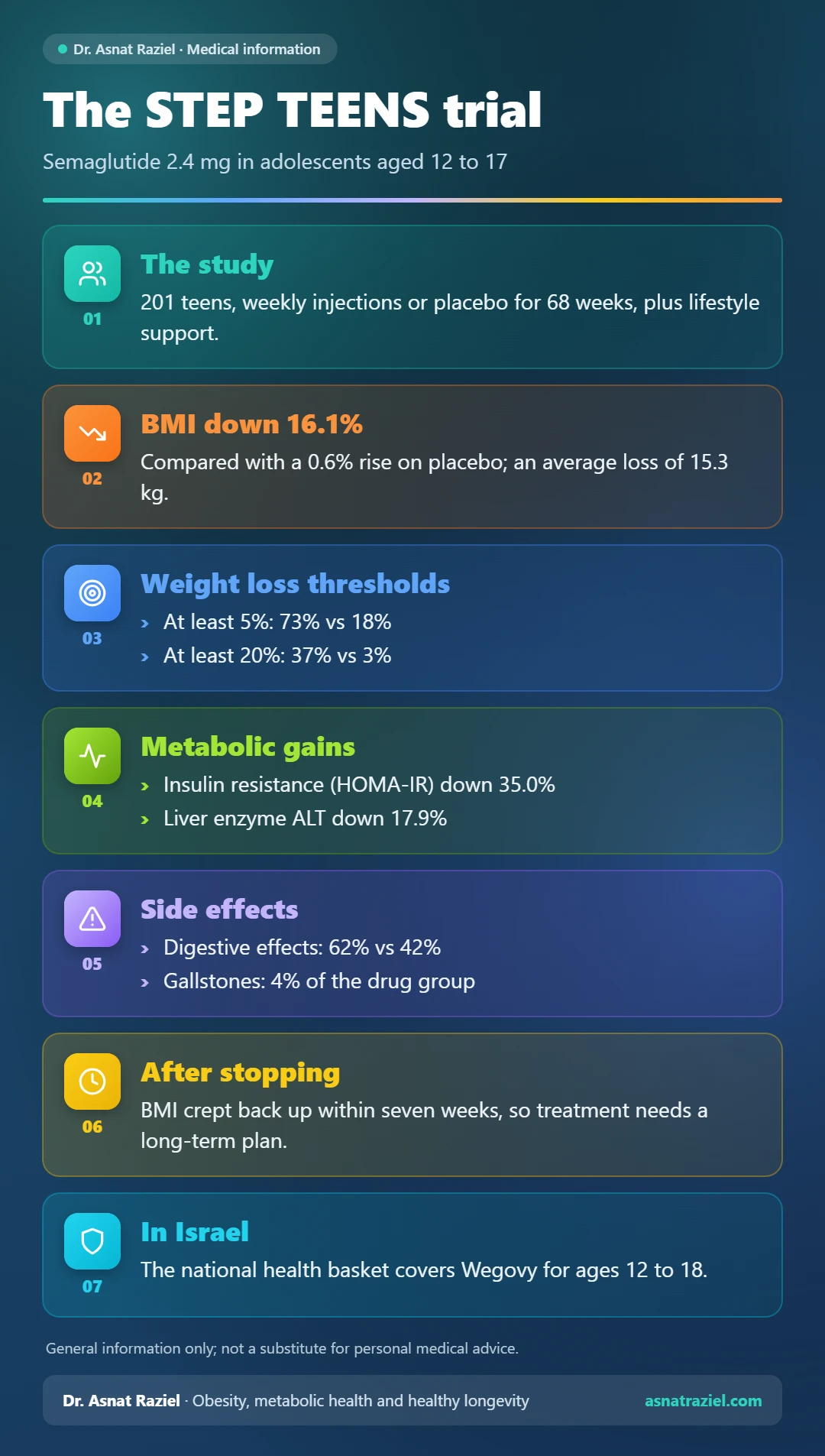
The STEP TEENS trial provided the first clear proof that drug treatment for obesity works in 12- to 17-year-olds. The study was published in NEJM in November 2022. It tested semaglutide at a dose of 2.4 mg, the active ingredient in Wegovy. The main result: an average 16.1% drop in BMI, compared with a 0.6% increase on placebo.
Obesity in adolescence is a chronic disease, not a problem of willpower. It is a biological condition with long-term metabolic and emotional consequences. That is why this study became the basis for the official approval in adolescents, and for Israel’s decision to add the drug to the 2026 national health basket.
How the study was designed
The study was randomized, double-blind and placebo-controlled. In other words, neither the participants nor the researchers knew who was getting the drug. It included 201 adolescents with a BMI at or above the 95th percentile. BMI is the ratio of weight to height, and in children we compare it with peers of the same age and sex. All participants except one had obesity.
The researchers split the participants into two groups at a 2:1 ratio. One group received a weekly injection of semaglutide 2.4 mg. The other group received a placebo. In addition, everyone received lifestyle support: nutrition counseling and a goal of 60 minutes of activity a day. The study lasted 68 weeks, and 90% of the participants completed treatment.
STEP TEENS results: lower BMI and weight
BMI fell by 16.1% in the drug group and rose by 0.6% in the placebo group. The gap was just as clear in body weight. Teens on the drug lost an average of 15.3 kg, or 14.7% of their weight. In contrast, weight in the placebo group went up by 2.4 kg.
The researchers also looked at how many teens passed meaningful weight loss thresholds:
- At least 5% weight loss: 73% on the drug, compared with 18% on placebo.
- 10% or more: 62% on the drug, compared with 8% on placebo.
- At least 15%: 53% on the drug, compared with 5% on placebo.
- 20% or more: 37% on the drug, compared with 3% on placebo.
Moreover, a follow-up analysis looked at movement between BMI categories. In 44.9% of the teens on the drug, BMI fell below the obesity threshold, compared with 12.1% on placebo. We had not seen a response this strong with drug treatment at this age before.
Better metabolic markers
The treatment also affected metabolic health. In the original study, waist circumference, HbA1c (average blood sugar over the past three months) and blood lipids all went down. Liver enzymes went down as well.
In 2026, a secondary analysis in Diabetes Care looked at 193 participants without diabetes. The insulin resistance index HOMA-IR fell by 35.0% on the drug, compared with 5.3% on placebo. The liver enzyme ALT fell by 17.9%, compared with 3.3%. For example, those whose BMI fell by 20% or more showed the greatest improvement. I wrote about the link between obesity at a young age and disease later in life in my article on the consequences of childhood obesity.
Quality of life and what happens after stopping
On the IWQOL-Kids quality-of-life scale, scores improved by 5.3 points on the drug, compared with 1.0 on placebo. Most of the improvement came from physical comfort. However, in areas such as body image and social life, the researchers found no difference between the groups.
In addition, the researchers followed the participants for seven weeks after treatment ended. Even in that short time, BMI crept back up slightly. In other words, obesity behaves like a chronic disease, and treatment needs a long-term plan. You can read more in my article on what happens when you stop weight loss medication.
Safety and side effects in the STEP TEENS trial
The safety profile was similar to what we know from adults. Digestive side effects occurred in 62% of teens on the drug, compared with 42% on placebo. The most common were nausea, vomiting and diarrhea. Gallstones occurred in five teens on the drug, 4% of the group, and in no one on placebo. Serious adverse events were reported in 11% on the drug and 9% on placebo. You will find practical information in my article on Wegovy side effects.
STEP TEENS in numbers: what parents should know
Percentages can feel abstract, so here is how I translate the main STEP TEENS results for parents:
- About 7 in 10 teens on the drug lost at least 5% of their weight, compared with about 2 in 10 on placebo.
- Roughly 1 in 3 teens on the drug lost at least 20%.
- About 6 in 10 had digestive side effects, mostly nausea, vomiting and diarrhea.
- Gallstones appeared in 4% of the drug group.
- Within seven weeks of stopping, BMI started to rise again.
In short, the drug works well for most teens, but it comes with side effects to watch for and works best as a long-term plan.
From the study to approval and the health basket
Following the study, drug regulators approved Wegovy for ages 12 and up. In 2024, a 1.7 mg maintenance dose for adolescents was also added to the label, based on a pharmacological model built from the study data. In Israel, the 2026 national health basket includes the Wegovy injection for ages 12 to 18. However, the basket does not cover adults. I wrote about eligibility and the process with the health funds in my article on weight loss injections for teens in the health basket.
This move is not just regulatory. It is a clear statement: obesity is a disease, and we treat diseases. As for younger children, you can read about Wegovy for children aged 6 to 11.
Not a shortcut, but evidence-based medicine
Drug treatment does not replace proper nutrition and physical activity. It is one more tool in the medical toolbox. When a multidisciplinary team provides it, with structured follow-up and a personalized approach, it can change the course of a whole life. In addition, timely intervention lowers the risk of type 2 diabetes, heart disease and fatty liver. This is deeply preventive treatment, not cosmetic treatment.
The study also holds a lesson that gets less attention. The placebo group also received lifestyle support, and yet its BMI rose slightly. In other words, for teens with established biological obesity, counseling alone is not always enough. That is why combining both tools is the foundation. At our clinic, we build a whole team around the teen: an obesity specialist, a dietitian, emotional support and guidance for parents. Parents are part of the treatment, not just companions.
Summary: what the STEP TEENS trial teaches us
The STEP TEENS trial marks a turning point in the treatment of obesity in adolescence. It showed an average 16.1% drop in BMI and high success rates. In addition, it showed significant metabolic improvement and a familiar safety profile. Finally, it was also a reminder that treatment needs to be long term. The decision to treat is always made with a professional team, based on each teen’s situation.
The information in this article is general and does not replace personal medical advice.
References
Once-Weekly Semaglutide in Adolescents with Obesity
The study was funded by Novo Nordisk, the drug’s manufacturer.




