By Dr. Asnat Raziel, bariatric surgeon specializing in obesity treatment, metabolic health and healthy longevity; Director of the Multidisciplinary Center for Obesity Treatment, Assia Medical, Assuta Ramat HaChayal, Tel Aviv
IV vitamin drips: the trend moving from social media to the vein
IV vitamin drips have become one of the biggest trends in the wellness world. Clinics, beauty salons and even at-home services offer a bag of fluids with vitamins, minerals and glutathione. The promises are many: detox, energy, a stronger immune system, glowing skin and hangover recovery. Celebrities post photos hooked up to a drip, and the price is far from cheap. Here I look at what is in the bag, what research shows, and the risks.
What is in the bag?
The base is saline or a similar IV fluid. To it, clinics usually add vitamin C, B vitamins, magnesium and calcium. The best-known formula is called the “Myers’ Cocktail,” after the American doctor who developed it. Today, glutathione, NAD+ and amino acids are often added too, depending on the latest fashion.
The clinics’ main claim is that the drip bypasses the digestive system. As a result, they say, the vitamins reach the cells directly at high concentration. Indeed, blood levels rise quickly. But the real question is different: does a healthy person have any deficiency that needs fixing?
“Detox”: a marketing term, not a medical diagnosis
Your body comes with an excellent cleansing system. The liver, kidneys, gut, lungs and skin remove harmful substances all the time. So when a product promises to “flush out toxins,” ask which toxins. And ask how anyone measures that they left.
A critical review of detox diets found very little clinical evidence of benefit. The researchers noted that commercial programs almost never identify the toxins they claim to remove. Instead of a drip, support natural cleansing. Keep your liver healthy and free of fatty liver disease, drink water and avoid smoking.
What research shows about IV vitamin drips
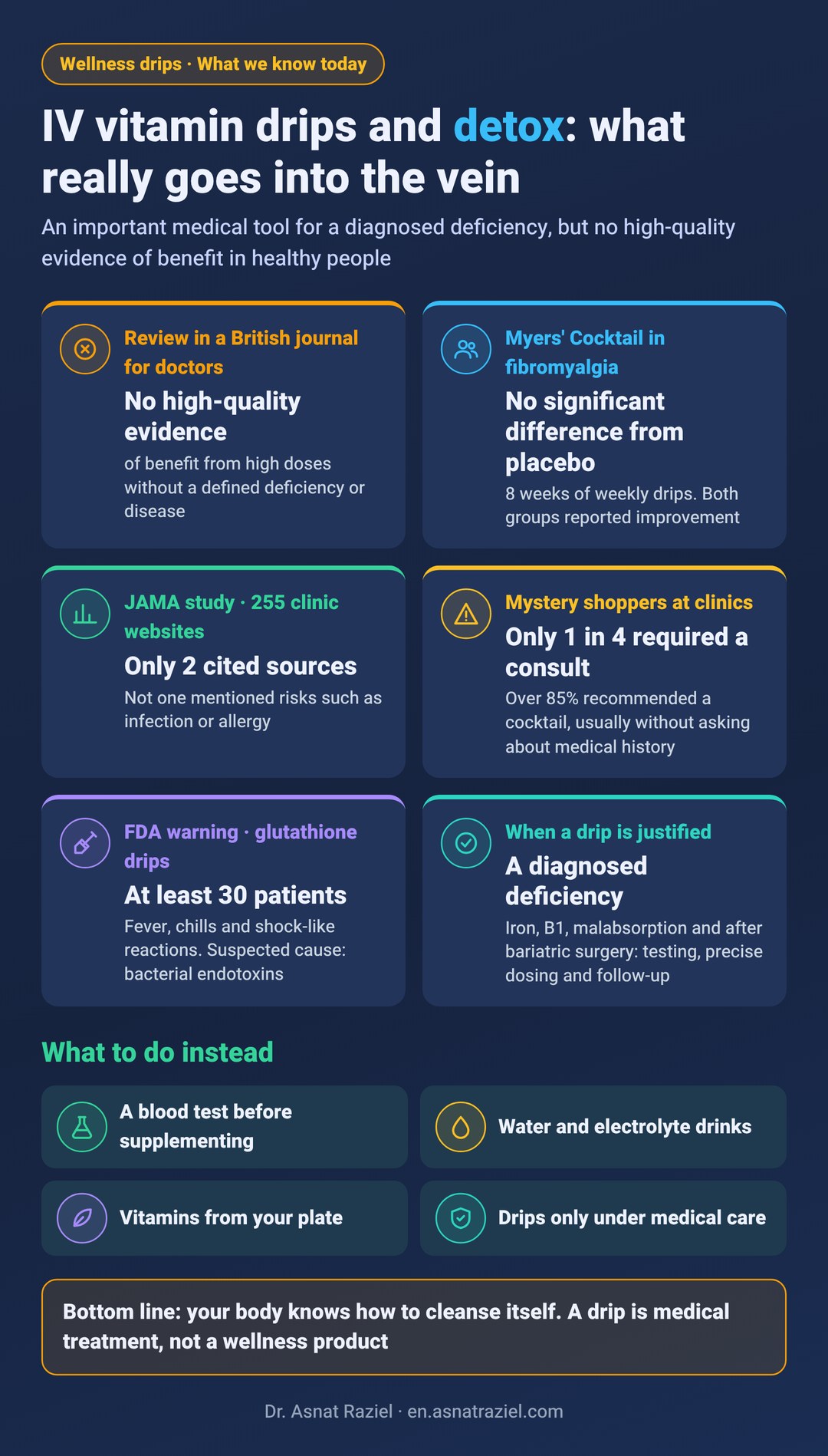
Research on IV vitamin drips in healthy people is very thin. A review in the British journal Drug and Therapeutics Bulletin found no high-quality evidence for high-dose IV vitamins. That holds when there is no defined deficiency or disease. According to the review, there are also possible harms.
One of the few controlled trials tested the Myers’ Cocktail in patients with fibromyalgia. This syndrome causes widespread chronic pain. Participants received a weekly drip of either vitamins or fluids alone for 8 weeks. Both groups reported improvement. However, the groups did not differ significantly. A strong placebo response and a small sample played a part. In other words, much of the good feeling came from the treatment itself, not from the vitamins.
Clinics without oversight: what a US study found
In a study published in JAMA Internal Medicine, Yale researchers examined the US IV drip industry. They reviewed 255 clinic websites, and only two cited scientific sources. Not one website mentioned risks such as infection or an allergic reaction.
The researchers also called clinics as mystery shoppers. More than 85% of clinics recommended a specific “cocktail” for fatigue or a cold. Most did not ask about medical history. Only one in four required a medical consultation first. Fewer than a quarter warned about side effects.
In Israel too, according to a report in Maariv, the Ministry of Health has spoken. Without scientific proof, drips must not claim healing or preventive powers.
The risks of IV vitamin drips
An IV drip is a medical procedure in every sense. A needle bypasses the protective barriers of the skin and gut. Any error in sterility or product goes straight into the blood.
Infection and bacterial toxins. In August 2026, the FDA warned about at least 30 patients. They developed fever, chills and shock-like reactions after glutathione infusions. Some needed hospital care. The main suspect: bacterial endotoxins in raw material made for dietary supplements only. According to the US Centers for Disease Control and Prevention (CDC), similar events happened before. No glutathione product in the US has FDA approval.
Allergic reactions and vitamin overload. Even a “natural” drip can cause an allergic reaction. High doses of some vitamins also build up.
Medical conditions that call for caution. In people with heart or kidney failure, a large fluid volume can strain the body. In addition, high-dose IV vitamin C can harm people with G6PD deficiency. It can also add to kidney stones. So any drip should be preceded by a real medical assessment.
When a drip is real medical treatment
There are conditions in which giving vitamins or minerals by IV is the right treatment, and even lifesaving. Examples include severe iron deficiency that pills do not fix, and malabsorption diseases. Vitamin B1 deficiency is another, as I explained in my article on thiamine deficiency during obesity drug treatment. After bariatric surgery, too, some patients need IV iron.
The essential difference is that in these cases there is a diagnosis. The doctor runs blood tests and finds a deficiency. Then the doctor gives a precise dose and tests again. I wrote about these tests in detail in my guide to iron and B12 testing.
What to do instead
Test before you supplement. Feeling tired? A simple blood test will show a real deficiency, for example in iron, B12 or vitamin D.
Drink water. For most people, a glass of water or an electrolyte drink gives the same “hydration” a drip offers.
Get your vitamins from your plate. Vegetables, fruit, legumes, fish and protein supply the vitamins and minerals your body needs. And if glutathione interests you, read what research shows about the glutathione supplement and about acetylcysteine, its raw material.
Ask questions. Who gives the drip, where does the product come from, and what happens if a reaction occurs? A serious provider will answer these simply. It is also worth remembering the warnings about NAD+ supplements and NAD+ drips.
The bottom line on IV vitamin drips
IV vitamin drips are an important medical tool for a diagnosed deficiency. They also help when a disease blocks absorption. However, as a “detox” or “wellness” treatment for healthy people, they have no high-quality evidence of benefit today. In contrast, the risks are real: infection, bacterial toxins, allergic reactions and harm to people with chronic conditions. Your body knows how to cleanse itself, and you can help it with diet, fluids, sleep and movement.
This article is general information and does not replace personal medical advice. Before any IV treatment, talk to your doctor.
References
Intravenous vitamin injections: where is the evidence?
State Policies and Facility Practices of IV Hydration Spas in the US
Detox diets for toxin elimination and weight management: a critical review of the evidence
FDA reminds compounders not to use dietary supplement grade glutathione for injectables