By Dr. Asnat Raziel, bariatric surgeon specializing in obesity treatment, metabolic health and healthy longevity; Director of the Multidisciplinary Center for Obesity Treatment, Assia Medical, Assuta Ramat HaChayal, Tel Aviv
Yamanaka factors: science fiction or real science?
Yamanaka factors and cell rejuvenation sound like an idea from a science fiction movie. But the story begins with a real and surprising question: how can the sperm and egg of adult parents produce a young baby? To answer it, we need to look at the first days of the embryo. From there, the path leads to an experiment that improved vision in mice, and in October 2026, to the first data from humans.
The embryo that resets the clock
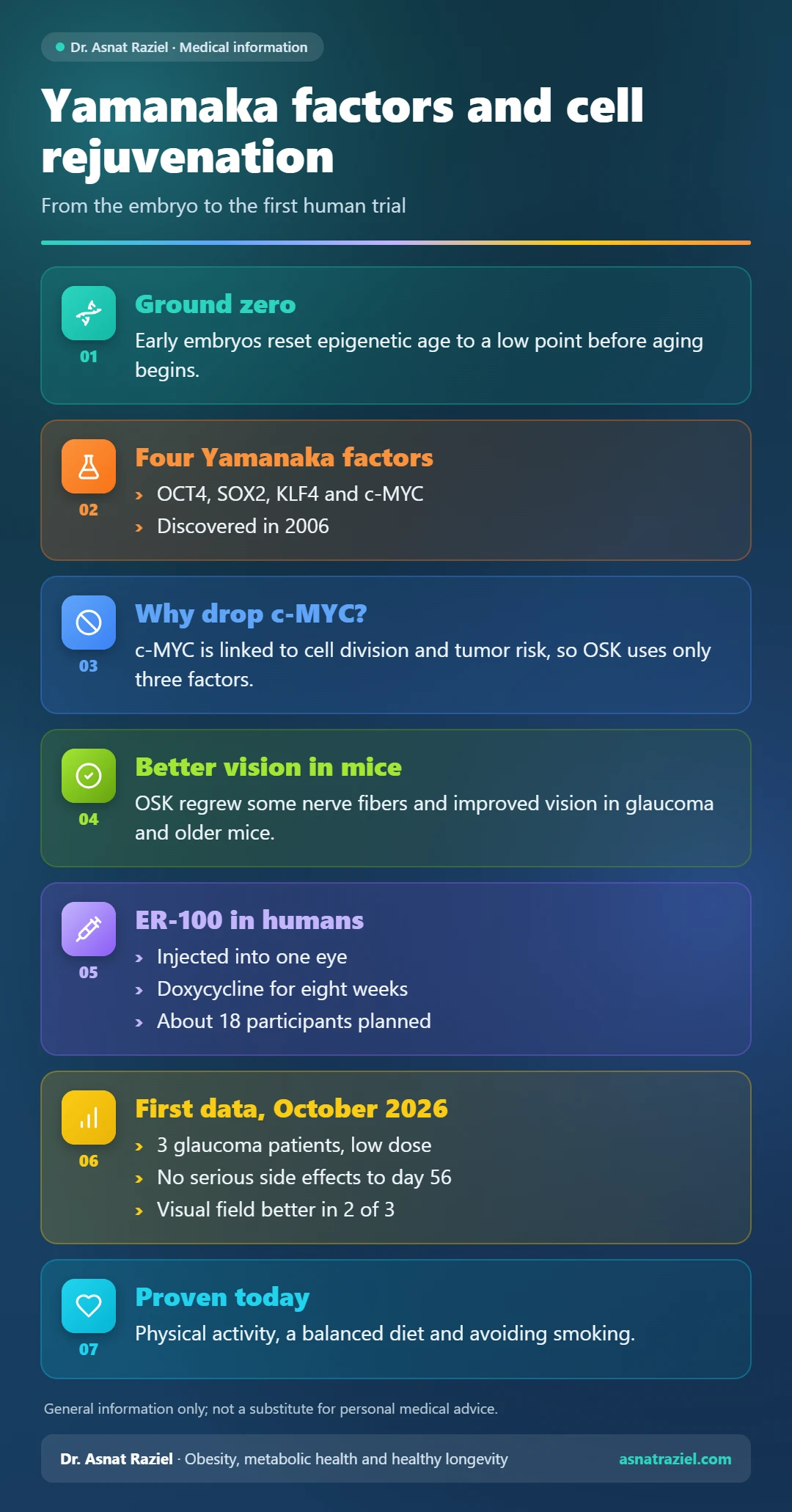
The sperm and the egg carry information from the parents. When they meet, they form an embryo. In its first days, the embryo reorganizes itself in a remarkable way. Researchers who studied chemical marks on DNA found that in the early stages of development, the “age” that these marks reflect drops to a low point. Only afterward does it start to rise again. The researchers called this point “ground zero,” the zero point of biological age.
This is not a button that nature presses on a particular day, nor does it erase every possible kind of damage. Still, the idea is fascinating: nature has a process that can reorganize some of the age marks in our cells. If we understand how it works, perhaps one day we can trigger part of it in adult, damaged tissue as well. For a related lab study, see my article on epigenetic rejuvenation in blood cells.
This is where the field of longevity, meaning healthy long life, comes in. Its goal is not only to add years, but also to preserve movement, thinking and independence over time. We can already improve our chances of that today. The World Health Organization emphasizes physical activity, a balanced diet and avoiding smoking. By contrast, no study has yet proven that a treatment can turn the whole human body back by years.
The instruction book and its bookmarks
Almost every cell in our body contains the same instruction book: DNA. Even so, a muscle cell and a nerve cell look and behave differently. The reason is that each cell reads different chapters of the book.
Imagine many bookmarks on the pages: “read this instruction,” “silence that one.” Some of these bookmarks change over the course of life. Scientists call this system epigenetics. It does not change the letters of the DNA; rather, it determines which instructions the cell switches on. I wrote about how scientists measure these changes in my article on epigenetic aging clocks.
Is it possible to change the bookmarks and give a cell back an ability it has lost? For years, this question was almost a fantasy.
Yamanaka factors: four proteins that changed the story
In 2006, Shinya Yamanaka and Kazutoshi Takahashi showed that researchers could introduce four factors into an adult cell: OCT4, SOX2, KLF4 and c-MYC. This reprogrammed the cell. In the lab, a cell that had already specialized in a particular role returned to a state similar to a stem cell. A cell like this can develop into many types of cells. Since then, scientists have called these four proteins the Yamanaka factors.
This is a dizzying discovery, but it also carries a clear danger. If you erase too much of an adult cell’s identity, it may lose its function and divide without control. In the original research, for example, such cells formed tumors when researchers transplanted them into mice. That is why the goal of a human treatment is much more modest and precise. Researchers do not want to turn a nerve cell into a stem cell. Instead, they want to improve its function while it remains a nerve cell.
Why three Yamanaka factors and not four?
The group of Prof. David Sinclair chose OCT4, SOX2 and KLF4, or OSK for short. They left out the fourth factor, c-MYC, which also promotes cell division and raises tumor risk. Researchers call the method partial reprogramming: changing activity patterns in a damaged cell without erasing its identity. However, leaving out c-MYC does not automatically make the method safe, and researchers are still testing its safety.
You can think of it like fixing software. The researchers do not want to format the computer and start from scratch. Instead, they want to restore a few lost settings and see whether the computer works well again.
Then came the mice
The researchers focused on the eye, and especially on the nerve cells that carry information from the eye to the brain. They switched on the three factors in these cells in mice. After an experimental injury to the optic nerve, some of the nerve fibers grew back. In a mouse model of glaucoma, vision improved. In older mice, too, the researchers measured better vision and a return of some epigenetic marks to a youthful state.
These are exciting results, but we need to state exactly what they are: an improvement in mice under experimental conditions. In other words, they do not mean that a blind human eye can see again. Nor do they prove that we can rejuvenate a whole human body. Other scientists are exploring very different routes to repair, such as the bioelectric approach to organ regeneration.
Later, the company Life Biosciences reported on an experiment in monkeys. The monkeys had an injury that mimics NAION, a sudden injury to the optic nerve that results from reduced blood supply. After the experimental treatment, the researchers found much less damage to the function of the nerve cells and nerve fibers. I wrote about NAION in the context of weight loss drugs in my article on optic nerve damage.
Yamanaka factors in circular RNA: rejuvenation without losing identity
The big risk in rejuvenating cells is that a cell “forgets” what it is and turns into a stem cell, which could lead to a tumor. Therefore, researchers are looking for ways to make sure reprogramming stays partial. A new study offers an elegant solution.
The researchers packed three Yamanaka factors, OCT4, SOX2 and KLF4, into a single circular RNA molecule and delivered it to cells inside tiny lipid nanoparticles. The RNA works only briefly and does not change the genome. They tested the method in mesenchymal stem cells, which are used in cell therapies and age in culture. According to the Fight Aging! summary, the aged cells showed fewer senescence markers, less DNA damage and less inflammatory secretion. In addition, they regained the ability to divide, migrate and differentiate like young cells.
Most importantly, this version of the Yamanaka factors did not turn the cells into pluripotent stem cells, and the cells kept their identity and genome stability. These are still cell-culture experiments, with no animal data yet. Nevertheless, it is an important step toward safer treatment, first of all for improving stem cell therapies.
Yamanaka factors in humans: what is happening now?
The name of the experimental treatment is ER-100. In the first trial in humans, doctors inject an engineered viral carrier into one eye. The carrier delivers instructions to the cells for making the three OSK factors. Participants then take doxycycline for eight weeks to switch the system on. The trial began in March 2026 and plans to enroll about 18 participants. In the first stage, it includes patients with open-angle glaucoma, and later also patients with NAION.
In June 2026, the company announced that the first participant had received the treatment. Then, on October 8, 2026, the company released first data from three patients with glaucoma. According to the company, the low dose caused no serious side effects through day 56. In addition, two of the three showed an improvement in their visual field. However, these are early data from the manufacturer, from a very small number of people, and not yet in a scientific journal. The trial’s main goal is to test safety, and it is now moving on to the higher dose.
The bottom line
This may be the most fascinating story in longevity science today. Biology has taught us that an adult cell does not stay fixed forever. In addition, animal experiments have shown that it is possible to improve the function of damaged cells. The big question, whether we can do this in humans safely and effectively, remains open. Companies are already racing toward it, as I described in my article on the NewLimit investment.
Meanwhile, the proven path to a long, healthy life runs through taking care of the body we have. You can read more about the ways we influence the pace of aging in my article on what slows aging, and in the story of the woman who lived to 117. Research on Yamanaka factors offers one more exciting possibility: perhaps one day we will also be able to repair some of what time has changed inside our cells.
The information in this article is general and does not replace personal medical advice.
References
Circular RNA Encoding Yamanaka Factors Enables Partial Reprogramming Without Pluripotency
Epigenetic clocks reveal a rejuvenation event during embryogenesis followed by aging
Reprogramming to recover youthful epigenetic information and restore vision
Life Biosciences Announces First Patient Dosed in Phase 1 Trial of ER-100 for Optic Neuropathies
Disclosure: Prof. David Sinclair, one of the authors of the mouse study, is a co-founder of Life Biosciences, the company developing ER-100.