By Dr. Asnat Raziel, bariatric surgeon specializing in obesity treatment, metabolic health and healthy longevity; Director of the Multidisciplinary Center for Obesity Treatment, Assia Medical, Assuta Ramat HaChayal, Tel Aviv
Aging clocks: which clock really works?
Aging clocks promise to measure our biological age, but can they detect a change after treatment? A new study in the journal Nature Medicine set out to answer this question. If you change your diet, exercise, lose weight or start a medication, can you see within months that your pace of aging has changed?
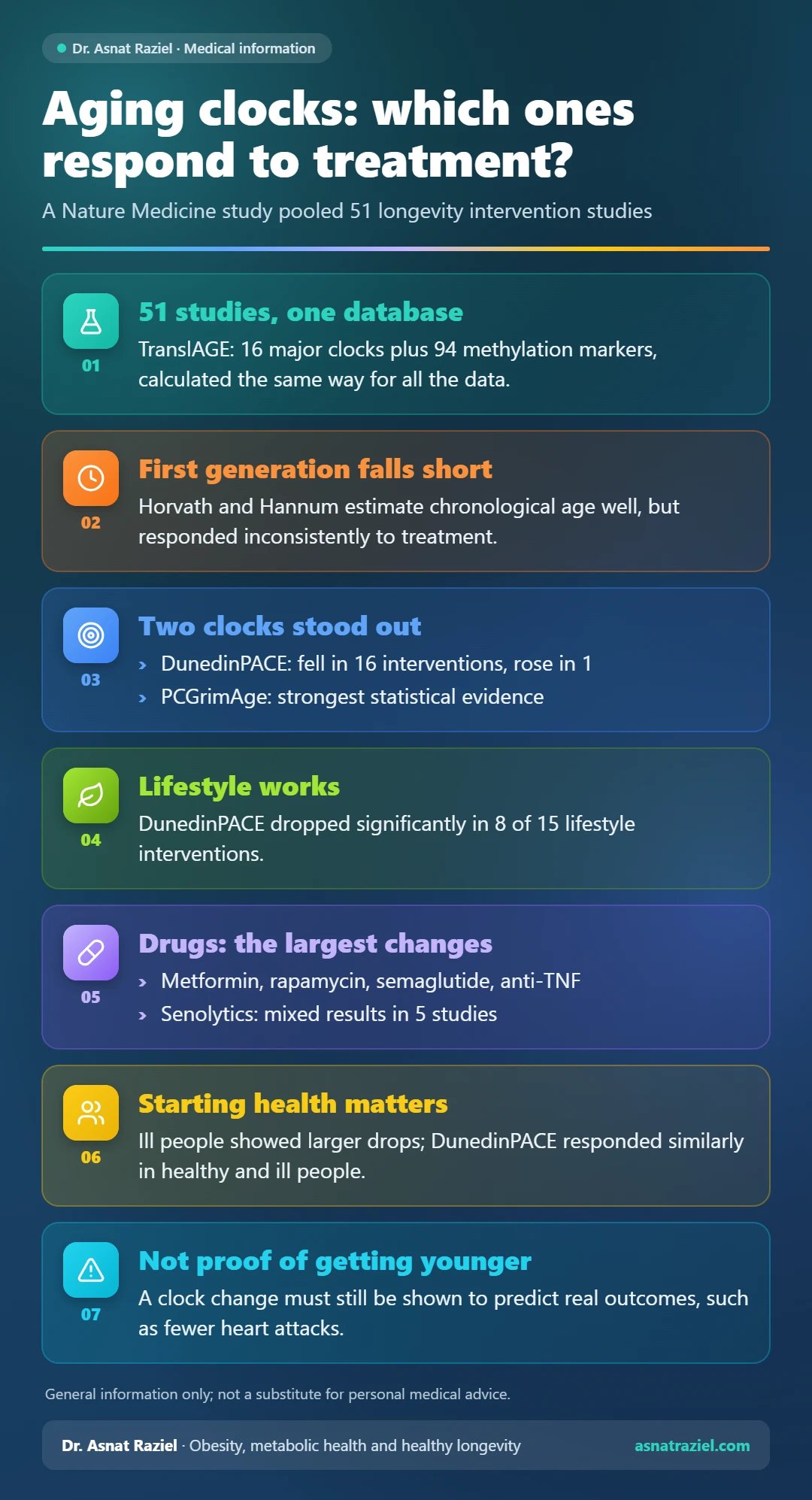
The researchers pooled data from 51 intervention studies in humans and compared dozens of markers based on DNA methylation. The conclusion is clear. Not every “biological clock” measures the same thing, and not all of them are suited to tracking treatment. In fact, it was the newer clocks, built to predict the pace of aging, disease and death, that responded most consistently to interventions.
What is biological age, anyway?
We all have a chronological age, the number of years since birth. Yet people of the same age differ greatly in their health. One 65-year-old may be active and strong, while another of the same age lives with chronic diseases. Nature offers striking examples of this too, as I describe in my article on butterflies and aging. This gave rise to the idea of biological age: an attempt to measure how fast the body is really aging, not just by date of birth.
One of the methods under study is based on DNA methylation. These are tiny chemical changes on the DNA that affect how genes work without changing the sequence itself. Methylation patterns change with age, so mathematical models use thousands of these sites to build an “epigenetic clock.”
The study that compared aging clocks
Until now, it was hard to know which clock is best for tracking longevity interventions. One study used the Horvath clock, another used GrimAge and a third used DunedinPACE. In addition, the populations, treatments and follow-up periods all differed.
So the researchers, led by a team from Yale University, built a database called TranslAGE. Into it, they pooled 51 studies in which blood samples were taken before and after the intervention. Then, using the same method across all the data, they calculated 16 major clocks plus 94 other methylation markers. As a result, for almost the first time, the clocks faced off head to head.
The first generation is not suited to tracking
The first clocks, including Horvath and Hannum, were built mainly to estimate chronological age. They do that well. In longevity medicine, however, the question is different: do they detect biological improvement after treatment? In the current study, the first-generation clocks responded inconsistently. By contrast, the second-generation clocks, built around disease, death and the pace of aging, showed a much more stable picture.
Two aging clocks stood out: DunedinPACE and PCGrimAge
Of all the clocks, DunedinPACE was the most sensitive to interventions. According to the preprint version of the study, it fell significantly in 16 interventions and rose in only one. It also showed the largest average drop among the reliable clocks. PCGrimAge, on the other hand, provided the strongest statistical evidence of change. GrimAgeV2, PCPhenoAge and SystemsAge were also among the promising markers.
The difference between them matters. DunedinPACE does not tell you “how old the body is.” Instead, it estimates how fast the body is aging. Put simply, it measures your driving speed rather than the odometer. GrimAge, by contrast, was built around markers that predict the risk of death and disease. Therefore, a person may get different results on the two clocks without either one being wrong.
Lifestyle, medications and aging clocks
One encouraging finding is that lifestyle changes produced measurable shifts. Out of 15 lifestyle interventions, DunedinPACE dropped significantly in eight. Two Mediterranean diet studies showed declines in similar groups of markers. When a result repeats across different studies, it is more likely to be a real change rather than noise. Likewise, a longevity diet rests on the same principle of a consistent eating pattern. I also wrote about a menu built around the epigenetic clock. In addition, my article on diet and aging covers ten healthy eating patterns.
On average, the drug interventions produced the largest changes. The database included metformin, rapamycin, semaglutide and biologic anti-TNF therapies. In patients with arthritis and inflammatory bowel disease, anti-TNF drugs changed almost all the second-generation markers. Even so, the fact that a drug changes an epigenetic clock does not prove that it should be taken to extend life. I look at how weight-loss drugs affect these clocks in a separate article.
What about senolytics?
Senolytics are drugs designed to clear out aging (senescent) cells. Here the picture was less convincing. Five studies showed mixed results: some clocks improved while others got worse. So, based on current methylation measures, there is no consistent signal today that senolytics slow aging in humans.
Not everyone responds the same way
A person’s health at the start of the study had a big effect on the size of the change. In people who were ill, PCPhenoAge, GrimAgeV2 and SystemsAge showed a larger drop than in healthy people. The explanation may be simple: when there is a metabolic or inflammatory disorder, there is more room for improvement. DunedinPACE was the exception, responding similarly in healthy and ill people.
The next generation: a map of body systems
The most interesting development is a move from a single number to measuring different systems in the body. SystemsAge tries to show which systems are changing. For example, quitting smoking had a particular effect on the lung score. Metformin stood out in the inflammation, brain and metabolism scores. Across seven dietary interventions, the musculoskeletal score dropped in all of them, while the metabolism and inflammation scores responded in six out of seven.
In the future, instead of telling someone “your biological age is 61,” we may get a detailed map: blood vessels, immune system, kidneys, lungs, muscles and brain. I discuss another emerging tool in my article on AI and aging.
Can a test prove that we got younger?
Not yet. This may be the most important point in the study. The fact that a marker changes after treatment does not make it a reliable surrogate measure of aging. For that to happen, researchers need to prove that a change in the clock also predicts real outcomes: fewer heart attacks, less cancer, less dementia, good function and more healthy years of life.
Still, the study has great value. The main problem in longevity research is time, because you cannot follow people for decades. A reliable measure would make it possible to test treatments quickly. The study does not deliver a single “gold-standard test,” but it does narrow the list of candidates. For a broader look, see my article on whether biological age can be reversed.
What does this mean if you take a biological age test?
Before you get excited about the number in your report, it is worth asking four questions:
- Which clock was calculated?
- What exactly is it designed to predict?
- Is it reliable for repeat measurement?
- Is the change larger than the technical variability of the test?
Two biological age tests may use different algorithms and give the same person different results. That is why it is best to see them as one more tool within a broader picture. Established clinical measures remain essential for medical decisions. These include blood pressure, blood fats, blood sugar, HbA1c (average blood sugar over the past three months), fitness, strength, muscle mass and sleep.
The bottom line on aging clocks
This study marks the coming of age of the longevity field. The question is no longer “Can we calculate biological age?” but rather “Does the measure change when the biology changes, and does that change predict a healthy life?” Of the dozens of markers, the second-generation clocks stood out, with DunedinPACE and PCGrimAge leading the way. The future will probably not rest on one “magic number.” Instead, it will likely combine clocks, system scores, blood tests, physical and cognitive function and long-term follow-up.
The information in this article is general and does not replace personal medical advice.
References
Responsiveness of epigenetic aging biomarkers to longevity interventions in humans
DNAm aging biomarkers are responsive: Insights from 51 longevity interventional studies in humans
Scientists compared 51 longevity studies to see which aging biomarkers respond most reliably
Yale Researchers Create Roadmap To Measure Whether Longevity Interventions Work




