By Dr. Asnat Raziel, bariatric surgeon specializing in obesity treatment, metabolic health and healthy longevity; Director of the Multidisciplinary Center for Obesity Treatment, Assia Medical, Assuta Ramat HaChayal, Tel Aviv
Butterflies and aging: from technology back to nature
The link between butterflies and aging may sound surprising, but a new study puts it center stage. In recent years, the longevity field has focused mainly on technology. Think artificial intelligence, genetic testing and biological clocks. Some entrepreneurs, such as the American Bryan Johnson, have even built elaborate anti-aging programs around them. However, a study published in June 2026 turns our attention to a remarkably delicate creature: a tropical butterfly. Its findings show that evolution has already developed its own ways to slow aging.
A butterfly that lives almost a year
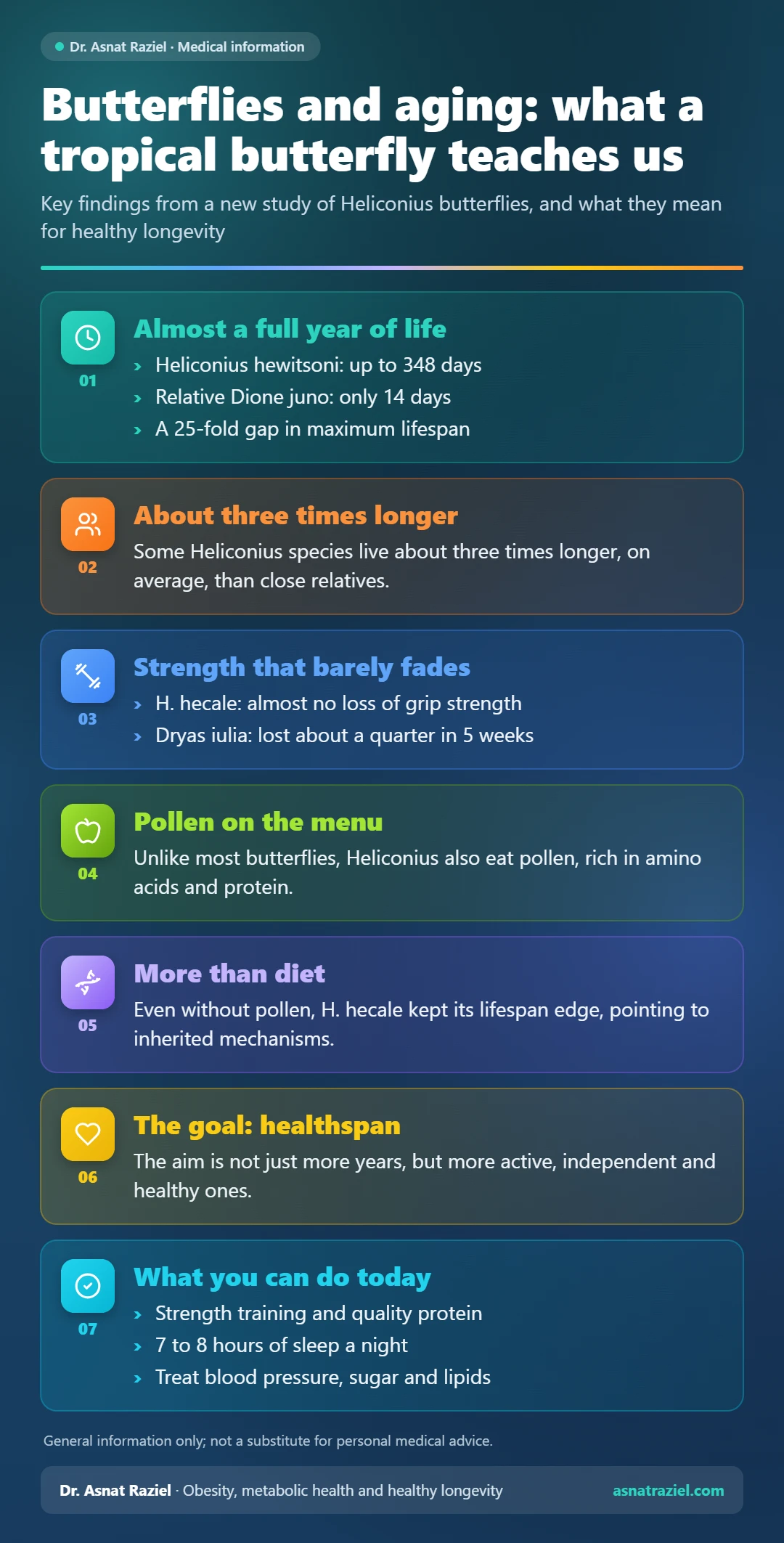
Most butterflies live only a few weeks after they emerge. By contrast, researchers from the University of Bristol and the Smithsonian Tropical Research Institute in Panama studied Heliconius butterflies. These butterflies live in the rainforests of Central and South America. According to the study in Nature Communications, some species in this genus live about three times longer, on average, than their close relatives.
The record belongs to Heliconius hewitsoni. In captivity, individuals of this species lived up to 348 days, almost a full year. At the other extreme, one short-lived relative, Dione juno, reached a maximum lifespan of only 14 days. In other words, there is a 25-fold gap in maximum lifespan between the two species.
Such a gap is not unusual among insects. According to the researchers, maximum lifespan varies roughly 5,000-fold across different insects. In mammals, by comparison, the range is only about 100-fold. That is why insects offer science a huge natural laboratory for studying aging. Moreover, they are relatively easy to follow across their entire lives, within weeks or months rather than decades.
Butterflies and aging slowly: more than a long life
The key insight of the study is not just how long these butterflies live, but how well they age. The researchers measured the butterflies’ function throughout their lives with a grip strength test. Grip strength is also a familiar measure in human medicine, as a sign of strength and vitality in older age. In addition, the team combined data from butterfly houses, field studies and controlled experiments.
The result surprised them. Heliconius hecale showed almost no decline in strength with age. On the other hand, Dryas iulia, a relative that does not eat pollen, lost about a quarter of its grip strength within five weeks, according to a summary of the study on Sci.News.
Put simply, these butterflies don’t just survive for a long time. They also stay “young” in how they function for most of their lives. The lead researcher, Dr. Jessica Foley, summed it up in a news release from the University of Bristol. In her words, the butterflies evolved not only longer lives, but also slower aging.
Is diet the key?
One of the main hypotheses involves the unusual diet of Heliconius butterflies. Most butterflies feed mainly on nectar. These species, however, can also eat pollen. Pollen is rich in amino acids and protein. As a result, it provides a high-quality food source throughout adult life.
Even so, the researchers believe diet alone cannot explain the whole picture. Even without pollen on the menu, Heliconius hecale kept a clear lifespan advantage. So it seems that inherited biological mechanisms also evolved over time. These mechanisms slow the pace of aging and lower the risk of death with age. This picture echoes what we know about dietary protein and longevity in humans as well.
Butterflies and aging: why it matters for humans
At first glance, a butterfly and a human could not be more different. Yet the biology of aging rests on basic mechanisms that many species share. A major review in the journal Cell listed twelve hallmarks of aging. Among them are damage to genetic material, mitochondrial dysfunction, chronic inflammation and senescent cells.
When scientists find an animal that naturally slows its own aging, they can study the pathways behind it. These include genetic, metabolic and cellular pathways. In the future, such insights may lead to new drugs and treatments. Still, the goal is not only a longer lifespan. Above all, the aim is a longer healthspan, meaning the years in which a person stays active, independent and healthy. I have also written about these directions in my article on drugs that aim to slow aging.
Nature as the greatest teacher
Today, many longevity studies focus on molecules, drugs and artificial intelligence. However, this new study reminds us of a simple fact. Over millions of years, evolution has run the largest experiments of all.
Some animals have developed exceptional resistance to aging, cancer or degenerative diseases. For example, the naked mole rat lives more than 30 years, while a mouse of similar size lives up to 4 years. Researchers identified a substance called hyaluronan in the naked mole rat. It has an especially high molecular mass and contributes to the animal’s resistance to cancer. Another example is the Greenland shark. A study that estimated the age of these sharks showed a lifespan of at least 272 years. Ultimately, learning from such mechanisms may become an important source of inspiration for the medicine of the future.
Looking ahead: what we can do today
Tropical butterflies will not teach us how to live to 120. Still, they offer a rare biological model for a question that occupies aging researchers worldwide: how do we slow aging without losing function?
Meanwhile, humans can also influence how fast they age. Good nutrition, physical activity, sleep and treatment of metabolic disease all affect the body’s biological clocks. It is also worth reading about the ways to age healthily and about accelerated biological aging in young adults.
The lesson from butterflies and aging is clear. What matters is not only how many years we live, but also how long we keep our strength and function. A few simple steps support this:
- Regular strength training, to preserve muscle mass and grip strength.
- A diet with high-quality protein and a variety of plants.
- Regular sleep of 7 to 8 hours a night.
- Monitoring and treating blood pressure, blood sugar and blood lipids.
- Social connections and activities that challenge the brain.
None of these steps is magic. Together, though, they affect the same aging mechanisms that researchers are studying in nature.
Labs are also looking for ways to repair the damage of time. You can read about this in my article on the enzyme that may repair age-related damage, and about the bigger picture in my article on healthy longevity and rejuvenation.
Bottom line: what butterflies and aging teach us
Research on butterflies and aging shows that evolution knows how to preserve health over time. The big answers will likely not come only from high-tech labs. They will also come from looking closely at nature. Ultimately, the better we understand how different species maintain function, the closer we will get to new ways of keeping people healthy for years to come.
The information in this article is general and does not replace personal medical advice.
References
Evolution of increased longevity and slowed ageing in a genus of tropical butterfly
‘Geriatric’ butterfly species lives nearly three times as long as their relatives
Secret to Heliconius Butterflies’ Longevity May Be Hidden in Pollen
Hallmarks of aging: An expanding universe
High-molecular-mass hyaluronan mediates the cancer resistance of the naked mole rat
Eye lens radiocarbon reveals centuries of longevity in the Greenland shark (Somniosus microcephalus)




