By Dr. Asnat Raziel, bariatric surgeon specializing in obesity treatment, metabolic health and healthy longevity; Director of the Multidisciplinary Center for Obesity Treatment, Assia Medical, Assuta Ramat HaChayal, Tel Aviv
A new protein repair enzyme against the damage of aging
For decades, researchers saw some forms of age-related damage as irreversible. Now a protein repair enzyme challenges that view. One such type of damage is the gradual harm to the body’s proteins, especially connective tissue proteins such as collagen and elastin. AGEs, or advanced glycation end products, cause this damage.
In July 2026, a study in Nature Communications presented a completely new approach. The researchers engineered an enzyme that removes a common type of AGE from aging human proteins. If studies in animals and in humans confirm the findings, this could be one of the most interesting advances in longevity medicine in recent years.
Not every protein in the body renews itself
The body breaks down and rebuilds most of its proteins within hours or days. However, some proteins have an unusually long life. The best-known example is collagen, the most abundant protein in the body. It builds the skin, tendons, bones, blood vessels and joints. Some collagen fibers stay in the body for decades.
Over time, these proteins meet glucose and other reactive molecules again and again. As a result, a slow chemical reaction called glycation takes place, which binds sugars to proteins. Gradually, AGEs build up. They damage the protein’s structure, stiffen it, reduce its flexibility and increase chronic inflammation.
Why do AGEs matter so much in aging?
Today, researchers consider AGEs one of the core mechanisms of aging. According to a review in Experimental Gerontology, their buildup in tissues leads to stiffer collagen, stiffer tissues and even high blood pressure. Among other things, they play a role in:
- Atherosclerosis and stiffening of the blood vessels.
- Diabetes and its complications, including kidney damage.
- Loss of skin elasticity and cataracts.
- Joint wear and neurodegenerative diseases, including Alzheimer’s.
In addition, AGEs activate a receptor called RAGE. This receptor triggers ongoing inflammation and oxidative stress, two central mechanisms of aging. A recent 2025 review describes this process in detail in people with diabetes.
Until now, we could only slow the damage of aging
So far, most efforts have focused on two strategies. The first is to reduce how many AGEs form: blood sugar control, a Mediterranean diet, physical activity and less processed and grilled food. The second is drugs that prevent new AGEs from forming. However, almost no one has managed to remove AGEs that have already formed on proteins that are decades old. This has been one of the big problems in aging medicine. I wrote about the nutritional side in my article on the longevity diet.
CMLase: a protein repair enzyme that fixes instead of replacing
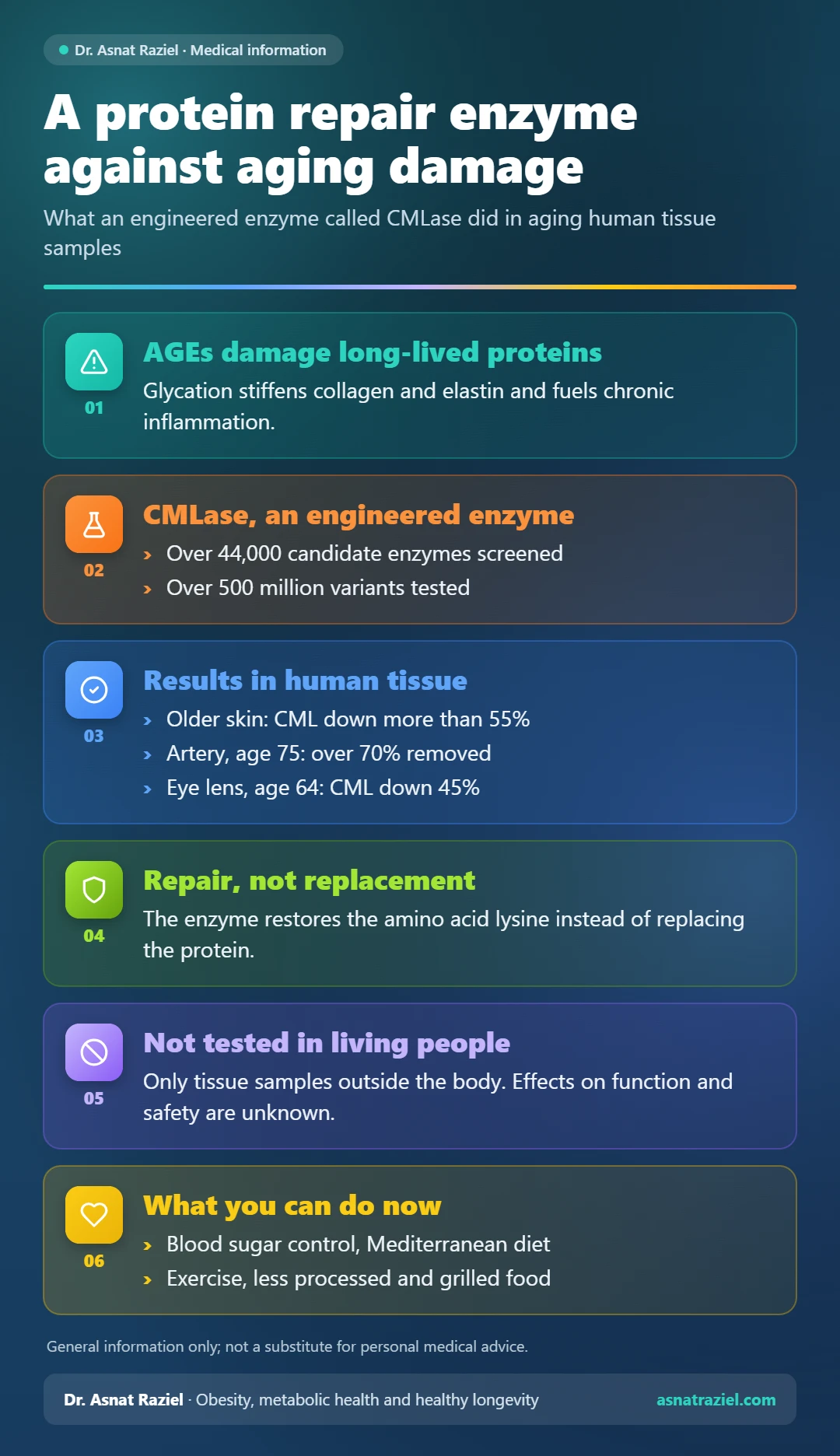
The researchers, from Revel Pharmaceuticals and its partners, used directed evolution, a method that mimics natural selection in the lab. According to the summary by Lifespan.io, they screened more than 44,000 candidate enzymes. They then tested more than 500 million variants. The result was a new enzyme called CMLase. It recognizes and breaks down carboxymethyl lysine (CML), one of the most common types of AGEs, and returns the amino acid lysine to its original state.
In other words, instead of replacing the damaged protein, the enzyme repairs it directly. This is a major shift in thinking: no more “replacing parts,” but rather “molecular renovation.”
Protein repair enzyme results in human samples
The researchers tested the enzyme on tissue samples from donors aged 20 to 75. According to the company’s announcement and the paper itself, the results were impressive:
- In older skin, CML levels fell by more than 55%, to a level lower than in the skin of a 31-year-old.
- In an artery from a 75-year-old donor, the enzyme removed more than 70% of the CML.
- In eye lens proteins from a 64-year-old donor, the amount of CML dropped by 45%.
- In a model protein in the test tube, the enzyme removed the CML and the protein stayed intact.
To be precise, the study did not check whether the structure or function of the tissues improved. It only measured the amount of CML.
Why a protein repair enzyme matters for longevity
One of the central ideas in longevity medicine is that aging is not a single event but a buildup of damage. To date, researchers have developed treatments against several types of it: senolytics (drugs that clear old cells), damage to mitochondria, telomere shortening and epigenetic changes. Now a new option joins them: directly repairing proteins that have aged. In other words, we may be able not only to slow the damage of aging, but also to remove some of it. You can read about other drug approaches in my article on anti-aging drugs.
Could we rejuvenate arteries?
If the technology also succeeds in animals and in clinical trials, it may one day make blood vessels more flexible. In addition, it might slow skin aging, improve tendon and joint function and reduce chronic inflammation. Since collagen builds almost every tissue, even a partial improvement in its condition could have very broad effects. If you are interested in how metabolic treatments affect the skin, you will find more in my article on the effects of Mounjaro on the skin.
But it is still too early to celebrate
Despite the excitement, it is important to stay cautious. The researchers tested the enzyme on samples outside the body (ex vivo), not in living people. The samples were thin slices or ground protein, so the enzyme had especially easy access. Therefore, many questions remain open:
- Will the enzyme reach dense tissues in the body after an injection?
- How long will it stay active?
- It comes from bacteria, so the immune system may recognize it as a foreign protein.
- Other types of AGEs, such as glucosepane (a durable cross-link in collagen), remain unaddressed for now.
- No one knows yet whether the molecular repair will improve organ function or extend life.
The company’s CEO also said in the announcement that “more work is needed.” Beyond that, the company developing the enzyme is also the one that carried out the study.
Beyond anti-aging: repairing the damage of aging
One of the most interesting developments in longevity is the shift from “slowing aging” to repairing the damage of aging. Just a few years ago, this idea was almost fantasy. Today, there is progress in several complementary directions: clearing old cells, partial epigenetic reprogramming, DNA repair, restoring mitochondria and now protein repair as well. In the future, combining them may address several mechanisms at once. Meanwhile, you can already track biological age with aging clocks.
Nature also offers clues for slowing aging. I wrote about this in my review of what really slows aging.
The bottom line on the protein repair enzyme
The new enzyme is not a “fountain of youth,” and it is still far from clinical use. However, it marks a deep shift in how science views aging. For years, experts believed that glycation damage in long-lived proteins was irreversible. The new study shows that, at least at the molecular level, an engineered enzyme can remove a significant part of it. If future studies prove it safe and effective in humans, we may start to repair aging, one molecule at a time. Until then, the safe path is a healthy lifestyle, as I described in my article on healthy longevity.
The information in this article is general and is not a substitute for personal medical advice.
References
Reversal of protein chemical aging by enzymatic deglycation
Engineered Enzyme Reverses Age-Related Protein Damage
Protein glycation – Between tissue aging and protection
Researchers from Revel Pharmaceuticals, the company developing the enzyme, carried out the study together with Calico and the University of Colorado.




