By Dr. Asnat Raziel, bariatric surgeon specializing in obesity treatment, metabolic health and healthy longevity; Director of the Multidisciplinary Center for Obesity Treatment, Assia Medical, Assuta Ramat HaChayal, Tel Aviv
Longevity drugs: not a miracle pill, but familiar medicines
Longevity drugs, meaning medicines that may slow aging, are one of the hottest topics in science today. For decades, scientists have searched for a “fountain of youth” pill. Most of that effort went into developing entirely new drugs. That is a long, expensive process that can take more than a decade and cost billions of dollars.
However, the answer may not be hiding in futuristic labs. Perhaps it is already sitting in pharmacies and in our own medicine cabinets. A new study published in June 2026 in the journal Nature Aging offers a new way to find these drugs.
Aging is a biological system we can understand
One of the biggest shifts in science over the past decade is the realization that aging is not just the passage of time. It is a biological process run by cellular mechanisms, and we can measure it and even intervene in it.
Today, researchers describe a set of hallmarks of aging. These include chronic inflammation, the buildup of senescent cells, declining mitochondrial function and epigenetic changes. In addition, there is impaired DNA repair, reduced autophagy (the cell’s recycling system) and disrupted communication between cells. Until recently, researchers studied each mechanism on its own. Yet each one affects the others, and aging as a whole works like one large network.
A subway map of aging
That is exactly where this study begins. Researchers from Northeastern University and Harvard led it, including network scientist Albert-László Barabási. According to the university’s announcement, they built a huge map of the biological connections in the human body.
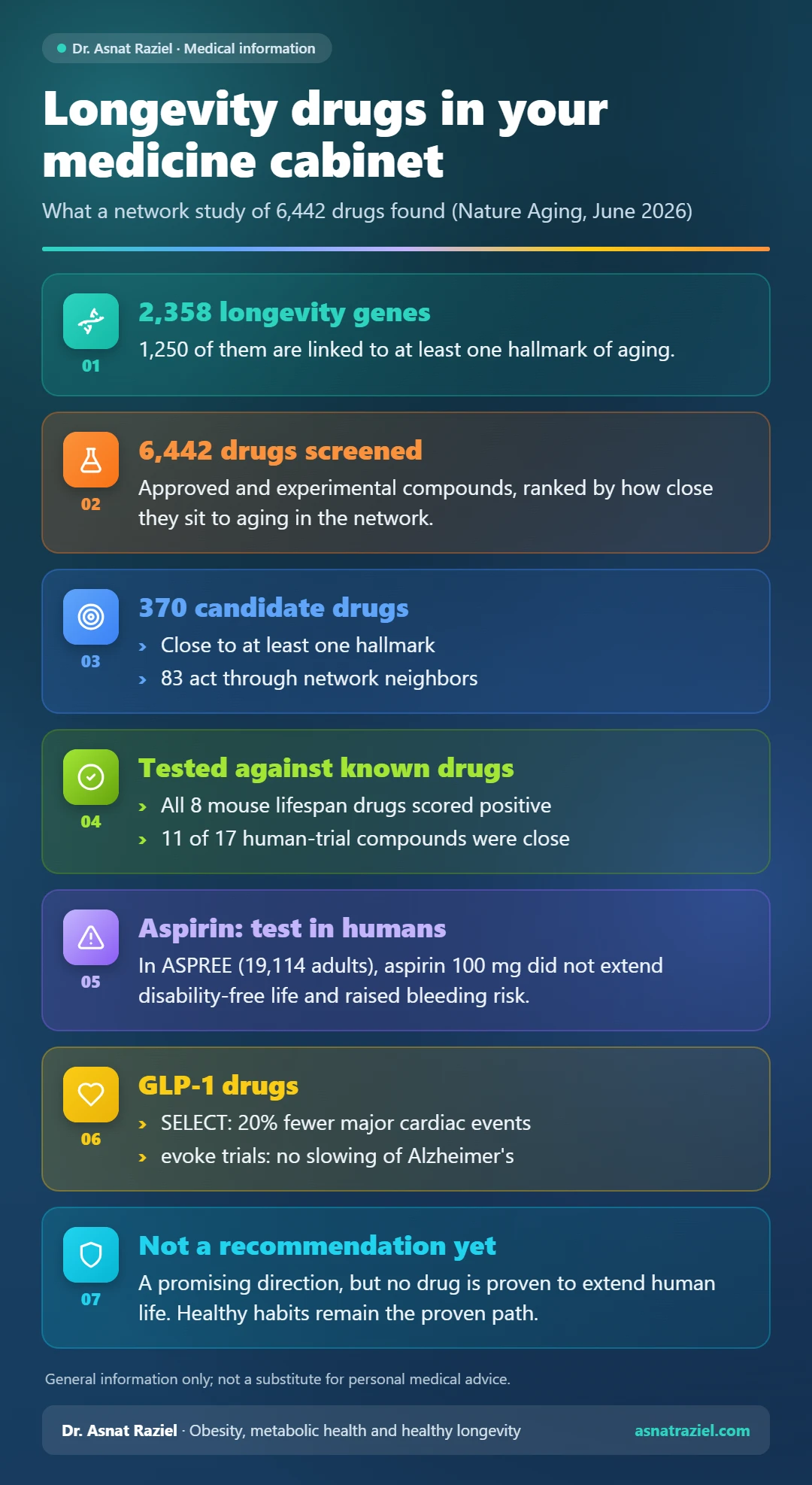
The researchers mapped 2,358 genes linked to longevity. Of these, 1,250 genes are linked to at least one hallmark of aging. They placed these genes within a network of more than half a million interactions between proteins. The result is a kind of “subway map” of aging, where every station connects to many others. In other words, when one pathway goes wrong, it also affects other pathways.
How to find longevity drugs in the network
Here is the new idea. Instead of asking which gene a drug acts on, the researchers asked how “close” it sits to the aging mechanisms in the network. To do this, they tested 6,442 drugs and compounds, both approved and experimental. The closer a drug’s targets are to the heart of the network, the more likely it is to affect aging. I wrote about one candidate from this kind of screening in my article on an anti-aging nasal spray.
But closeness alone is not enough. So the researchers developed a score called pAGE. It checks whether a drug shifts gene activity in the opposite direction to the changes of aging, or actually reinforces them. In other words, the question is not only whether the drug reaches the mechanism, but whether it moves it in a “younger” direction. I describe a related gene-expression approach in my article on geroprotectors.
What the study found
The method identified 370 drugs close to at least one hallmark. Of these, 83 do not act directly on an aging gene, but work through neighbors in the network. The researchers also tested the method against well-known drugs:
- All 8 compounds that extended lifespan in mice, and had enough data, received a positive pAGE score for at least one hallmark.
- Of 17 compounds now being tested in humans, including metformin and rapamycin, 11 showed significant proximity to the network.
- Aspirin mapped to six hallmarks, and rapamycin to one, intercellular communication.
Still, some drugs improved one hallmark and harmed another. On the other hand, the method also held up well against a parallel, independent mouse study of 10 compounds, whose results came out only after the researchers made their predictions. Barabási himself stresses that the study does not offer a cure for aging and does not prove that any drug will extend human life. You can read the full paper for free.
Why existing drugs?
The big advantage is speed. A drug that is already approved has gone through years of safety testing. In addition, doctors understand how it works and know its side effects. So if it turns out to affect aging, researchers can move quickly to dedicated clinical trials.
This approach is called drug repurposing. For example, drugs developed for diabetes became effective treatments for obesity. Now the same thinking is reaching the longevity field: instead of asking which disease a drug was developed for, we ask which aging mechanisms it affects. I wrote about the regulatory path in my article on the FDA and anti-aging drugs.
The familiar stars among longevity drugs
Metformin, one of the oldest diabetes drugs, is at the center of this research. The reason is its effect on metabolism, inflammation and insulin sensitivity. Rapamycin, which comes from a bacterium found in the soil of Easter Island, extended lifespan in animal studies. It acts on the mTOR pathway, one of the cell’s main control pathways.
Aspirin, by contrast, shows how important it is to test in humans. In the ASPREE trial, 19,114 healthy older adults, most of them aged 70 or older, received aspirin 100 mg or a placebo. Aspirin did not extend disability-free survival, and it increased the risk of bleeding. Therefore, do not take aspirin to prevent aging without your doctor’s advice.
GLP-1 drugs and healthy aging
In recent years, most of the attention has turned to GLP-1 drugs, led by semaglutide and tirzepatide. At first they were used for diabetes, and then they revolutionized obesity treatment. In the SELECT trial, semaglutide cut the risk of a major cardiac event by 20% in people with obesity and heart disease. In addition, these drugs protect the kidneys and improve fatty liver. You will find more detail in my article on GLP-1 drugs against aging.
Even so, not every hope comes true. In November 2025, the evoke and evoke+ trials, with 3,808 participants, did not show that oral semaglutide slows Alzheimer’s disease. In other words, a broad effect on the body does not guarantee an effect on every disease of older age. I also wrote about the link between these drugs and aging in my article on semaglutide and aging.
The future of longevity drugs: a whole strategy, not one pill
The main message is that there is no single “magic pill”. The future is far more likely to rely on a smart combination of several interventions. For example, drugs that act on different pathways, tailored nutrition, physical activity, good sleep and stress reduction. In addition, advanced monitoring and computational tools will help match the right combination to each person. Network research shows how much tools like these, and also artificial intelligence in medicine, are changing the rules of the game.
Bottom line on longevity drugs
Longevity medicine does not aim only to add years. Its goal is to add healthy, active and independent years, with a healthy heart, a clear mind and strong muscles. In the end, longevity drugs from the existing medicine cabinet are a promising direction, but not yet a recommendation. Until human trials arrive, the proven path runs through habits that support healthy aging and proper treatment of chronic diseases.
The information in this article is general and does not replace personal medical advice.
References
Network-driven discovery of repurposable drugs targeting hallmarks of aging
Effect of Aspirin on Disability-free Survival in the Healthy Elderly
Semaglutide and Cardiovascular Outcomes in Obesity without Diabetes
Results of EVOKE and EVOKE+ trials show no effect of oral semaglutide on AD progression




